
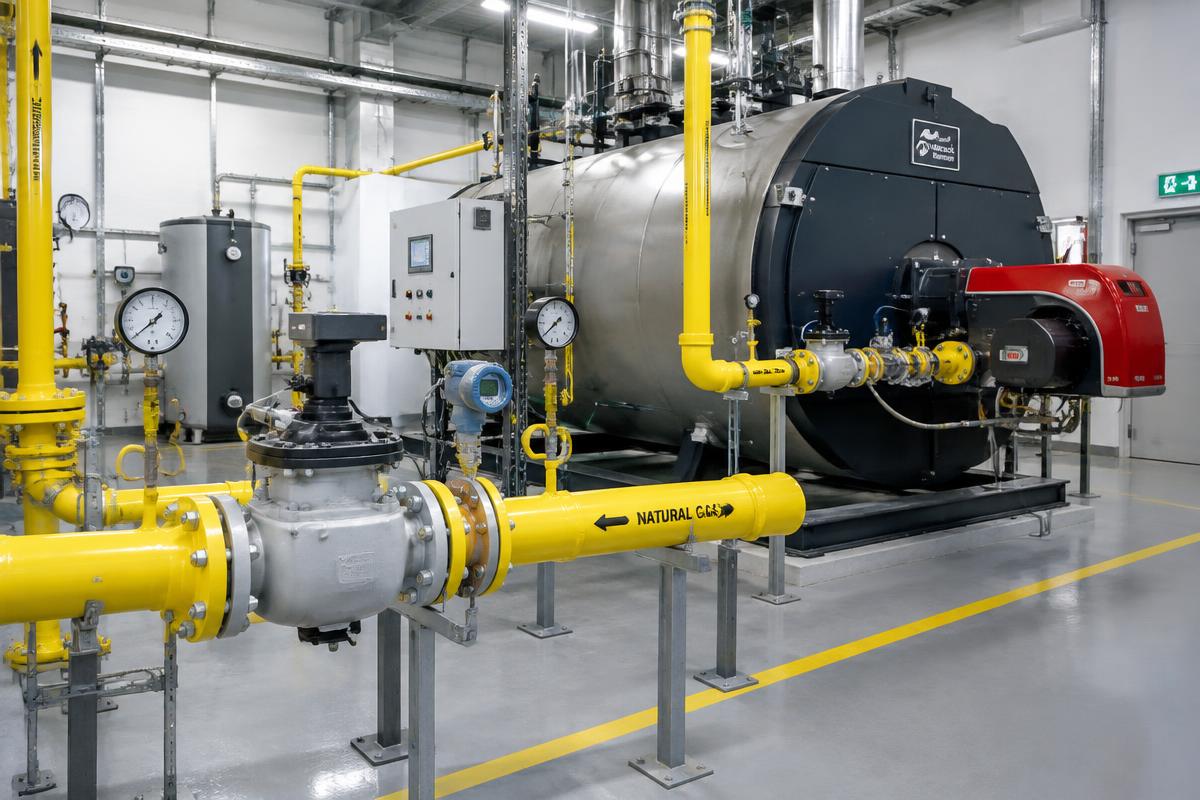
Proper ventilation of an industrial boiler room serves two distinct needs: the safe removal of any leaks and the provision of sufficient air for combustion. A lack of air can cause unstable combustion, increased CO, decreased efficiency, and burner start-up problems.
Combustion air
The burner requires a specific amount of air depending on its power and load. If the space is too enclosed, ventilation fans or other equipment can create negative pressure and affect the air supply to the burner.
Natural and mechanical ventilation
Depending on the design, the space may use permanent openings or mechanical ventilation. The location of the openings, their cross-section, and the operation of the fans must be determined by design calculations and not by empirical choice.
Relationship between ventilation and gas detection
The gas detector does not replace ventilation. Conversely, ventilation does not replace the detection system. In a properly designed installation, both systems work in tandem with safety valves and automation.
Negative pressure in the space
A common industrial problem occurs when large extraction fans operate in the same space. If the fresh air supply is insufficient, significant negative pressure can be created. This can affect the flame, the chimney, and the burner operation.
Maintenance checks
Ventilation openings must be kept clear. Filters and fans should be checked and cleaned. If there are interlocks with the BMS or the burner, it should be tested to ensure that the loss of required ventilation triggers the intended safety response.
Conclusion
Ventilation is part of combustion safety. It should not be treated as a simple hole in the wall, but as part of the overall boiler room design.