
An overvoltage often lasts for a fraction of a second, but it can destroy a boiler circuit board, a TV power supply, or the electronics of a heat pump. A direct lightning strike to the house is not necessary: a nearby strike can cause dangerous spikes in electrical lines and communication cables.
Effective protection of electrical devices from overvoltage and lightning is not based on a single component. It requires a combination of proper grounding, equipotential bonding, and suitable surge protective devices (SPDs). Below is a practical guide on what a homeowner should check and what a licensed electrician must handle.
1. What is overvoltage and where does it come from?
In standard residential supplies, the nominal voltage is 230 V between phase and neutral and 400 V between phases. Overvoltage is an increase in voltage above the specified levels. However, different causes require different protection.
- Transient overvoltages: very short spikes from lightning phenomena or electrical operations, such as load switching.
- Prolonged overvoltages: longer-duration anomalies, for example, from a neutral wire break in a three-phase system.
- Voltage dips and interruptions: different problems that particularly affect computers, automation systems, and devices with motors.
Surge arresters, known as SPDs, limit transient spikes. They are not a general solution for prolonged overvoltage or loss of neutral. In such cases, a voltage monitoring relay with an appropriate disconnection device, selected for the specific installation, might be required.
Also, a fuse or circuit breaker primarily protects against overcurrent and short circuits. A residual current device (RCD) protects against differential currents. Neither replaces an SPD.
2. Protection Levels: SPDs, Power Strips, and UPS
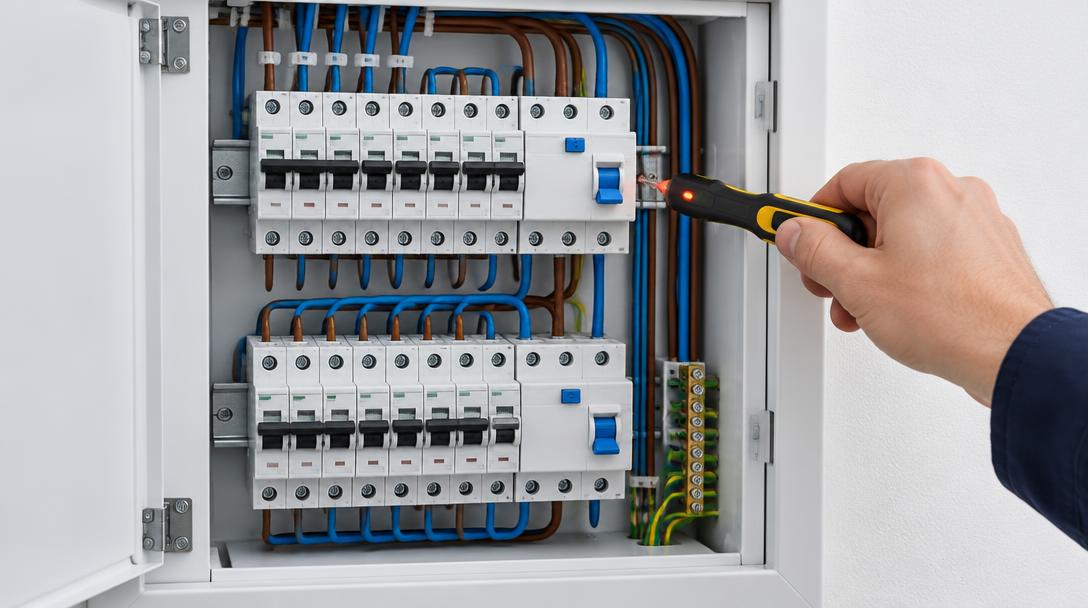
Panel-mounted surge arresters
Protection is organized into successive stages so that the energy of the disturbance is limited before it reaches sensitive equipment:
- Type 1 SPD: intended for the discharge of part of the lightning current. It is especially considered for buildings with external lightning protection or where a study predicts such stress.
- Type 2 SPD: acts as the main stage of protection against induced and switching overvoltages at the distribution board.
- Type 3 SPD: installed near sensitive devices as supplementary protection in coordination with previous stages.
There are also combined Type 1+2 arresters. Selection is not based solely on price or the highest kA rating. Data regarding the supply, the earthing system, the lines, and the existence of a lightning protection system are required.
What a surge-protected power strip offers
A true surge-protected power strip can limit residual spikes near the equipment. A simple power strip with a switch does not necessarily have this capability. Look for clear technical specifications, compliance documentation, and a status indicator for the protection.
A power strip does not replace the arrester in the panel and does not guarantee survival from a direct lightning strike. Avoid daisy-chaining power strips and using them for high-power, permanently connected loads.
Where a UPS is needed
A UPS mainly provides backup power. Depending on its technology, it can also correct certain voltage fluctuations. It is useful for computers, routers, and automation systems, but it does not replace organized lightning protection. For circulators or boiler electronics, compatibility, power, output waveform, and manufacturer instructions must be checked.
3. Grounding and Proper Installation: The Critical Details
Even a high-quality SPD can perform poorly if installed incorrectly. Conductor paths must be as short as possible and properly routed. Extra length increases inductive voltage drop during the pulse passage, straining the final level of protection.
The electrician needs to check:
- The continuity of the protective conductor, the earthing, and the main equipotential bonds.
- The supply system, such as TT or TN, and the correct SPD wiring.
- The maximum continuous operating voltage (Uc) and the protection level (Up).
- The discharge capacity, without confusing the different test waveforms of Types 1 and 2.
- The cross-sections, backup protection with a fuse or circuit breaker where required, and coordination with RCDs.
- The need for an additional stage in a remote sub-panel or device.
In a 230 V network, SPDs with Uc 275 V are often encountered, but this is not a universal buying guide. Similarly, when the cable distance to the equipment exceeds approximately 10 m, additional protection is considered according to manufacturer instructions and the study.
There is no single grounding resistance value that by itself guarantees lightning protection. An overall inspection with suitable instruments is required. Never use water or gas pipes as a makeshift earthing electrode.
Do not overlook other entry points: copper telephone lines, coaxial antenna cables, and external Ethernet wiring may require specific arresters. Protection must cover relevant entry paths, not just the power outlet.
4. Cost, Heating Protection, and Maintenance
For a residence in Greece, a reputable Type 2 arrester typically costs about €60–€180 for standard single-phase setups and €100–€300 for three-phase ones. Prices refer to materials including VAT and vary depending on the wiring and characteristics.
A simple addition to a suitable single-phase panel can amount to approximately €150–€400 in total, including materials and labor. This does not include extensive panel modifications, grounding improvements, or external lightning protection systems. Request a quote after an on-site inspection, with clear mention of the protections and checks.
Boilers and heat pumps
Circuit boards, power inverters, and electronic circulators require attention. For a heat pump with a remote outdoor unit, both power supply and communication cables are considered. Protection is selected according to the manufacturer's requirements; a power strip is not a solution for a permanently connected heat pump.
- Visually check the SPD indicator without opening the panel.
- After a severe storm, report any change in the indicator, odor, or malfunction to an electrician.
- If the indicator shows the end of its lifespan, replacement is required according to product instructions.
- Include surge protection in the periodic inspection of the installation.
5. Frequently Asked Questions
Does a lightning rod protect all electrical devices?
No. The external lightning protection system manages direct strikes to the building. Protecting internal circuits requires additional equipotential bonding and coordinated SPDs.
Should I unplug devices during a storm?
Preemptively disconnecting sensitive devices, along with their associated wired connections, reduces exposure. Do this before the storm approaches. When there is already nearby lightning activity, do not touch plugs or cables.
Can I install an SPD in the panel myself?
No. This is work for a licensed electrician, involving safe isolation, verification of absence of voltage, and testing of the installation. A faulty connection can create a serious hazard.
Is there protection that guarantees zero damage?
No. A properly designed installation substantially reduces the risk but does not provide an absolute guarantee against every lightning event.
6. Conclusion
Start with a panel and grounding check, continue with appropriate SPDs, and supplement protection near sensitive devices. A UPS covers different needs. For a safe result, entrust selection and installation to a licensed electrician, based on applicable ELOT 60364 standards and the ELOT EN 62305 series, where relevant to the study.