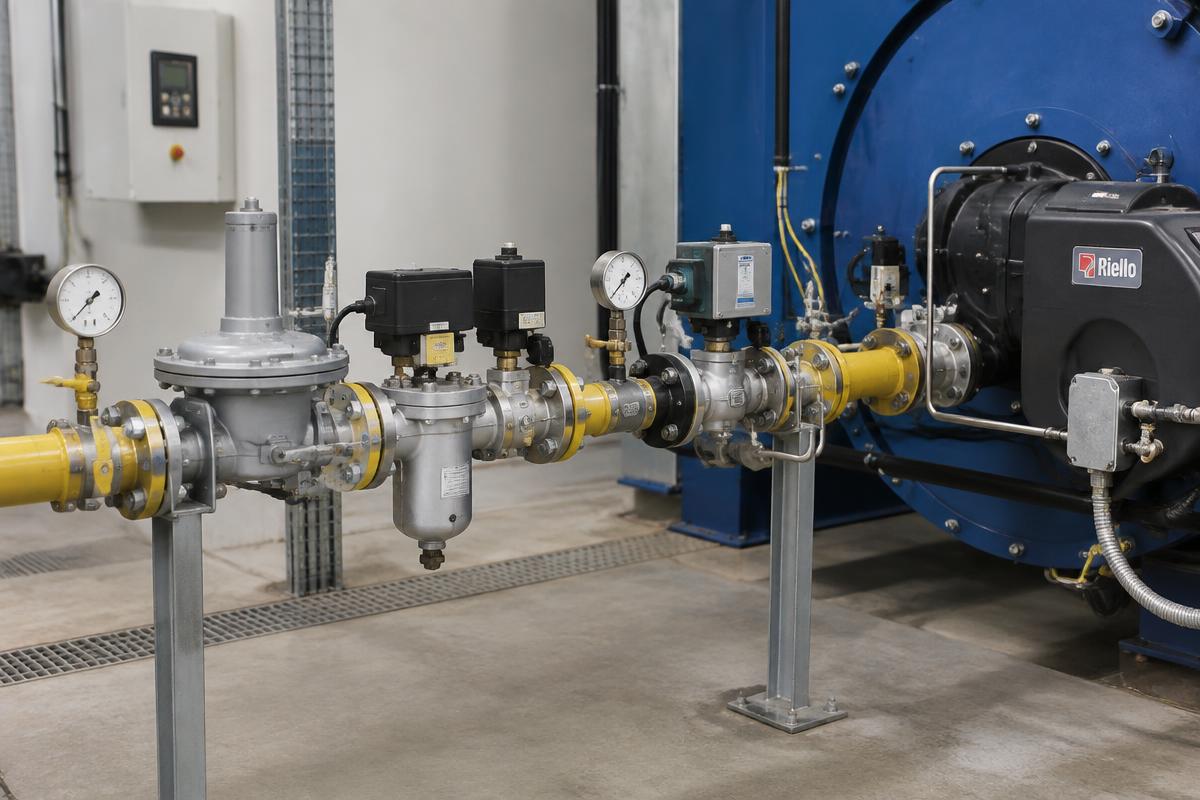
Many safety valves feature an auxiliary position contact, known as an end switch, position switch, or proof-of-closure contact. Its role is to provide the automation system with information regarding the mechanical position of the valve, rather than merely indicating whether voltage is applied to the coil.
Why an electrical command is not enough
The fact that the controller has sent voltage to the solenoid valve does not prove that the valve has moved. Similarly, the removal of voltage does not, by itself, confirm that the valve has closed mechanically.
What is proof-of-closure
In applications where confirmation of the closed position is required, an independent contact changes state when the mechanism reaches the intended final position. The automation system can use this signal as a permissive for the next step in the sequence.
Difference from valve proving
The position contact confirms mechanical position, not tightness. Valve proving checks whether the valves are sealing tightly through pressure variation in a controlled volume. The two functions are different.
Common faults
Incorrect microswitch adjustment, mechanical wear, stuck contacts, or wiring issues can trigger an alarm even when the main valve appears to be moving. Conversely, an electrical contact may indicate a correct status while the seat tightness is unacceptable.
How diagnosis is performed
The command to the coil, the actual movement of the mechanism, and the change of the auxiliary contact are checked separately. The chronological sequence of these three events is particularly useful for intermittent alarms.
Why we do not bridge the contact
Permanent bridging removes the surveillance required by safety logic. If the system requires proof-of-closure, the cause for the missing signal must be identified and rectified.
Key: command, position feedback, and tightness are three different things. Proper diagnosis examines them separately.