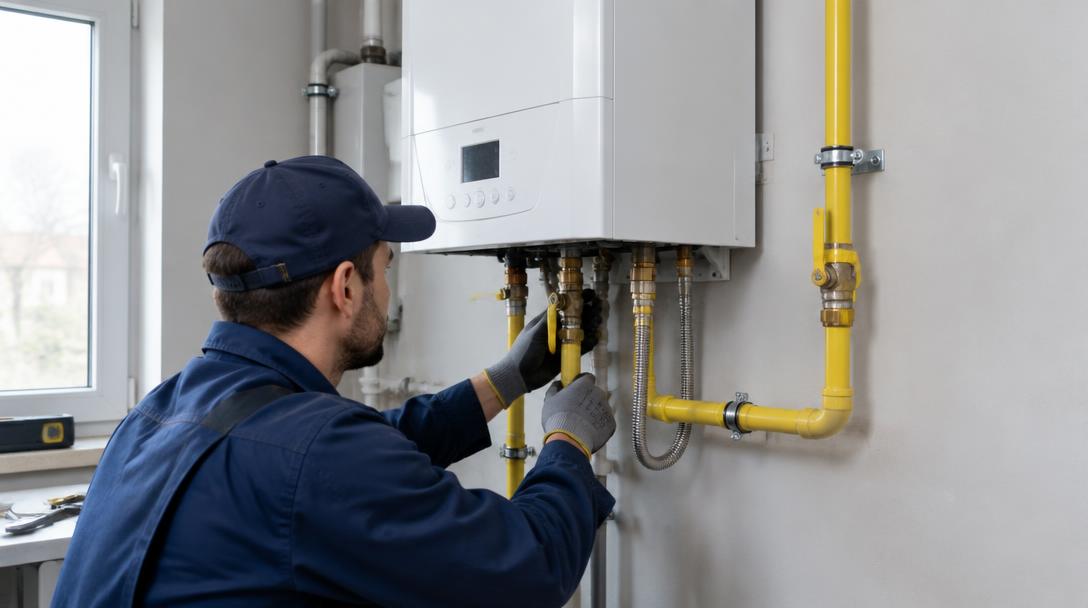
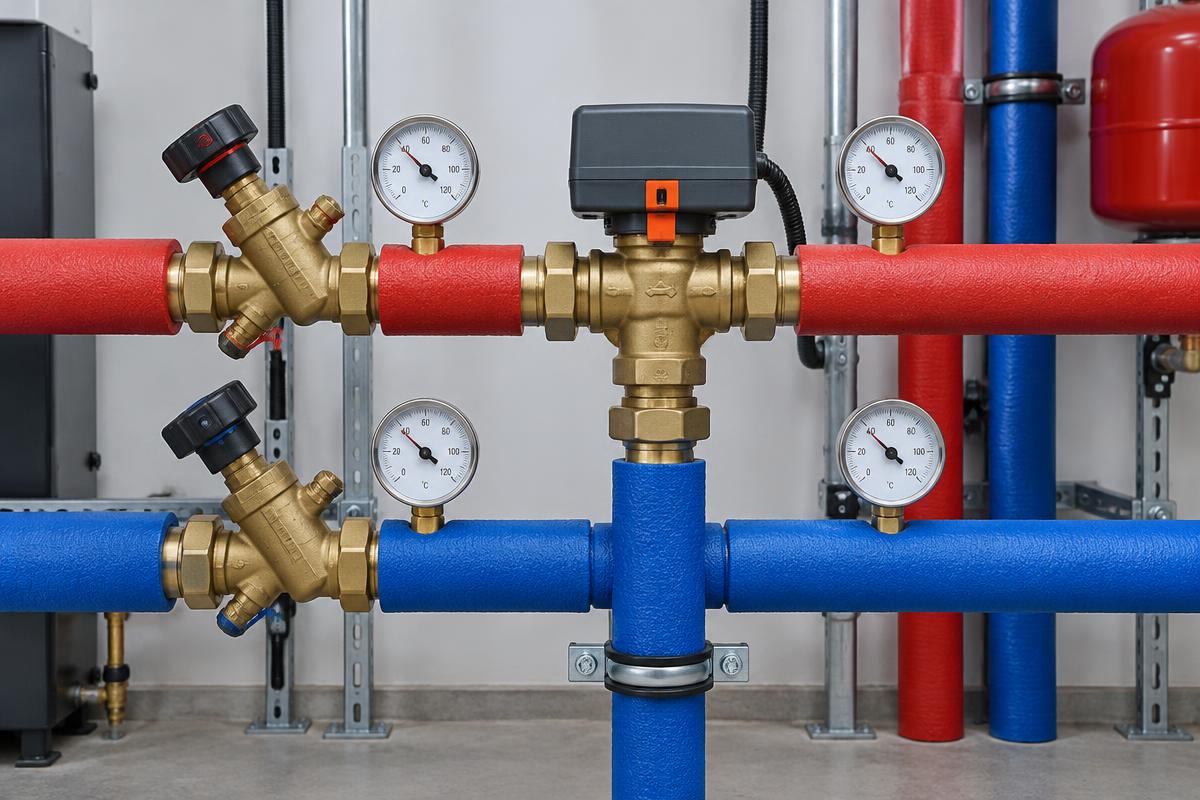
What the Natural Gas Solenoid Valve Does in an Installation
A natural gas solenoid valve is a valve that controls the passage of gas via an electrical command. Depending on its design, it allows or cuts off the supply to an appliance, a branch, or a larger section of the installation. Its role becomes particularly important when working in conjunction with a gas detector or other safety system, so that an alarm signal leads to a flow cut-off.
However, the central shut-off solenoid valve should not be confused with the gas valve located inside a boiler. The former usually serves to isolate a part of the network. The latter participates in the operation of the burner and, depending on the appliance, in regulating fuel supply. They differ in terms of control, construction, and maintenance requirements.
No solenoid valve replaces proper design, ventilation, leak testing, or appliance maintenance. Furthermore, it does not detect leaks on its own: it requires an appropriate detection and control system if that is its intended use.
Solenoid Valve Types and Behavior During Power Failure
The behavior of a solenoid valve when power is lost depends on its type and mechanism. It is not true that all natural gas solenoid valves close the same way or that they reset automatically once power returns.
- Normally Closed (NC): In its standard construction, it remains closed without power and opens when electrically activated, provided the required conditions are met.
- Normally Open (NO): In its standard construction, it remains open without electrical activation and closes upon the appropriate command. Loss of power does not necessarily result in a shut-off.
- Manual Reset: After a shut-off, it requires a specific reset procedure. This property refers to the reset mechanism and is not a separate NC or NO classification on its own.
In practice, there are different configurations, which is why identification should be based on the data plate and technical manual, not on external appearance. Voltage, power supply type, operating pressure, and activation method must be checked. Even the presence of a reset button does not mean it is safe to use without investigating the cause of the shut-off.
What It Means When the Natural Gas Solenoid Valve Jams
The expression "the solenoid valve is jammed" often describes a symptom, not a confirmed failure. The valve may have a mechanical problem, but it could also be functioning correctly and remaining closed because the safety system does not permit a reset.
When it remains closed, the appliance may not turn on or may display a flame failure error. Possible causes include lack of power, coil failure, wiring problems, an active alarm, or a jammed mechanism. However, similar symptoms are caused by other conditions, such as a closed manual valve or a power supply issue from the grid. A boiler error alone does not prove a solenoid valve failure.
When it remains open while it should be closed, a critical protection function is lost. The inability to shut off may be due to mechanical jamming, wear, or the absence of the correct command. A different possibility is that the mechanism is moving but the seat is not ensuring a tight seal. This is why a "click" sound does not prove complete closure or tightness.
Particles, corrosion, unsuitable installation conditions, and stress can affect operation. A loud humming sound, an unusual burning odor, or repeated shut-offs require investigation. Some coils heat up normally during operation, so temperature should be evaluated based on specifications rather than by touch.
How to Safely Handle a Problem
If there is a smell of gas, a detector alarm, or other signs of a possible leak, the priority is protecting people, not testing the solenoid valve. Do not attempt to restart the boiler and do not assume the area is safe because the valve appears closed.
- Do not light a flame and do not smoke.
- Do not operate electrical switches, sockets, exhaust fans, or other electrical appliances in the suspicious area. Do not use the phone in that location.
- Evacuate the area. Open doors or windows only if you can do so immediately without exposing yourself to danger or delaying your exit.
- Close the manual isolation valve only if you know which one it is and it is safely accessible. Do not return to the area to search for it.
- From a safe outdoor location, inform the emergency service of the relevant network operator. In case of immediate danger, call 112.
If there is no indication of a leak but the supply is not restored, record the error code and system indicators for the licensed technician. Do not bypass the detector, do not bridge contacts, and do not provide temporary power to the coil. Striking the body, loosening connections, or attempting to hold the valve open can cause a leak and negate protection.
Professional Inspection, Maintenance, and Replacement
Diagnosis is performed by an authorized licensed professional based on the specific installation and the manufacturer's instructions. This includes checking the electrical supply, control command, detector, and wiring, as well as evaluating mechanical operation. With appropriate instruments and procedures, the tightness of connections and the effective shut-off of flow are confirmed.
The solenoid valve must be evaluated as part of the entire safety chain. A functional detector is not enough if its command does not reach the valve, and a functional valve does not protect against a leak if the detection system is non-operational. Tests are performed using established methods, never by intentionally releasing gas into the area.
For replacement, it is not enough for the thread to match. Requirements include suitability for natural gas, correct operating pressure, required flow rate and acceptable pressure drop, compatible power supply, and an appropriate method of shut-off and reset. Maintenance and functional tests are scheduled according to the manufacturer, the design specifications, and applicable requirements, without arbitrary uniform intervals for every installation.
Frequently Asked Questions
Does the solenoid valve always close when the power goes out?
No. This depends on its type and the overall safety configuration. Actual behavior is confirmed by the manual and inspection of the installation, not by assumptions.
Can I press the reset button myself?
Only if the instructions provide for user operation and it has been confirmed that the cause of the shut-off has been safely resolved. If there is a smell of gas, an active alarm, or an unknown cause, do not attempt to reset it.
If a "click" is heard, does it mean it is working properly?
No. The sound may indicate movement of the mechanism, but it does not certify complete opening, closing, or tightness. These require technical inspection using a proper procedure.
Does a closed solenoid valve rule out all leaks?
No. There could be a leak before the valve, insufficient tightness of the valve itself, or gas that has already escaped. Smell and alarms should be treated as a potential danger, regardless of the valve's position.