How many circuit breakers does a home actually need?
There is no fixed number of circuit breakers that is correct for every home. Two apartments of the same size may require a different electrical panel: one may have basic household appliances, while the other features electric cooking, several air conditioners, a heat pump, and provisions for electric vehicle charging. The correct question, therefore, is how many independent circuits are required and what protection each one needs.
In everyday language, we usually call "fuses" the miniature circuit breakers (MCBs) that protect individual lines from overload and short circuits. Their number is related to the distribution of the installation. It does not correspond to the number of sockets, nor does it mean that every room must necessarily have only one line.
For a home with several electrical loads, an arrangement of approximately 12–18 independent circuits can be an indicative design scenario, not a regulatory requirement. Smaller or larger installations may reasonably fall outside this range. The final choice results from a load study, inspection of the wiring, and the application of current requirements by a licensed electrician.
How to distribute lighting, socket, and appliance lines
Distribution must limit the consequences of a fault and accommodate the expected simultaneous operation. If all lighting is on one circuit, a trip could leave the entire house without light. If many demanding appliances share one socket line, the probability of overload increases.
Usually, separate lines are considered for lighting, general-purpose sockets, and significant fixed loads. The kitchen requires special attention because a kettle, coffee maker, and other countertop appliances may operate at the same time. Separate protection for an appliance requires a truly independent circuit; simply adding an MCB to the panel does not isolate the existing wiring by itself.
For an indicative home with electric cooking, a water heater, air conditioners, and a heat pump, the following distribution of 16 circuits could be considered:
- 3 lighting circuits, separated into functional zones.
- 4 general-purpose socket circuits for the living room, bedrooms, and other areas.
- 2 circuits for kitchen countertop sockets.
- 1 circuit for the electric stove or the selected cooking arrangement.
- 1 circuit for the electric water heater.
- 1 circuit for the washing machine.
- 1 circuit for the dishwasher.
- 2 circuits for air conditioners, depending on the units and their requirements.
- 1 circuit for the heat pump, provided it is sufficient for the specific configuration.
This example is not a ready-to-use implementation study. A separate oven and hob might require a different layout, while a heat pump might require additional power supplies for auxiliary heaters or other equipment. A storage room, outdoor areas, a dryer, and a vehicle charger can also increase the number of lines.
What is in the panel besides circuit breakers?
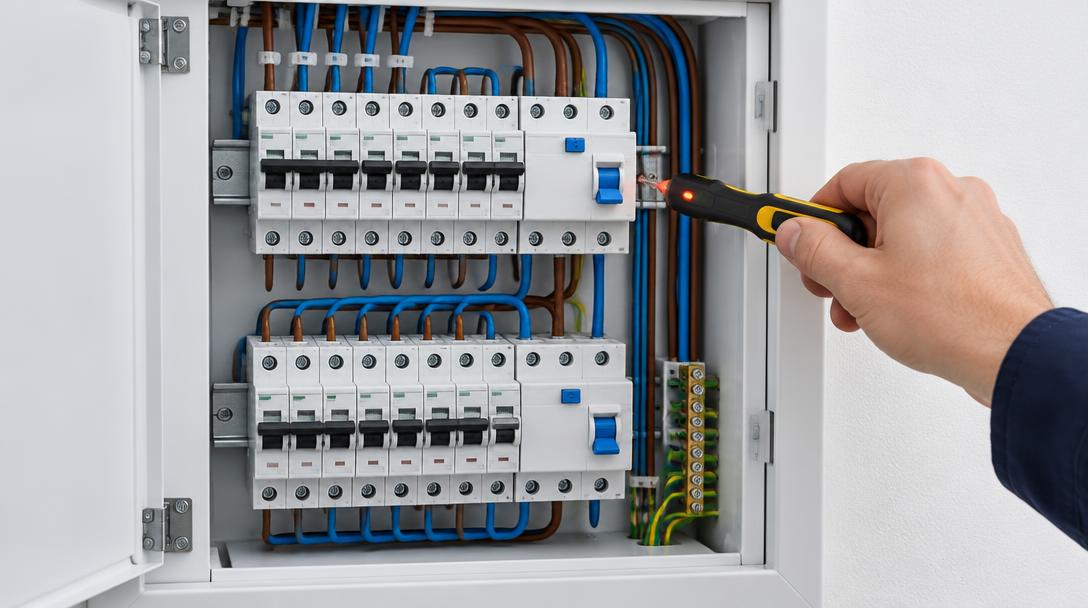
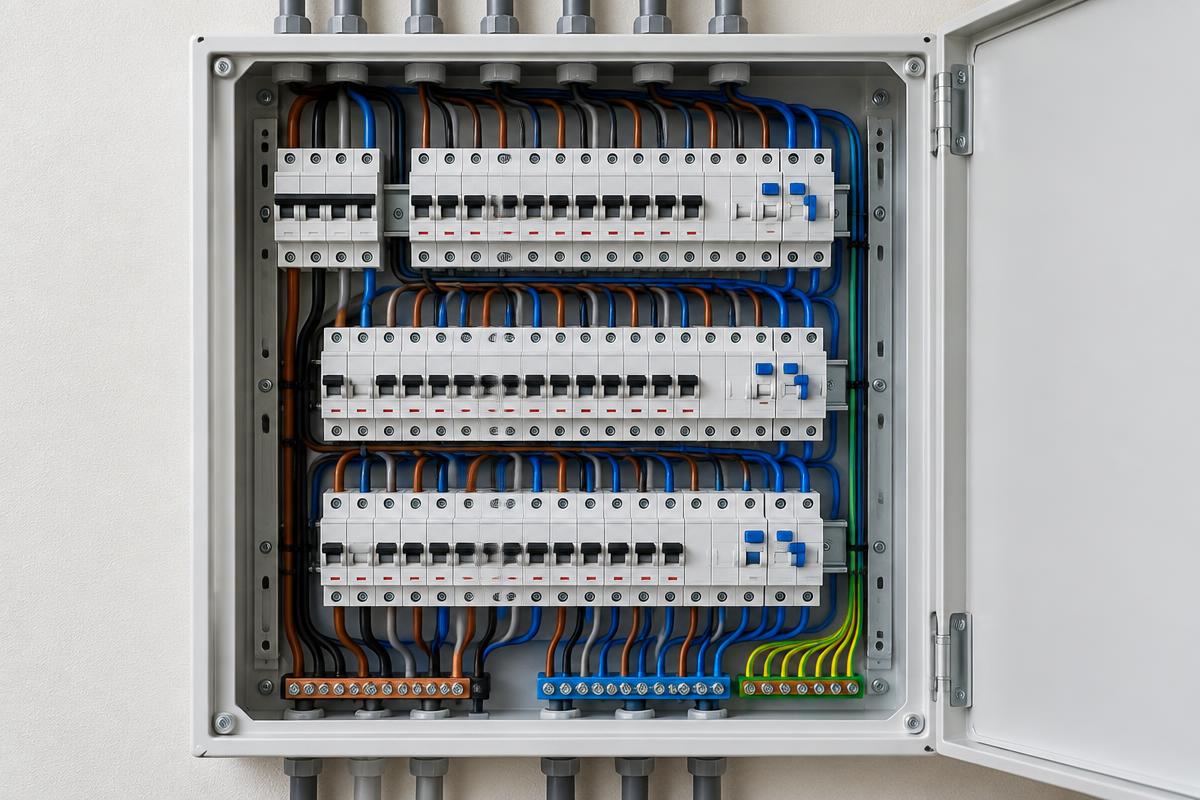
The electrical panel does not consist only of MCBs. It includes isolation means, protection devices, and, where applicable, control or monitoring equipment. These devices have different roles and do not replace each other.
- Main switch: allows isolation of the installation. It is not necessarily an overcurrent protection device.
- Miniature circuit breaker (MCB): protects the corresponding circuit from overload and short circuits, provided it is selected and coordinated correctly.
- Residual current device (RCD), known as a leakage relay: detects differential current. A simple RCCB device does not provide overload or short-circuit protection by itself.
- Combined RCBO device: integrates residual current and overcurrent protection for the circuit it serves.
- Surge protective device (SPD): limits transient overvoltages when selected and installed appropriately. It does not replace the grounding or the leakage relay.
Residual current protection up to 30 mA is used for additional protection against electric shock on circuits where required. The appropriate type of device also depends on the characteristics of the appliances. Equipment with power electronics, such as certain heat pumps and vehicle chargers, needs evaluation according to the manufacturer's instructions.
Separation into more residual current protection groups or the use of RCBOs per circuit can limit the extent of an outage. Conversely, when all lines are served by a single device, one leakage can interrupt power to the entire residence.
How are nominal currents and panel size selected?
The nominal current of a circuit breaker is not selected based solely on the power of the appliance. The cross-section and material of the conductors, the method of installation, cable grouping, temperature, line length, and voltage drop must be taken into account. The expected short-circuit current, breaking capacity, and required tripping times are also considered.
This is why the generalization that "all sockets take the same breaker" is not safe. If an MCB trips frequently, it should not simply be replaced with a larger one: there may be an overload, appliance failure, or a problem in the installation. A higher nominal current without inspection may leave the wiring inadequately protected.
In a three-phase supply, single-phase loads are distributed across phases based on power and likely simultaneous use, not just an equal number of breakers. At the same time, the sum of the nominal currents of all individual MCBs does not equal the required supply capacity of the house.
The size of the panel is calculated based on available DIN rail slots. Sixteen circuits do not mean a sixteen-slot panel, because the main switch, residual current protections, and other devices occupy additional space. Proper cable management, adherence to the manufacturer's thermal limits, and useful spare capacity for future needs are also required.
What do we check during renovation or electrical panel replacement?
Replacing an old panel does not automatically fix problems in the house's lines, grounding, or connections. Before selecting new equipment, a mapping of existing circuits and a list of appliances to be added are needed.
The licensed electrician checks the condition of the conductors and performs the required tests and measurements, such as checks for protective conductor continuity, insulation resistance, and the operation of residual current devices. They also examine the conditions for automatic disconnection of supply and the required documentation, including the YDE (Electrical Installation Report) where applicable.
Every circuit must have clear labeling so it can be identified without testing and guessing. A smell of burning, visible deterioration, or repeated trips require immediate professional evaluation. Do not remove covers or interfere with the interior of the panel: some parts may remain energized even with the main switch turned off.
Frequently Asked Questions
Is one breaker enough for each room?
Not necessarily. Design is based on loads and usage. The lighting of a room may belong to a different circuit than its sockets, while a demanding appliance may require an independent line.
Does every appliance need its own breaker?
Not every small appliance. Independent circuits are considered mainly for high-power or special-requirement loads, based on the study and manufacturer instructions. General-purpose sockets are organized into appropriately sized groups.
Do more breakers mean more available power?
No. They offer better separation of circuits, but they do not increase the power of the supply. For additional large loads, supply adequacy checks, load management, or a supply upgrade may be required.
Can I add a breaker if there is an empty slot?
An empty slot is not enough. You need to check the power supply, ensure an appropriate line, use compatible protection equipment, and verify the installation. Additions must be done by a licensed electrician, not as a simple component installation.