
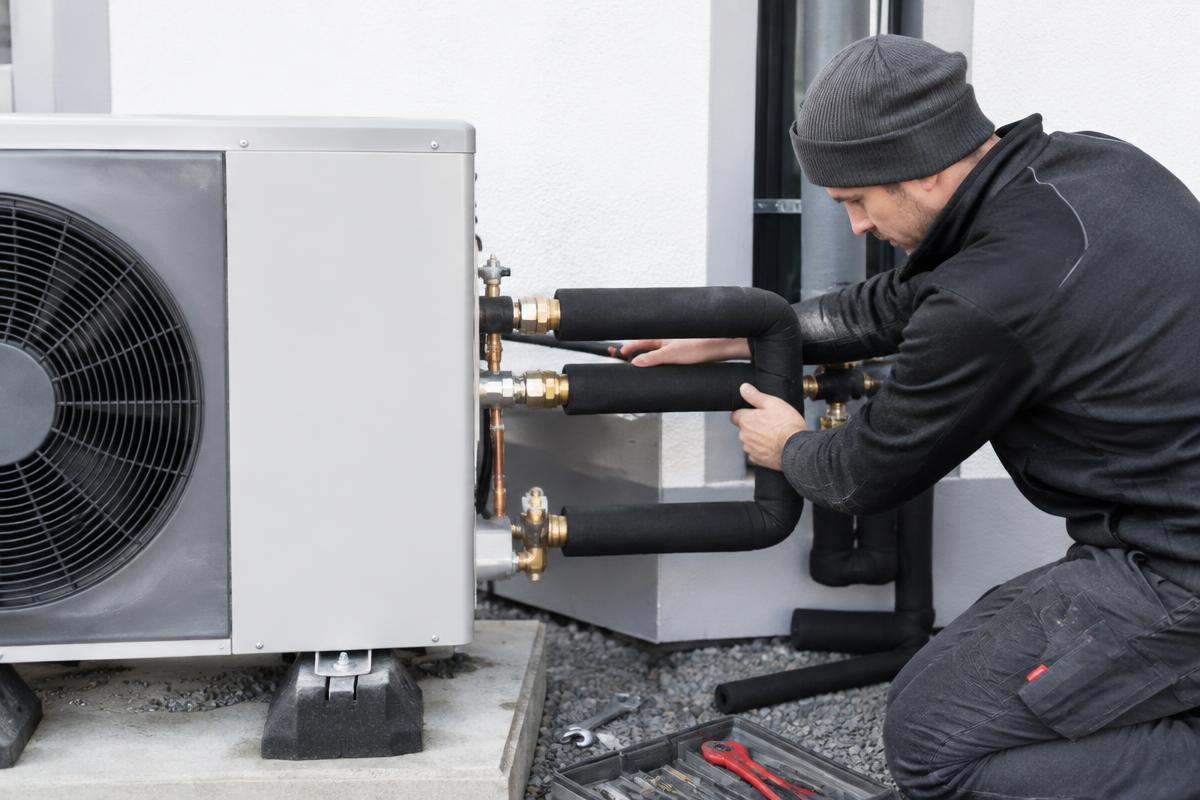
A heat pump may be technically sound and yet function poorly from the very first day. Frequent starts, insufficient heating, noise, and flow errors are often related to the installation rather than a device defect. The crucial approach is to treat it as part of an integrated system: the building, radiators, piping, circulators, and automations must work together. Below are the points that need checking before the installation can be considered complete.
1. Incorrect sizing and inappropriate water temperatures
Choosing power based solely on square footage or the nominal capacity of an old boiler is risky. A heat loss calculation is required, based on insulation, openings, ventilation, and external design conditions. An old boiler may have been much larger than actual needs, so copying its capacity transfers the problem to the new installation.
Oversizing can cause frequent starts and stops, especially when the unit's minimum output power exceeds the instantaneous load. Undersizing, conversely, may leave needs unmet or increase the use of electric heating elements. The choice must consider actual performance at the required outdoor air and water temperatures, not just a favorable catalog nominal condition.
Equally important is checking the terminal units. A radiator that was sufficient with very hot water from a boiler will not provide the same output at a lower supply temperature. Verification of its performance under the new conditions is necessary. Permanently increasing the water temperature to compensate for an inadequate radiator usually increases the entire system's consumption.
2. Hydraulic connection without sufficient flow and available water volume
A heat pump requires a specific water flow to its exchanger. Small cross-sections, long paths, excessive fittings, and unsuitable valves increase pressure losses. If the circulator cannot meet the required flow, circulation problems, reduced efficiency, or alarms occur. Diameters should be chosen based on calculation, not just because they fit existing stub-outs.
For water, a useful approximation is: flow in m³/h = thermal power in kW / (1.163 × ΔΤ in °C). ΔΤ is the difference between supply and return temperature. This relationship helps with initial calculation but does not replace manufacturer requirements and checking available head pressure. With glycol, fluid properties change and a corresponding correction is required.
Special attention is needed when thermostatic heads or solenoid valves can close multiple zones simultaneously. Minimum flow and the required active water volume must be ensured, even during defrost cycles. A bypass valve can maintain a circulation path, but it does not, by itself, ensure sufficient thermal reserve.
A buffer tank is not mandatory for every installation, nor does it cure every failure. Its need, size, and connection method arise from the design and the unit's manual. Similarly, hydraulic separation requires correct selection and adjustment of circulators to avoid unwanted mixing and reduced temperature to the radiators.
3. Dirty network, trapped air, and insufficient protection
Connecting a new heat pump to an old network without inspection and cleaning is a common cause of problems. Sludge, magnetite, rust, and work debris can restrict flow or stress the exchanger and circulator. Cleaning must be performed using a process and materials compatible with the metals, seals, and manufacturer's requirements.
A properly selected magnetic separator traps ferromagnetic particles but does not replace initial cleaning or every required filter. Filters are installed according to flow direction, with access for maintenance and isolation capability. A clogged and unchecked filter itself becomes a cause of insufficient flow.
- All branches must be filled and bled, not just the mechanical room.
- Water quality and permitted additives are checked according to specifications.
- The expansion tank is sized and its pre-pressure is set for the specific system.
- The safety valve, required fill pressure, and safe discharge path are confirmed.
Continuous water refilling is not normal maintenance. It may indicate a leak or expansion problem and introduces new oxygen into the circuit, favoring corrosion.
4. Poor outdoor unit placement and insufficient frost protection
The outdoor unit requires free air intake and discharge, with the clearances defined by the manufacturer. A narrow balcony, enclosed structure, or obstacles in front of the fan can cause air recirculation and degrade operation. Placement is also chosen based on maintenance access, noise, and vibration transmission to the building.
In heating mode, defrosting produces water that must be removed via a safe path. If it pools under the unit or freezes on a walkway, it creates operational problems and slip hazards. Where applicable, proper frost protection for the drain is applied according to installation instructions.
In monobloc heat pumps, water circulates outside the building, so frost protection is critical. Insulation reduces thermal losses but does not prevent freezing indefinitely. Electronic protection usually requires available power and circulation capability. Depending on the climate and unit, an approved antifreeze or other specified provisions are considered, without arbitrary combinations. Glycol concentration affects heat transfer and hydraulic losses.
5. Delivery without settings and operational testing
The fact that the unit turned on and heated water does not mean the installation was completed correctly. Hydraulic balancing, circulator adjustment, and verification of cooperation with thermostats, zones, and domestic hot water production are needed. Weather compensation must be adjusted to the building so that supply temperature follows needs without unnecessary overheating.
The electrical installation is checked by a licensed electrician regarding power supply, wire cross-sections, grounding, and required protections. The RCD type and fuses are chosen based on the specific unit and applicable requirements, not a generic recipe for all heat pumps.
At delivery, at least the flow, supply/return temperatures, pressure, and basic settings should be recorded. Behavior when zones close is tested, and activation of the backup heater is verified. The owner needs instructions regarding filters, error indicators, and maintenance. A re-check in real winter conditions helps optimize initial settings.
Frequently Asked Questions
Is a buffer tank always needed?
No. An evaluation of minimum flow, active water volume, zones, and defrost requirements is needed. The decision must be documented for the specific installation.
Can it be connected to existing radiators?
Yes, provided the output of the radiators at the intended water temperatures is checked. Larger radiators, improved insulation, or different terminal units might be necessary.
Why does a flow error appear immediately after installation?
Possible causes include trapped air, closed valves, a clogged filter, an inadequate circulator, or incorrect hydraulic connection. Measurement and diagnosis are needed, not bypassing protection.
Do continuous starts mean the pump is damaged?
Not necessarily. They may be due to oversizing, small active water volume, closed zones, or improper settings. Evaluation must consider the load and operating conditions.