
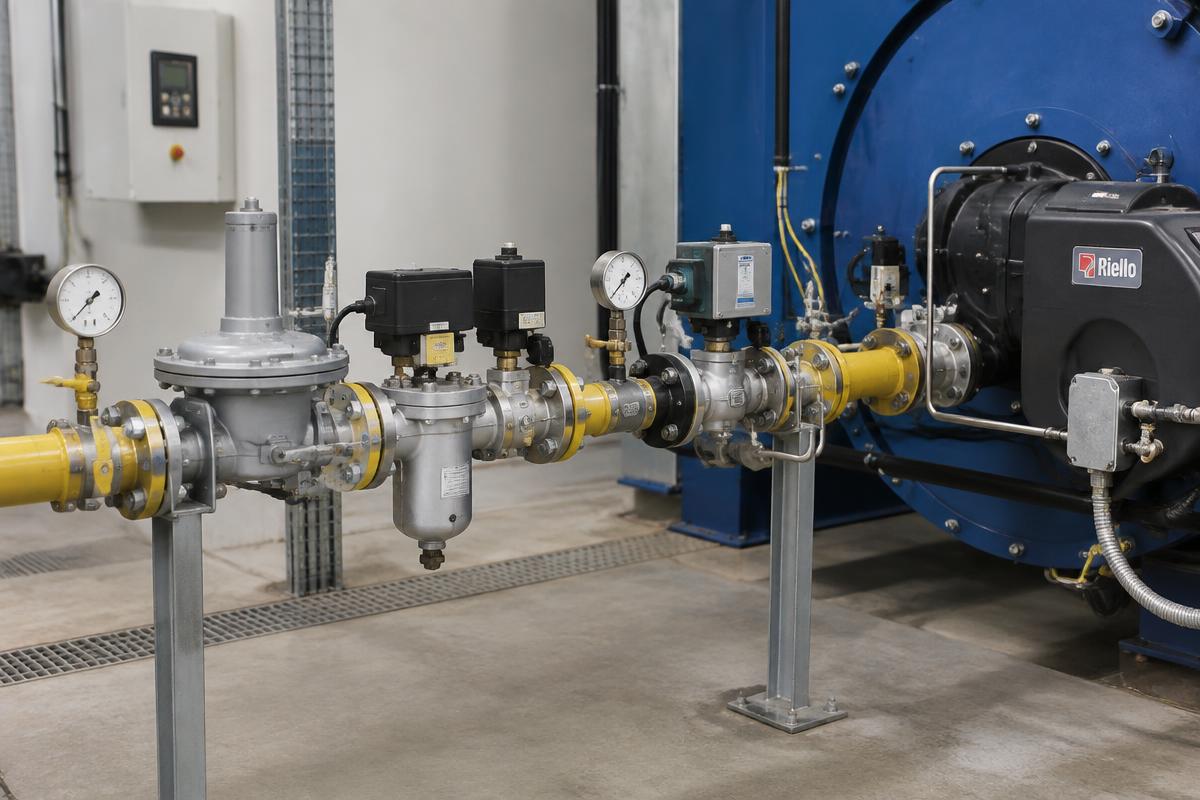
Introduction to the Gas Train
For the safe and efficient operation of a natural gas or LPG burner, the burner itself is not enough. The heart of the supply system is the gas train, which consists of a series of components that control fuel pressure, filtration, and flow. As technicians, we know that proper combustion starts with precise pressure adjustment, as fluctuations in the distribution network can cause anything from simple performance loss to serious malfunctions or dangerous accidents.
Basic components of a Gas Train
A typical gas train is not just a pipe, but a comprehensive safety system. Its main parts include:
- Manual isolation valve: Allows the supply to be shut off for maintenance work.
- Gas filter: Retains particles and filings that may come from the network, protecting the valves.
- Pressure regulator: Reduces inlet pressure (e.g., 50-100 mbar) to the burner's operating pressure (e.g., 15-25 mbar).
- Minimum gas pressure switch: Stops operation if the pressure drops below a limit, preventing flame flashback.
- Solenoid valves: Typically two in series for safety reasons (double block and bleed), which control flow during ignition.
The pressure regulator: The "heart" of stability
The pressure regulator is the most critical instrument for combustion control. Its operation is based on balancing the forces between a spring and a diaphragm. In Greece, pressures in low-pressure networks typically fluctuate around 20 mbar for natural gas and 30-37 mbar for LPG.
Why is precision necessary?
If the pressure is too high, the burner will operate with excess fuel, leading to incomplete combustion, carbon monoxide (CO) production, and possible overheating of the combustion chamber. Conversely, pressure that is too low causes flame instability and difficulty in ignition.
Pressure adjustment and measurement procedure
Gas train adjustment must always be performed using a high-precision digital manometer. Technicians follow these steps:
- Static pressure measurement: With the burner off, we check the pressure coming from the meter.
- Dynamic pressure measurement: At the moment of ignition, the pressure drops slightly. This is the value we are interested in for adjusting the regulator.
- Spring adjustment: By turning the adjustment screw on the regulator, we bring the pressure to the levels specified by the manufacturer (e.g., Riello, Bentone, etc.).
- Tightness check: After every intervention, checking with a special leak detection spray or an electronic detector is mandatory.
Maintenance and common problems
A gas train that is not properly maintained can cause a burner "lockout." The most common problems we encounter in practice are:
- Dirt in the filter: Reduces gas flow, causing a pressure drop during operation.
- Diaphragm wear: Over the years, the regulator's rubber diaphragm may dry out or puncture, causing a leak from the vent hole.
- Solenoid valve sticking: Often due to deposits, preventing opening or, worse, full closing of the supply.
Annual maintenance should include cleaning the filter and checking the response of the pressure switch.
Frequently Asked Questions (FAQ)
1. Why is there a gas smell near the pressure regulator?
This may be due to a leak from the diaphragm or a loose connection. If the smell is strong, close the main valve immediately and call a licensed technician.
2. Can I adjust the gas pressure myself?
No. Adjustment requires specialized measuring instruments and knowledge of safety specifications. Incorrect adjustment can cause an explosion or carbon monoxide poisoning.
3. How often should the gas train filter be cleaned?
Checking and cleaning once a year during regular burner maintenance is recommended, especially if the local network is old.
4. What does it mean when the burner shows a "Low Gas Pressure" error?
It means that the pressure switch detected a pressure lower than the safety limit. It may be due to a clogged filter, a problem with the utility's regulator, or very low flow from the network.
Conclusion
The pressure regulator and gas train are not just auxiliary components, but the "guardian angels" of the installation. Choosing them correctly based on the burner's power (kW) and adjusting them precisely ensures that the heating system will operate trouble-free, with maximum fuel economy and, above all, with safety for the occupants.