
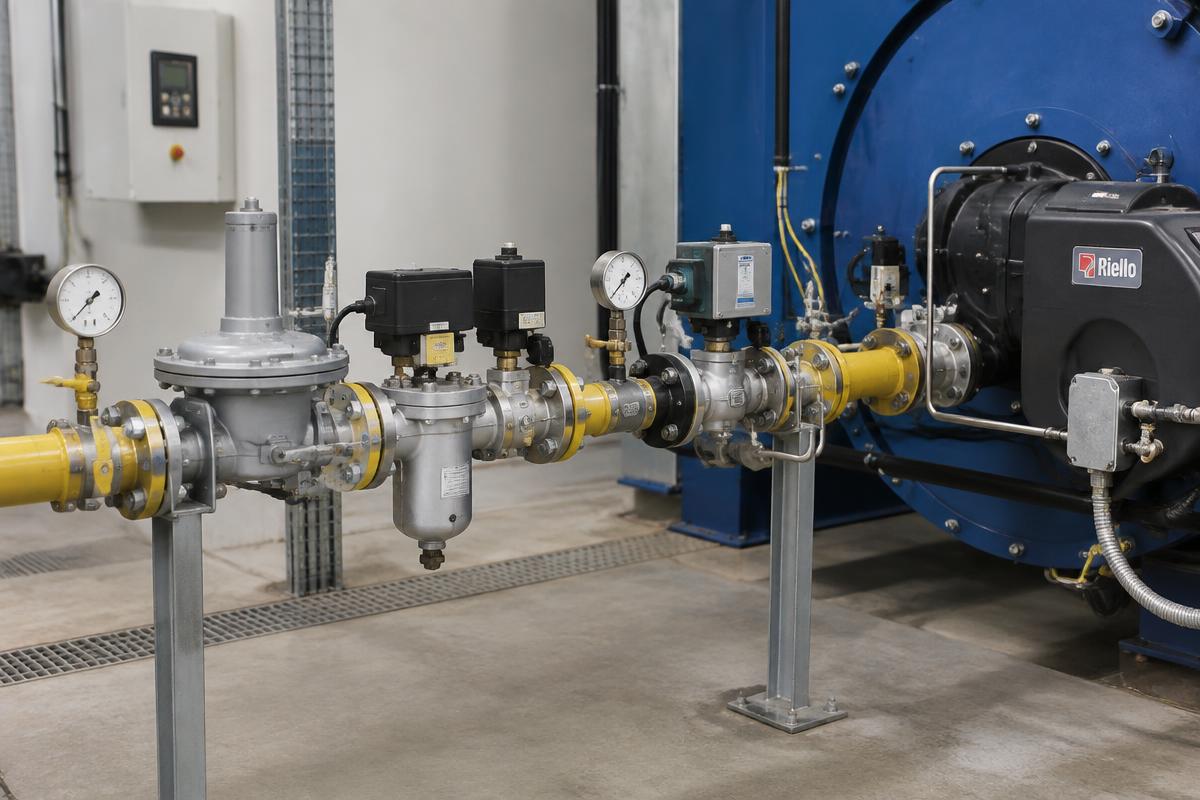
What is the role of a natural gas pressure regulator?
The natural gas pressure regulator reduces the pressure at its inlet and maintains the outlet pressure close to the target value within its operating limits. This ensures that the boiler, burner, or other gas consumer is supplied under the conditions for which it was designed. It is not just a flow restriction valve: it adjusts the gas passage as consumption and supply pressure vary.
In many mechanical regulators, operation is based on the balance between a diaphragm, a spring, and a valve. When the outlet pressure changes, the mechanism moves the valve to correct the deviation. Precise construction varies depending on the type, flow rate, and application.
Correct pressure is a prerequisite for smooth ignition and stable operation, but it does not in itself ensure proper combustion. Equally important are burner adjustment, combustion air, and flue gas exhaust. There is no single correct pressure for all devices: the required value is determined by the design and the manufacturer's technical data.
Where is it located in the installation and the gas train?
The position of the regulator depends on the supply method and the layout of the installation. In many supply setups, it is located in the metering and regulation assembly, near the natural gas meter. There, the grid pressure is adjusted to the pressure specified for the internal installation. The meter and the regulator have different roles: the former records consumption, while the latter controls pressure.
In boiler rooms and industrial applications, there may be an additional regulator in the burner's gas line, known as a gas train. Depending on the design, this layout includes a filter, isolation devices, safety solenoid valves, pressure switches, and measurement points. In some systems, multiple functions are integrated into a single assembly.
It should not be assumed that every device has a separate external regulator. Identification is made based on the installation design and the component markings. Accessibility, orientation, protection from external influences, and any required ventilation layout are determined by the manufacturer and applicable requirements. Breathing holes and designated outlets must not be covered or arbitrarily modified.
Which characteristics determine the correct choice?
A regulator is not selected based solely on the connection diameter. Two components with the same thread sizes might be intended for completely different pressures and flow rates. For a correct selection, its behavior is examined both at maximum demand and when consumption decreases or stops.
- Inlet pressure: the range of pressures that may occur in the supply.
- Outlet pressure: the value and allowed deviations required by the consumers.
- Flow rate: the required amount of gas, taking into account the simultaneous operation of devices.
- Installation conditions: compatibility with the gas, temperature, mounting position, and environment.
- Protection devices: the required measures against impermissible overpressure or underpressure.
The regulator is not identical to an automatic safety shut-off valve. Such protection may be integrated or independent, if required. Similarly, the filter limits the entry of particles that can affect seat tightness or the movement of the mechanism. Replacing it with a component that simply "fits the connection" is not a safe technical solution.
Which signs may indicate a malfunction?
Malfunction of a regulator can manifest as insufficient pressure, instability, or an increase in outlet pressure beyond the specified limits. However, most symptoms are not exclusive to it. A clogged filter, insufficient pipe cross-section, supply issue, or device failure can cause a similar situation.
- Repeated ignition failures: the burner attempts to start and goes into lockout.
- Interruptions at high load: the problem occurs when demand increases or more consumers are operating.
- Unstable operation: fluctuations or errors related to gas supply are observed.
- New, intense noise: whistling or vibration requires evaluation, especially if accompanied by a malfunction.
- Activation of a safety device: the cause must be investigated rather than simply resetting it repeatedly.
The characteristic odor of the odorant added to natural gas should be treated as a potential leak, not just a sign of "poor adjustment." Do not light a flame, smoke, or use electrical switches or telephones inside the suspicious area. Move away and call the network operator's emergency service or 112 from a safe location outside the premises if there is an immediate danger. Close the manual valve only if it is immediately accessible and can be done without exposure to danger.
How is inspection and maintenance performed?
Inspection is carried out by a licensed professional with appropriate instruments and according to the manufacturer's procedure. It includes verification of the regulator's data, visual inspection, and pressure measurements before and after it, under the specified operating conditions. A measurement only when the burner is off is not sufficient to evaluate the supply under load.
Depending on the layout, the pressure drop across the filter, the stability of the pressure during consumption, and the behavior when flow is interrupted are examined. Where applicable, safety devices are also checked. After any intervention, required tightness and function tests are mandatory, as well as a combustion analysis when the device's operation is affected.
The owner can keep a record of when the problem appears, which devices are operating, and what error code is displayed. You should not remove covers, turn adjustment screws, disconnect piping, or bypass safety features. For sealed equipment belonging to the network operator, their specific procedure is followed. Maintenance intervals are determined by equipment guidelines and applicable requirements, not by a general rule for all regulators.
Frequently Asked Questions
Can I increase the pressure if the boiler is not performing well?
No. Poor performance can be due to many causes, even the hydraulic circuit. Arbitrary pressure increases can create dangerous conditions. Measurements and diagnosis by a licensed technician must come first.
Does whistling mean it needs replacement?
Not necessarily. It may be related to flow, pressure difference, sizing, or component malfunction. A new or intense noise requires inspection. If a gas odor is present, safety actions for a potential leak take priority.
How often should the natural gas regulator be changed?
There is no uniform replacement interval for all types. The manufacturer's guidelines, the operator's requirements where applicable, and the findings of the inspection apply. Age alone is not a complete diagnosis.
Does the absence of odor mean it is working correctly?
No. A regulator can provide improper or unstable pressure without an external leak. Also, carbon monoxide from faulty combustion is odorless. Evaluation requires technical checks and is not based on smell alone.