
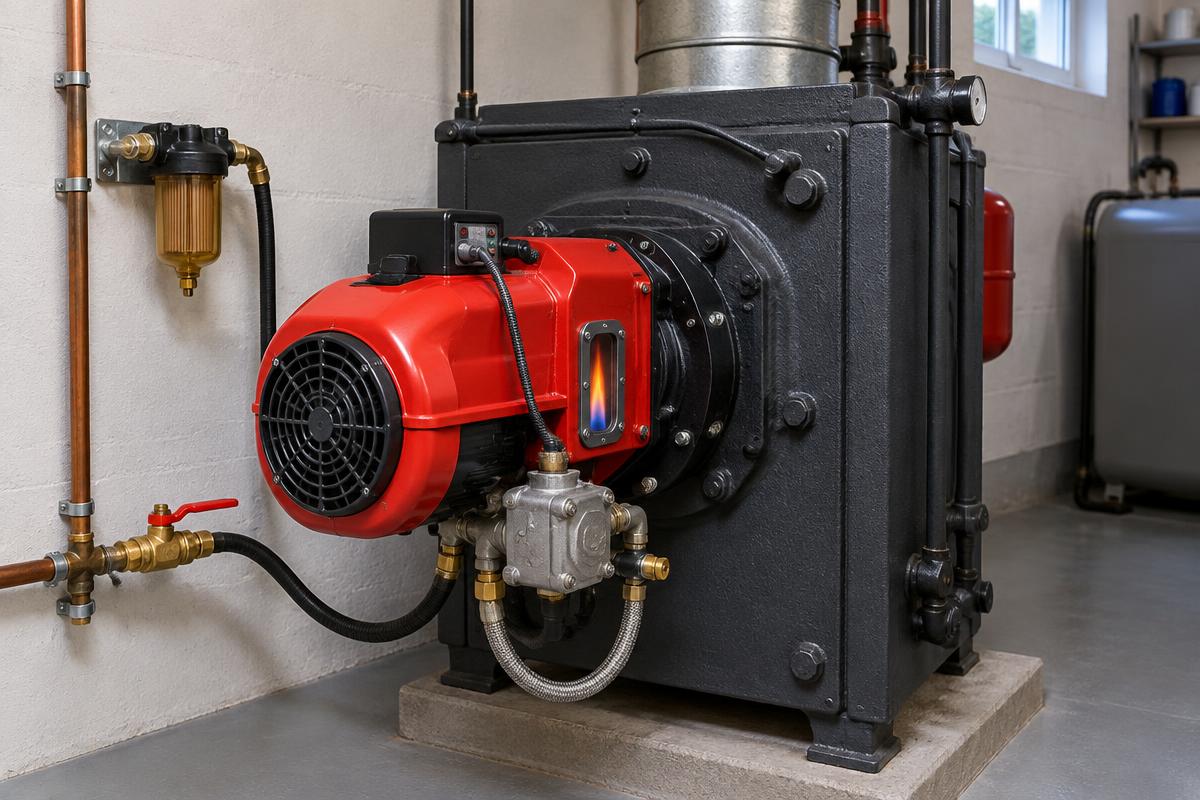
Proper oil burner operation is the most critical factor for heating efficiency and the longevity of the system. A burner that "smokes" is not merely an aesthetic nuisance or an environmental problem; it is a clear indication of incomplete combustion that translates into wasted money and impending failures. In this article, we will analyze the causes of smoke emission and the steps for proper technical adjustment.
Why does the oil burner emit black smoke?
Black smoke at the chimney exit or the accumulation of soot inside the boiler is almost always due to an incorrect air-fuel mixture ratio. When the oil sprayed into the combustion chamber is more than the oxygen provided by the fan can burn, the carbon molecules do not fully oxidize.
Main causes of incomplete combustion:
- Lack of combustion air: Clogged air damper or dust on the fan blades.
- Worn nozzle: The nozzle is a consumable part. Over time, its orifice expands or starts "dripping," resulting in improper atomization.
- Incorrect pump pressure: If the oil pump pressure is excessively high, the nozzle will deliver more fuel than the boiler's specifications require.
- Poor fuel quality: Presence of water or impurities in the heating oil.
The process of proper adjustment
Adjusting a burner should not be done "by eye." An experienced technician uses a specialized flue gas analyzer to measure performance and emissions. The steps followed are:
1. Cleaning and preparation
Before any adjustment, the boiler must be thoroughly cleaned of soot using special brushes and a vacuum cleaner. Soot acts as an insulating material: just 1 millimeter of soot on the boiler walls can increase fuel consumption by 3-5%.
2. Nozzle selection and replacement
Each boiler has a nominal capacity (e.g., 30,000 kcal/h). The technician selects the appropriate nozzle size (in gallons per hour - GPH) and the spray angle (e.g., 60° or 80° S/H/B) so that the flame does not hit the boiler walls.
3. Pump pressure adjustment
Typically, pressure in residential installations is set between 10 and 12 bar. Lower pressure can cause poor atomization, while higher pressure increases the flow beyond the boiler's limits.
The importance of flue gas testing
After mechanical adjustments, the technician inserts the analyzer probe into the chimney. The goals for proper combustion in Greece are:
- Carbon Dioxide (CO2): Ideally between 11% and 12.5%.
- Flue gas temperature: 160°C to 200°C. A very high temperature means energy is escaping through the chimney, while a very low one can cause condensation.
- Soot index (Bacharach): Must be 0 or at most 1.
- Excess air (Lambda): Approximately 1.2 to 1.4 to ensure sufficient oxygen for complete combustion.
Practical advice for owners
If you notice that your burner starts with a loud bang ("popping") or if you see smoke coming from the chimney pipe joints, you must call a licensed technician immediately. Do not attempt to adjust the air damper yourself, as a lack of oxygen can lead to the production of Carbon Monoxide (CO), which is odorless and extremely dangerous.
Also, ensure adequate ventilation of the boiler room. A burner that is "choked" by a lack of fresh air in the room will never be properly adjusted, no matter how many changes are made to its components.
Frequently Asked Questions (FAQ)
How often should maintenance and adjustment be performed?
Maintenance is mandatory by law once a year, ideally at the end of the heating season (April-May) or at its beginning (September-October). Cleaning the boiler while the soot is still "fresh" is more effective.
Why does the burner smell like oil inside the house?
This is usually due to poor chimney sealing or exhaust gas backflow due to insufficient draft. It may also be due to a small leak in the pipes or the burner filters.
Can an old nozzle increase consumption?
Yes, absolutely. A worn nozzle does not spray oil into uniform droplets. This creates a "wet" flame that does not burn completely, reducing efficiency and forcing the burner to run longer to reach the thermostat temperature.
Conclusion
Adjusting the oil burner is not just a routine procedure, but an investment in safety and economy. A properly adjusted system reduces consumption by up to 15%, protects the environment, and ensures your installation will operate smoothly for many years. Do not neglect your annual appointment with your technician and always ask for the report sheet with the analyzer measurements.