
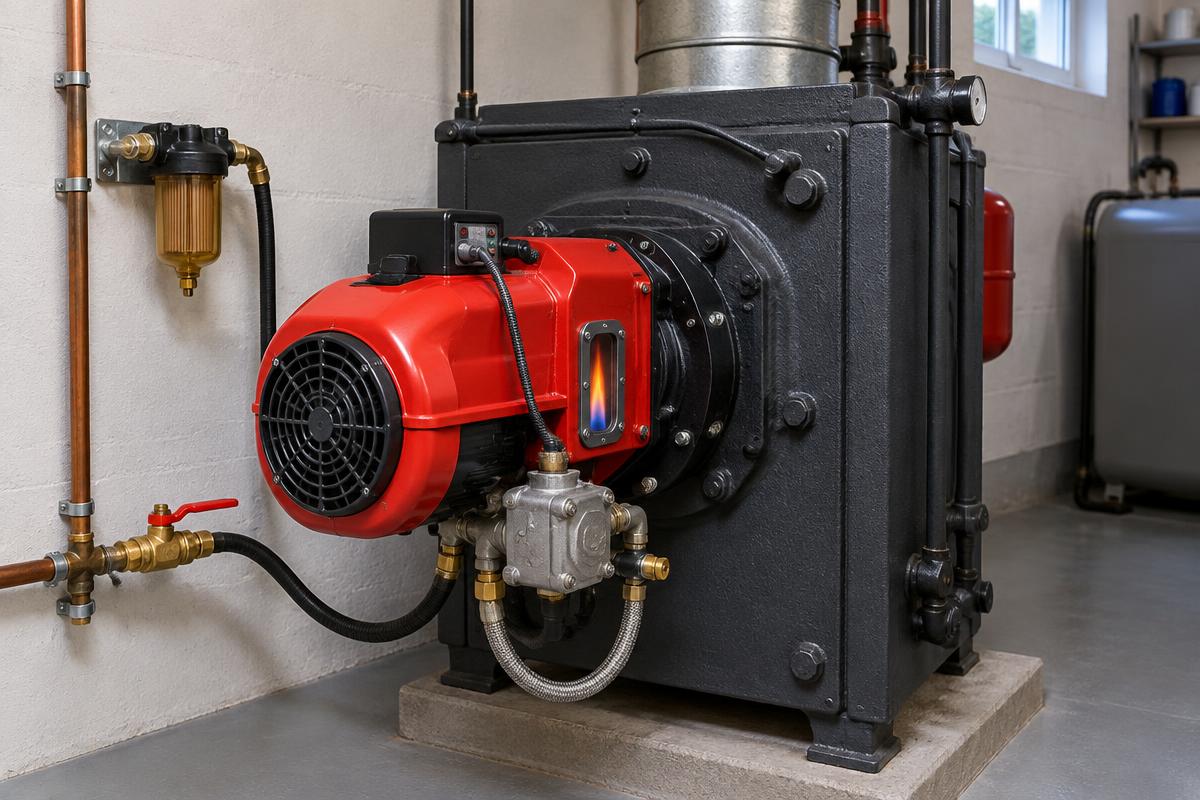
Introduction to oil burner problems
The shutdown of an oil burner, especially during periods of low temperatures, is one of the most common and annoying problems a homeowner faces in Greece. When the burner "trips," meaning it stops and the red light turns on (lockout), there are several causes, ranging from simple oversights to serious mechanical failures. In this article, we will analyze the most common causes and the recommended solutions from the perspective of an experienced technician.
1. Problems with fuel supply and quality
The first step every owner should take is to check if there is enough oil in the tank. Often, the gauge reading can be misleading due to the accumulation of sludge at the bottom.
- Lack of fuel: If the level is too low, the pump draws in air or impurities.
- Clogged oil filter: The filter retains particles. If it has not been replaced during the annual maintenance, it clogs, reducing supply pressure.
- Water in the tank: Condensation or poor fuel quality can lead to water entering the circuit, causing combustion to stop.
2. The nozzle and the importance of proper spraying
The nozzle is the component that converts liquid oil into a mist for ignition. It is a precision component with a very small orifice, which can be easily affected.
Why does the nozzle wear out?
Over time and with use, the nozzle orifice widens or becomes clogged with combustion residues. This results in poor fuel dispersion, the production of soot (smoke), and ultimately the burner shutting down. The nozzle must be replaced annually with the correct size (e.g., 0.60 GPH) and the correct spray angle (e.g., 60° S/H) specified by the manufacturer.
3. The photocell: The "eyes" of the burner
The photocell is a sensor that "sees" the flame. If for any reason it does not detect light after ignition, it instructs the electronic controller to stop operation for safety reasons.
- Dirty photocell: Soot can cover the sensor glass, preventing it from seeing the flame.
- Incorrect placement: If it has shifted, it may not be aimed correctly at the combustion chamber.
- Sensor failure: Normal wear and tear can render the photocell inactive.
4. Electronic and electrical parts
The burner relies on a series of electrical processes to start and maintain combustion. Problems in these areas usually require the intervention of a licensed technician.
Transformer and electrodes
The electrodes (igniters) create the spark that lights the mixture. If the electrodes are worn, have carbon deposits, or if the high-voltage transformer has weakened, the burner will attempt to start without success (the characteristic "crack-crack" sound will be heard, but there will be no ignition).
Electronic control (Control box)
It is the central component that orchestrates the operation. A fault in its internal circuitry can cause random shutdowns or a complete refusal to operate.
5. Oil pump and air adjustments
The pump must send the oil at a specific pressure (usually 10-12 bar for residential burners). If the pump-to-motor coupling is broken or if the pump has internal wear, the supply will be unstable.
Also, the air adjustment is critical. Too much air "blows out" the flame, while too little air causes incomplete combustion and heavy smoking, which eventually leads to a lockout.
Frequently Asked Questions (FAQ)
1. Why does my burner emit black smoke before shutting down?
This is usually due to a poor air-fuel ratio, a clogged nozzle, or a very dirty boiler that does not allow the free exit of exhaust gases.
2. How often should maintenance be performed?
Burner maintenance and boiler cleaning should be done once a year, ideally after the end of the heating season (spring) or before the start (autumn).
3. What does it mean when I press the reset button and the burner shuts down again after a while?
It means there is a permanent fault (e.g., a burnt-out photocell or a problem with the pump). Do not press the reset button more than twice, as there is a risk of fuel over-accumulation in the combustion chamber.
4. Can air in the lines cause a shutdown?
Yes, if the circuit has taken in air (e.g., after the tank has emptied), the oil flow is interrupted and the burner shuts down. Bleeding from the pump is required.
Conclusion
A burner that shuts down is most often the result of poor maintenance or poor fuel quality. While some checks (such as the oil level) can be done by the owner, the diagnosis and repair of mechanical parts must always be performed by a specialized burner technician for reasons of safety and fuel economy.