Introduction to Choosing a Water Pump
Choosing the right water pump is a critical decision for every homeowner, as it directly affects daily comfort, shower pressure, and irrigation efficiency. In the Greek market, needs vary from boosting the pressure of a poorly performing water supply network to drawing water from wells or rainwater tanks. As technicians, we often see the mistake of oversizing or buying an unsuitable type of pump, which leads to unnecessary power consumption and premature failures.
1. Understanding Technical Specifications
Before going to the market, you must understand two basic concepts found on every pump label: Head and Flow Rate.
Head (H)
Measured in meters (m), it represents the height to which the pump can push water. Caution: The maximum head indicated by the manufacturer is the point where the flow becomes zero. For a two-story house, we need a pump that maintains satisfactory pressure (approximately 3 bar) at the highest point.
Flow Rate (Q)
Measured in cubic meters per hour (m³/h) or liters per minute (l/min). For a typical family of 4, a flow rate of about 2.4 to 3.6 m³/h is usually sufficient to cover the simultaneous use of two bathrooms and a washing machine.
2. Types of Pumps by Application
The water source determines the type of machine you will install:
- Surface Pumps (Centrifugal): Ideal for moving water from tanks located at the same level or slightly lower (up to 7-8 meters deep).
- Submersible Pumps: Placed inside the water (wells, boreholes, or tanks). They are quiet and do not have suction problems.
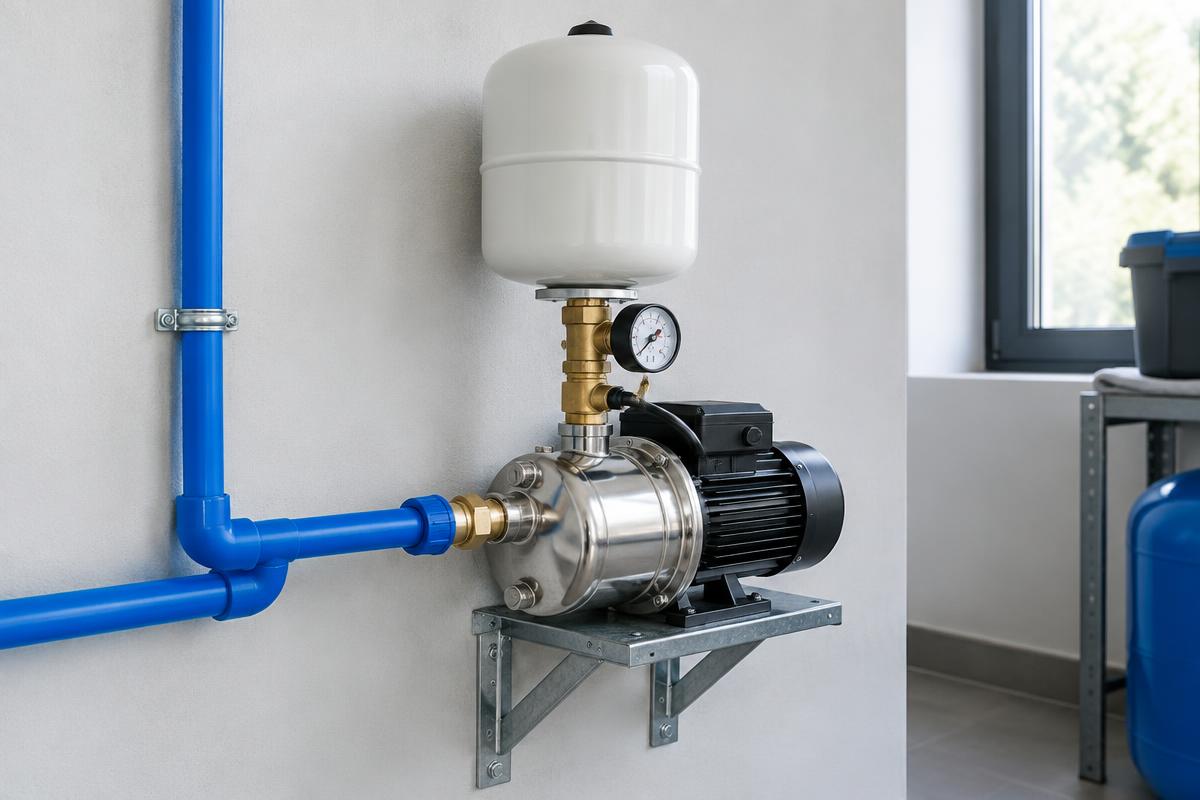
- Pressure Booster Systems: A combination of a pump with an expansion tank and a pressure switch. Used to maintain constant pressure at the household taps.
3. Pressure Booster Systems: Inverter or Expansion Tank?
This is the most frequent question from owners today. Technology has advanced, and there are two choices:
Classic Pressure Booster with Tank
Uses a tank with a diaphragm (usually 20-60 liters). The pump starts when the pressure drops below a threshold and stops when the tank is full. It is more economical to purchase but shows pressure fluctuations during use.
Inverter Pumps
These are the top choice. The inverter controller increases or decreases motor speed according to demand. If you open the tap slightly, the pump works at a low level. If you open three taps, it increases speed. Advantages: constant pressure, energy savings of up to 50%, and silent operation.
4. Construction Materials and Reliability
A pump is a decade-long investment. You must pay attention to the following:
- Pump Body: Cast iron is robust but rusts if left idle. Stainless steel (inox) is the best solution for potable water.
- Impeller: Plastic (noryl) is economical, but brass or stainless steel impellers withstand heat and friction from any sand much better.
- Dry-running protection: An essential component to prevent the motor from burning out if the water in the tank runs out.
5. Practical Installation Tips
Even the best pump will fail if installed incorrectly. Ensure that:
- The diameter of the suction pipe is not smaller than the pump inlet.
- A foot valve (check valve) with a filter is installed at the end of the pipe inside the water.
- The electrical supply has a circuit breaker and the wiring is of the correct cross-section (e.g., 3x1.5mm² for small pumps).
- There is frost protection, especially in mountainous areas of Greece, by insulating it or placing it indoors.
Frequently Asked Questions (FAQ)
How many HP do I need for a house?
For an average detached house, a 0.75 HP to 1 HP pump is usually more than enough. Excessive power (e.g., 2 HP) for no reason will simply stress your pipes with too much pressure.
Why does my pressure booster keep starting (it "kicks")?
It is usually due to a loss of air in the expansion tank or a ruptured diaphragm. You need to check the air pressure with a simple car tire gauge (it should be 0.2 bar lower than the start pressure).
Can I use a surface pump for a depth of 15 meters?
No, standard centrifugal pumps stop sucking after 8 meters due to physical limitations. For such depths, a submersible pump or a pump with an external ejector (jet) is required.
Conclusion
Choosing a pump is not a simple "horsepower" matter. It requires studying your needs regarding flow and the height that must be covered. Prefer reputable solutions with available spare parts in Greece and consult a licensed plumber for the final connection. A properly sized pump will offer you trouble-free use for many years with the lowest possible operating costs.