
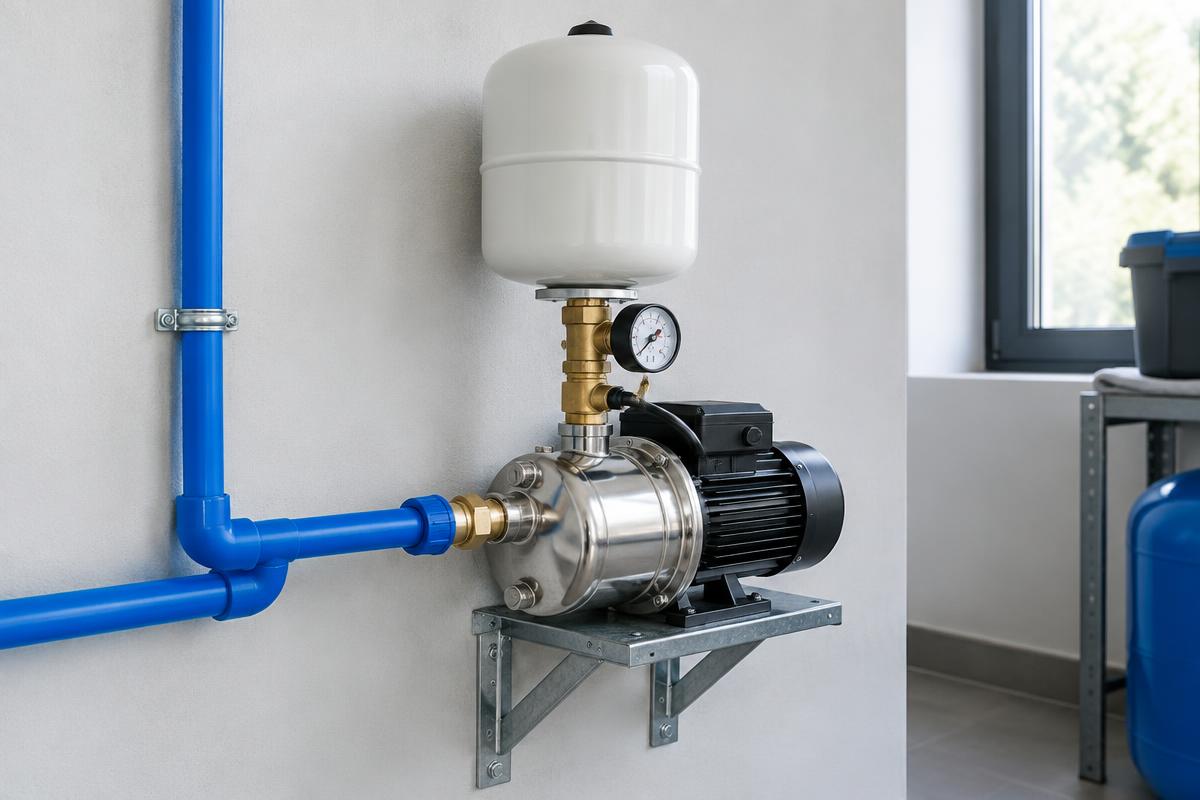
An automatic water pump with press control is a practical solution for residential water supply from a tank, pressure boosting in a properly configured system, and irrigation. The electronic controller handles starting and stopping the pump, sparing the user from operating switches every time a tap is opened.
Success, however, does not depend on automation alone. It requires the right pump selection, adequate water supply, and careful hydraulic and electrical connections. Below, you will find out what a press control really offers, where its limitations lie, and which points require inspection before installation.
1. How press control works
A press control is an electronic device that monitors pressure and flow at the pump's discharge side. When a consumption point is opened and pressure drops below the start threshold, it triggers the pump. When consumption points are closed and flow drops to zero or falls below the detection limit, it stops the pump, usually after a short delay.
Unlike a conventional pressure switch, it usually does not cut off at a preset maximum pressure. Before shutting down, the system may approach the maximum pressure generated by the pump at zero flow. Therefore, the durability of all components must be verified.
- The start pressure is often around 1.5–2.2 bar, either fixed or adjustable depending on the model.
- Many models feature dry-run protection, though not all use the same reset logic.
- Permissible pressure, water temperature, and maximum electrical load are determined by the manual.
It is not an inverter: it does not vary the pump's RPM and does not ensure constant pressure by itself when consumption changes.
2. Advantages and practical limitations
The main advantage is simple automation. A suitable system operates without a large pressure tank, limiting the space required and the number of components.
- User-friendly operation: the pump starts whenever water is requested.
- Continuous supply: as long as there is sufficient flow, the cycling common in conventional systems with inadequate tanks is avoided.
- Protection capability: compatible devices stop operation when no water is detected.
- Compact dimensions: facilitates installation in limited spaces.
However, there are limits. A leak or a toilet cistern that does not close properly can cause unwanted starts. Very low consumption, such as in certain drip irrigation networks, may fall below the flow detection threshold.
A small diaphragm tank can limit starts caused by micro-consumption, provided it is allowed by the manufacturer. Its position and pre-charge are chosen according to the instructions for that specific combination, not by trial and error.
3. Selecting a pump and compatible automation
First, the required flow rate and total head are calculated. For a small residence, a flow of approximately 1–3 m³/h and a pressure of 2–3 bar at the points of use serve as an indicative starting point, not a universal specification. Simultaneous consumption, elevation, and piping losses significantly change the selection.
Altitude affects the start
Every 10 meters of vertical lift corresponds to approximately 1 bar. If the highest tap is 12 meters above the controller, the static difference is about 1.2 bar. The start pressure must be selected with the manufacturer's required margin so that opening the tap reliably activates the pump.
- Check the flow-head curve, not just the motor horsepower.
- Confirm that the pump generates sufficient pressure above the start threshold.
- Compare operating current and starting requirements with the controller's switching capacity.
- For potable water, choose components suitable for that specific use.
A larger motor may require a contactor and an appropriate protection panel. Electrical compatibility is not determined solely by the stated power.
4. Installation: correct sequence and critical points
Installation must be performed with isolated electrical supply and depressurized lines. Fixed electrical connections and safety checks must be handled by a licensed electrician.
Hydraulic connection
A common layout is: tank → supply/suction line → pump → press control → consumption network. The controller is placed at the discharge, with the arrow pointing towards the consumption points. Whether vertical or horizontal placement is allowed depends on the model.
- Suction must be airtight, of appropriate diameter, and as short as possible, without unnecessary bends.
- For suction from a lower level, a suitable foot valve is required. Do not add check valves without verifying the overall layout.
- Filters are chosen with low pressure drop. A clogged or overly fine filter on the suction side can cause supply issues.
- Unions, appropriate isolation valves, and a pressure gauge facilitate maintenance and troubleshooting.
- Piping must be supported independently so that it does not exert mechanical load on the pump and controller.
Do not take for granted the ability to draw water directly from the public network. Check the local provider's regulations. Where required, a break tank with proper separation from the potable water network must be used; a simple check valve does not replace every protection requirement.
Electrification and first start
Proper grounding, appropriate overcurrent protection, and a residual current device (RCD) are required in accordance with local installation standards. Equipment must be protected from rain, flooding, and frost.
Before starting, fill and bleed the pump as specified by the manufacturer. Even a self-priming pump usually requires an initial prime. Open a tap, check the flow, and then confirm that the pump stops when all consumption points are closed.
5. Cost, maintenance, and common faults
Indicatively, in the Greek retail market, a simple press control may cost approximately 30–100 €, while a small surface pump for residential use costs about 150–450 €. A simple installation may require 80–200 € in labor. These ranges are not a formal quote: ask for clarification regarding VAT, materials, electrical work, and any potential tank.
- Frequent starts: check for leaks, toilet cisterns, and water backflow from a faulty check valve.
- The pump does not stop: look for an open consumption point, a large leak, or a flow detection problem.
- Water shortage indication: check the tank level, filters, suction airtightness, and priming.
- Low pressure: examine available flow, piping losses, and the actual operating point.
Do not perform repeated resets without finding the cause. Periodically check for tightness, filter cleanliness, and automation functionality, always with safe isolation before any intervention.
6. Frequently Asked Questions
Is a pressure tank absolutely necessary?
No. Many controllers work without a tank. A compatible small tank can help with micro-consumption, but it does not fix leaks or incorrect pump selection.
Can I increase the pressure from the press control?
The start setting, where available, changes when the pump starts. It does not increase its hydraulic capabilities nor does it equate to a constant outlet pressure setting.
Does it connect to a submersible pump?
Yes, provided there is hydraulic and electrical compatibility. Specifically, the maximum head, check valves, and required motor protections must be verified.
Does it save on electricity?
It does not guarantee specific savings. Consumption depends primarily on the pump, the operating point, and usage. The press control is a start-stop automation, not a variable speed system.
Conclusion: An automatic pump with press control is effective when chosen as an integrated system. Proper sizing, secure water supply, and careful installation are more valuable than high nominal power or an arbitrary pressure setting.