Introduction to Electrical Inspection and Safety
The electrical installation of a building, whether it is an old residence or a modern professional space, is a "living" organism that wears out over time. An electrical inspection is not just a bureaucratic obligation for the issuance of the DEDDIE certificate (YDE), but the only safeguard against electric shock and fire. In this article, we will analyze the critical measurements performed by a licensed electrician, focusing on grounding, insulation, and the certification process.
The Importance of Grounding: The Foundation of Protection
Grounding is the intentional electrical connection of the metal parts of an installation to the earth. Its purpose is twofold: to provide a low-resistance path for fault currents and to immediately trigger protective devices (fuses, RCDs).
How do we measure grounding?
Grounding resistance measurement is performed with a special instrument, the earth tester. In Greece, acceptable values depend on the connection system (usually TN-S or TT). In a typical city network, the grounding value must be as low as possible, ideally below 1-2 Ohm for foundation grounding, although the HD 384 standard defines limits based on touch voltage.
- Visual inspection: Checking connections on the distribution board grounding bus and the condition of the electrode (rod, plate, or strip).
- Loop Test: Performed to confirm that in the event of a short circuit, the current will be sufficient to "trip" the fuse instantaneously.
Insulation Resistance Measurement (Megger Test)
Cable insulation degrades due to heat, moisture, and material (PVC) aging. The insulation resistance measurement reveals if there are current "leaks" between conductors or to the ground, which could cause a fire.
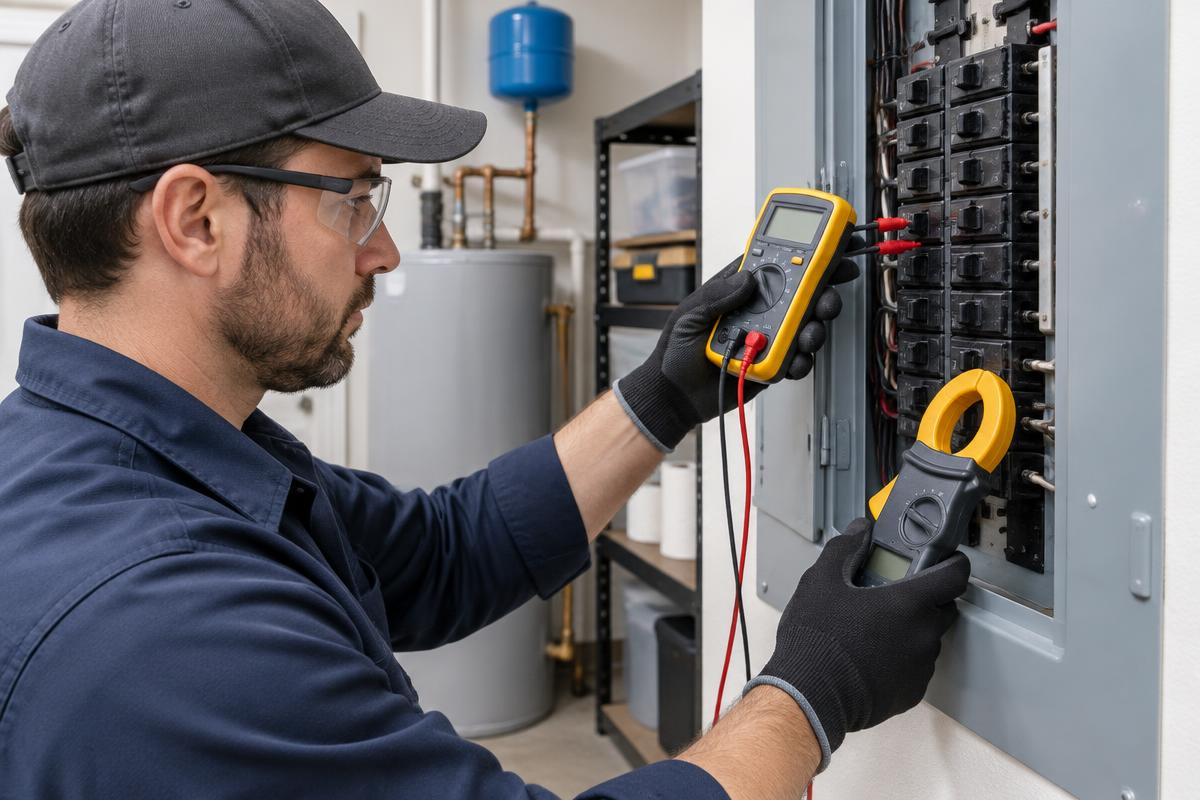
To perform the measurement, the electrician uses an insulation tester (Megger), applying a 500V DC voltage (for 230V/400V installations). According to the standard, the minimum acceptable value is 1 MΩ, although in new installations, values are typically much higher (>200 MΩ).
- Preparation: Disconnecting all sensitive electronic devices to avoid destruction from the high test voltage.
- Procedure: Measuring between Phase-Neutral, Phase-Ground, and Neutral-Ground.
Checking the Residual Current Device (RCD/Safety Relay)
The Residual Current Device (RCD) is the most critical component for the protection of human life. Testing is not limited to pressing the "Test" button. The technician uses a digital analyzer to measure:
- Response time (ms): How quickly the current is cut off. For a 30mA current, the time must be under 300ms (typically <40ms).
- Trip current (mA): The exact point at which the relay "trips" (usually between 21mA and 27mA for 30mA relays).
The Licensed Electrician's Responsible Declaration (DEDDIE Certificate)
The Licensed Electrician's Responsible Declaration (YDE) is the official document certifying that the installation is safe and compliant with the ELOT HD 384 standard. It is necessary for:
- New electricity connection or reconnection after a disconnection.
- Change of name on the electricity bill.
- Power upgrade (e.g., installing night tariff or an EV charger).
- Periodic re-inspection (every 14 years for residences, every 7 for professional spaces without flammable materials).
The certificate is now mandatorily accompanied by the single-line diagram of the distribution board, the installation layout, and the test protocol with the measurements mentioned above.
Frequently Asked Questions (FAQ)
1. Why does my RCD trip for no apparent reason?
This is often due to low insulation resistance in a line (e.g., moisture in outdoor lighting) or cumulative leakage from multiple electronic devices. An electrician with a Megger can locate the line presenting the problem.
2. How long does an electrical inspection take for a residence?
For a typical 80-100 sq.m. apartment, a thorough inspection including measurements takes approximately 1.5 to 2 hours, provided no serious faults requiring immediate repair are found.
3. Can I issue a certificate without measurements?
Legally and technically, no. Issuing a YDE without measurements is a serious violation for the electrician and endangers the occupants. Modern measurement instruments record data that is often requested in the event of an accident or official inspection.
4. What is foundation grounding?
It is the method where the grounding is placed within the building's foundation during the concrete pouring phase. It is the most effective and durable form of grounding with the lowest resistance values.
Conclusion
Electrical inspection and grounding and insulation measurements are not a luxury, but a necessity. Proper maintenance of the installation and the issuance of a valid YDE ensure that your home remains a safe place, while also protecting the longevity of your electrical appliances. Do not neglect periodic re-inspection and always trust licensed professional electricians with modern measurement equipment.