Introduction to the role of air in closed circuits
Every experienced heating technician knows that air is the "number one" enemy of an installation. Many owners believe that traditional manual venting on radiators is sufficient, but the reality is more complex. In modern systems, especially those with heat pumps or condensing boilers, the presence of trapped air in the form of microbubbles can reduce efficiency by up to 15-20%.
A deaerator is not just a simple air vent. It is a specialized device installed on the main supply line that removes not only free air but also dissolved gases from the system's water. In this article, we will analyze its function and why it is an investment for every home.
How does air enter the heating system?
Even in a seemingly sealed circuit, air finds entry points. The main causes are:
- Network filling: During filling with fresh water from the municipal water supply, the water carries dissolved oxygen and nitrogen.
- Diffusion: Through plastic pipes without an oxygen barrier (common in older underfloor heating systems).
- Negative pressure: If the expansion vessel is not properly pressurized, negative pressure can be created at high points, sucking air through joints and connections.
The advantages of using a deaerator
1. Protection against corrosion and sludge
Oxygen in the water causes oxidation in metal parts (steel radiators, boilers, pumps). The chemical reaction creates magnetite (black sludge), which settles in the heat exchanger and destroys it. A deaerator stops corrosion at its source by removing oxygen before it has a chance to react with the metal.
2. Silent operation
Annoying "flow" or "gurgling" noises in radiators and pipes are almost always caused by air bubbles. A deaerator ensures that the water circulates as a uniform mass, eliminating the noises that disturb residents during the night.
3. Reduction in fuel consumption
Air is a poor conductor of heat. When bubbles settle on heat exchange surfaces, they create an insulating layer. This forces the boiler or heat pump to work longer to reach the desired room temperature.
Technical comparison: Deaerator vs. Simple Air Vent
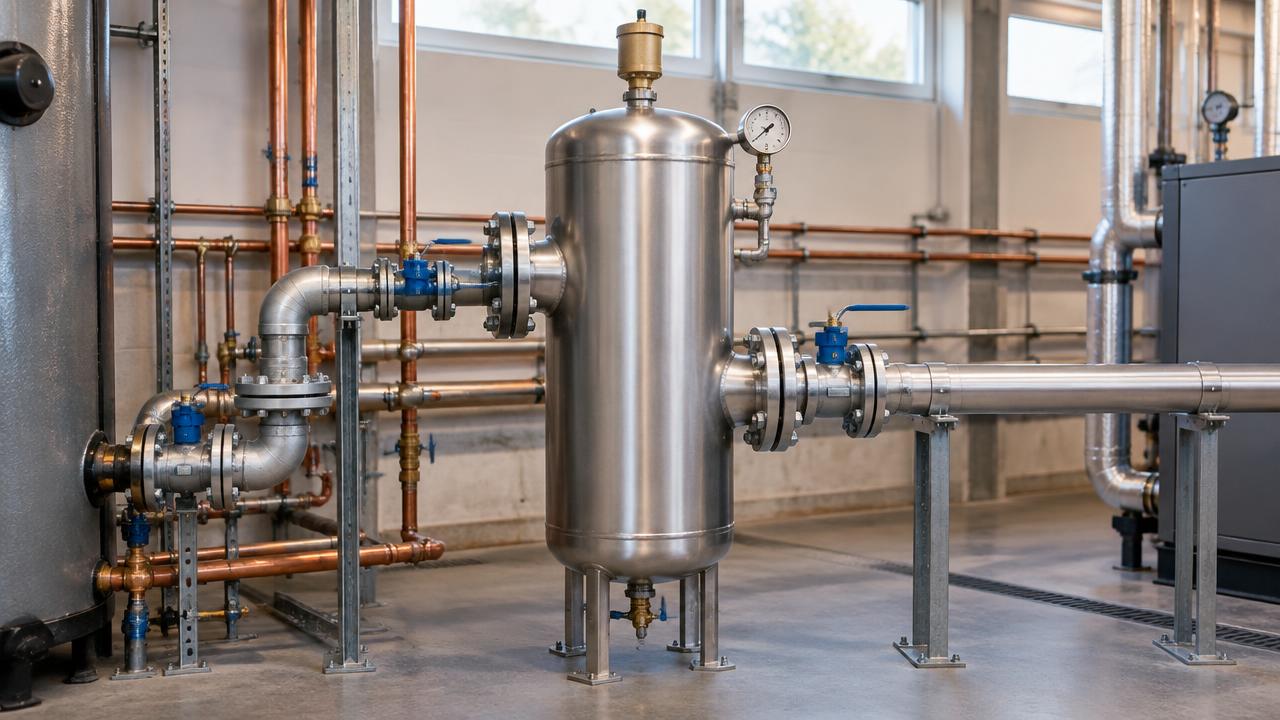
It is crucial to understand the difference. A simple automatic air vent removes only the air that has collected at high points (static bubbles). In contrast, a deaerator uses the principle of "velocity reduction" and special internal meshes (such as Pall rings) to force microbubbles to coalesce, grow, and rise toward the vent valve.
A deaerator can remove even gases that are "trapped" within the water flow, which a common air vent cannot do due to the velocity of the water.
Where and how is it installed correctly?
For a deaerator to be effective, it must be installed at the point where the water has the highest temperature and lowest pressure. In heating systems, this point is the supply (outlet) of the boiler, immediately after the heat production unit.
In cooling installations, conversely, it is placed on the return to the chiller. The correct installation is vertical, to facilitate the rise of bubbles to the collection chamber.
Frequently Asked Questions (FAQ)
Do I need a deaerator if I already have radiator vents?
Yes. Radiator vents only remove air that has already become trapped there. A deaerator cleans the water on a continuous basis, protecting both the circulator pump and the boiler—components not affected by radiator venting.
How much does it cost to install a deaerator?
The cost of the device for a typical residence ranges from €80 to €150, depending on the pipe diameter (e.g., 3/4" or 1"). The labor cost is minimal if done during boiler installation, while in an existing network, it requires about one hour of labor.
How often does a deaerator need maintenance?
Most reputable deaerators do not require special maintenance. A visual inspection for any leaks at the valve during the annual heating check is more than enough.
Conclusion
A deaerator is not a luxury, but an essential component for any modern heating network. It protects your investment from corrosion, ensures complete silence, and contributes to lower energy bills. If you are planning a new installation or upgrading an existing one, ask your technician to install a reliable microbubble deaerator.