What a heating system deaerator is and how it works
A heating system deaerator is a component that separates and expels air from the system's water circuit. It is used in installations with boilers, heat pumps, radiators, and underfloor heating. Its purpose is to limit gas concentration so that water circulates smoothly and transfers heat effectively.
Air exists in the circuit as large pockets, microbubbles, or dissolved gases. It mainly enters during initial filling and water top-ups, but can also enter through areas with poor airtightness or through pipes lacking a proper oxygen diffusion barrier. As temperature and pressure change, part of the dissolved gases may be released as bubbles.
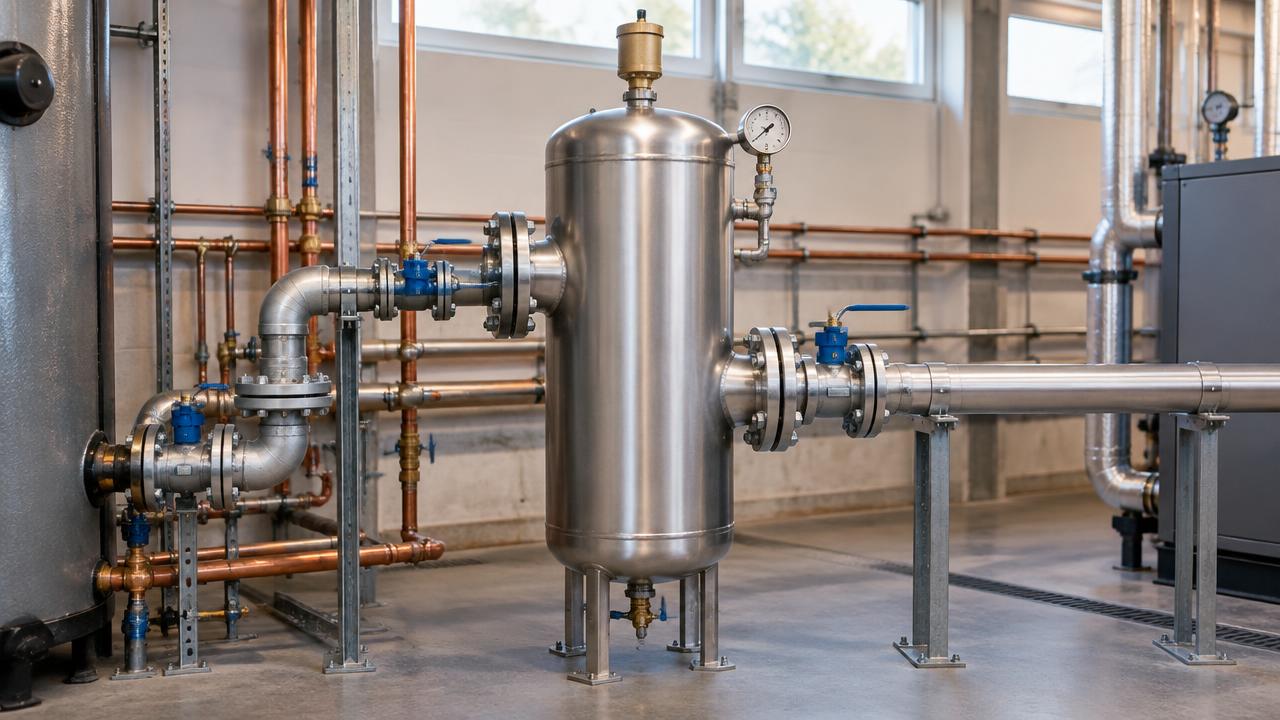
In a microbubble separator, water passes through a specially designed chamber with an internal separation element. Small bubbles are captured and coalesce into larger ones, which rise to the top. There, they are expelled by an automatic air vent mechanism. Through the successive passes of the water, the free air circulating in the installation is gradually reduced.
Why air causes problems and damage
Trapped air does not just cause annoying noises. It can hinder flow, leave parts of radiators cold, and create uneven heating between rooms. In underfloor heating, an air pocket can significantly restrict circulation in a specific loop, even when the circulator is running.
When water supply becomes unstable or insufficient, the operation of the heat source is also affected. Depending on the equipment, low flow errors, frequent shutdowns, or local overheating may occur. Air in the circulator can also cause noise and affect cooling and lubrication in wet rotor models. However, not every noise should be attributed to air: cavitation is related to insufficient local pressure and requires separate inspection.
Oxygen that enters with air and fresh water promotes the corrosion of metal components. Corrosion products can form sludge and deposits in heat exchangers, valves, and circulators. Effective deaeration limits a contributing factor but does not replace proper water quality, tightness, and pressure control.
- Limits gurgling and noises due to bubbles.
- Helps restore more stable water circulation.
- Reduces the need for repetitive manual air venting.
- Contributes to equipment protection without guaranteeing the elimination of all failures.
Automatic air vent, microbubble separator, or vacuum deaerator?
The names are often used as if they describe the same component, but the capabilities differ. A simple automatic air vent removes air that has already gathered at the point where it is installed, usually at high points or collectors. It does not have the same ability to remove microbubbles from passing water as a dedicated separator.
The microbubble separator is installed in the flow and acts continuously during circulation. A vacuum deaerator is a different device: it treats part of the water under reduced pressure, facilitating the removal of dissolved gases. It may be chosen for larger or demanding installations, as well as where operating conditions make effective passive deaeration difficult.
Selection is not determined only by the connection diameter. It requires checking the actual flow rate, pressure drop, maximum operating temperature and pressure, and compatibility with glycol or additives if used. In heat pumps, the increased flow requirements in many applications make limiting unnecessary hydraulic resistance particularly important.
There are also combined deaeration and particle separation devices. However, a simple deaerator is not a sludge filter or a magnetic filter. For comprehensive protection, the needs for air and solid pollutant removal must be considered separately.
Where it is installed and what proper installation requires
Air separation is generally favored by higher temperatures and lower pressures, because under these conditions the solubility of gases in water decreases. For this reason, in many heating installations, the microbubble separator is installed in the supply, near the outlet of the heat source. The final position, however, is determined by the hydraulic plan, the position of the circulator, the connection of the expansion vessel, and the manufacturer's instructions.
In heat pump systems that also operate in cooling mode, a general installation rule is not enough. Both modes of operation must be taken into account. Correspondingly, in installations with an inertia tank, a hydraulic separator, or multiple circuits, the designer examines from which point the appropriate flow passes for effective deaeration.
- The flow direction, where specified, and the allowed orientation of the component must be followed.
- The automatic air vent chamber must remain in the position provided by the manufacturer, usually vertically upwards.
- Access must be left for inspection, cleaning, and replacement of the mechanism.
- Safe management of potential leakage, away from electrical components, must be provided.
Installation is performed by a qualified technician, with the relevant section isolated, cold, and depressurized. After the work, filling, venting, leak testing, and confirmation of correct operating pressure follow.
Inspection and maintenance: when intervention is needed
The deaerator needs periodic checking, even if it operates automatically. Salts and particles can affect the float or the air vent valve, causing dripping or failure to expel air. The connections, presence of moisture, and condition of the mechanism are checked externally. The cap or venting device is adjusted exclusively according to the specific model's instructions.
If radiators constantly need venting, the pressure drops frequently, or persistent noises are heard, adding a larger deaerator is not enough. Checking for leaks, a problem with the expansion vessel, incorrect filling pressure, or air ingress is required. Constant water topping-up introduces new oxygen and salts, sustaining the cause of the problem.
Maintenance frequency depends on the manufacturer's instructions and the condition of the network. Practically, the check can be part of the scheduled heating maintenance. Do not open or clean a component while it is under pressure or contains hot water.
Frequently Asked Questions
Does the deaerator eliminate the need to vent radiators?
Not completely. It limits the need for repetitive venting, but after filling or network work, local air pockets may remain. Radiators and underfloor loops are vented according to the installation's procedure.
Is a deaerator needed in a heat pump?
Effective air removal is important for stable flow and protecting the heat exchanger. Whether an additional deaerator is required depends on the integrated equipment, the hydraulic network, and the manufacturer's requirements.
Does it reduce energy consumption?
It can help when air causes insufficient circulation and poor performance of heating surfaces. There is no universal saving percentage: the result depends on the initial state, the setting, and the hydraulic balancing of the system.
What should I do if the deaerator is dripping?
It requires checking for dirt, seal wear, or valve malfunction. Avoid disassembly under pressure and call a technician. Permanently stopping the vent may temporarily stop the dripping, but it does not fix the failure.