
Introduction: The modern heating dilemma
Choosing a heating system is one of the most critical decisions during the construction or renovation of a home in Greece. The question of "underfloor vs. radiators" does not have a simple answer, as it depends on the use of the building, the budget, and the energy source. As technicians, we often see owners swayed by trends without calculating the technical parameters. In this article, we will analyze the facts realistically, focusing on the Greek reality.
1. Underfloor Heating: The comfort of low temperature
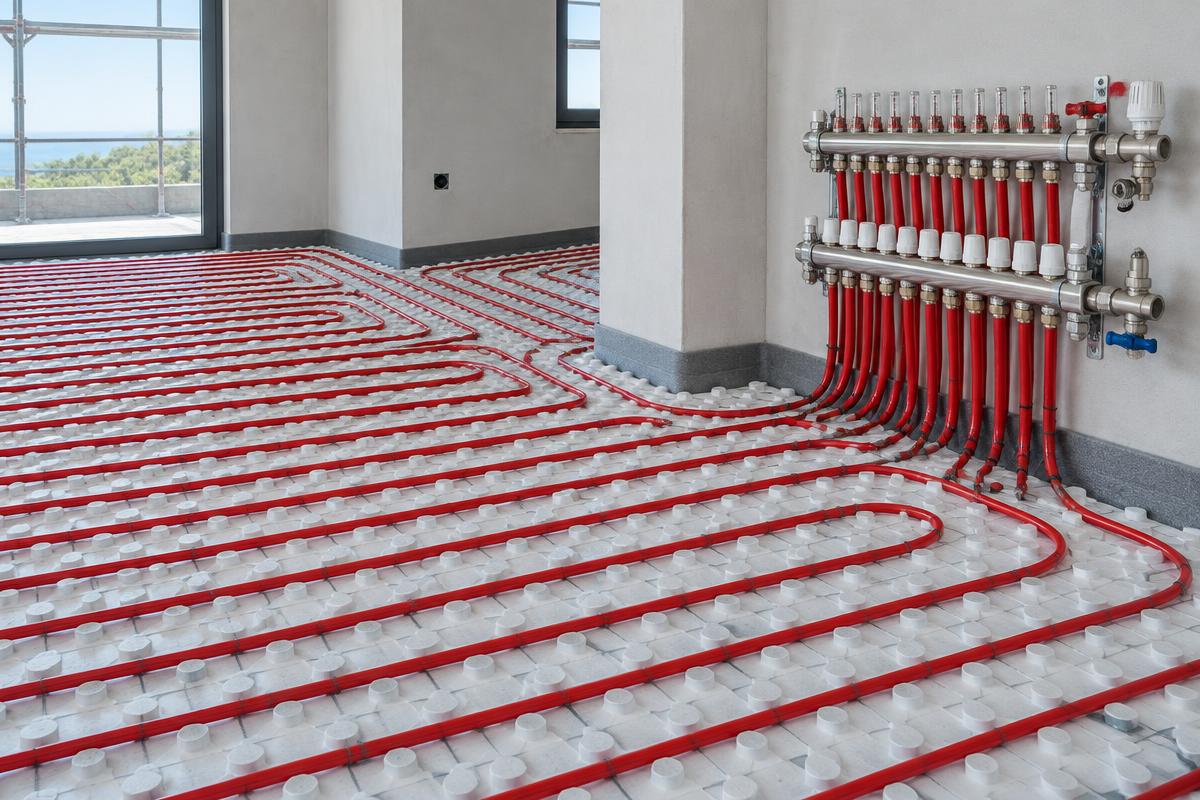
Underfloor heating acts as a massive heating element under our feet. Its main difference from classic radiators is the water supply temperature. While radiators require water at 65-75°C, underfloor systems operate efficiently at 35-45°C.
Advantages
- Uniform distribution: Heat is diffused evenly from bottom to top, eliminating cold spots.
- Aesthetics and Space: Absence of visible units, allowing full freedom in furniture placement.
- Hygiene: Less dust circulation and dryness in the atmosphere compared to radiators.
- Compatibility with Heat Pumps: Due to low temperatures, the maximum coefficient of performance (COP) is achieved.
Disadvantages
- High installation cost: Approximately 40-60% more expensive than radiators.
- High inertia: It takes several hours to heat the house (not recommended for holiday homes).
- Floor limitations: Requires specific specifications for tiles or wood (glued-down).
2. Classic Radiators: The reliable and immediate solution
Heating radiators (panel or aluminum) remain the dominant solution in the Greek market, mainly due to their speed of response and lower initial cost.
Advantages
- Speed: The house warms up within 20-40 minutes from the moment the thermostat is turned on.
- Low maintenance cost: Easy access and replacement of components.
- Flexibility: Can be easily installed in existing homes without ripping up floors.
Disadvantages
- Uneven heating: Heat near the unit, cold in the corners, and heat concentration at the ceiling.
- Space consumption: Radiators take up valuable square footage and limit decoration options.
3. Cost comparison: Installation vs. Operation
In Greece, for a 100 sq.m. single-family house, an underfloor installation (pipes, insulation, screed, manifolds, labor) usually ranges between €4,500 - €6,500, excluding the heat source. The corresponding installation with panel radiators costs approximately €2,800 - €4,000.
However, operational economy is the "key." Underfloor heating can offer energy savings of 15-25% compared to radiators, especially when combined with a heat pump. Over a decade, the difference in installation cost is often offset by lower electricity or fuel bills.
4. Technical requirements and limitations
Before deciding, you must consider the "height" of the floor. Underfloor heating requires at least 8-10 cm of height for insulation and thermal screed. If the house has low door headers, the installation becomes difficult or impossible without structural changes.
Also, water quality is critical. In underfloor systems, cleaning the circuit every 5-7 years is necessary to avoid sludge (deposits) that reduces efficiency.
5. When to choose which?
The choice is a matter of lifestyle and technical specifications:
- Choose Underfloor if: You are building a new house, intend to use a heat pump, have small children who play on the floor, and the house is your primary residence.
- Choose Radiators if: You are renovating an apartment without changing floors, use the house only on weekends, or have a limited initial budget.
Frequently Asked Questions (FAQ)
1. Can I put a wooden floor over underfloor heating?
Yes, provided it is "glued-down" and suitable for heating (usually semi-solid or specific types of oak). Floating floors with underlay act as insulators and reduce efficiency.
2. How long does it take for a house with underfloor heating to warm up?
Due to the thermal inertia of the concrete, it takes from 12 to 24 hours for the installation to reach full efficiency from a completely cold state. For this reason, underfloor heating is never turned off completely in winter but works with compensation.
3. Which system has a longer lifespan?
Underfloor pipes (PEX or Pert) have a lifespan of over 50 years, as they do not rust. Iron panel radiators may show corrosion after 20-25 years, depending on water quality.
Conclusion
Underfloor heating is undoubtedly the highest quality system in terms of comfort and long-term economy, especially in southern Greece where the need for rapid temperature changes is lower. However, radiators remain an honest and effective solution for those seeking speed and low entry costs. Always consult a mechanical engineer for a heat loss study before the final purchase.