
Why choose underfloor heating for a renovation?
Underfloor heating is no longer a privilege exclusive to new buildings. With advancements in materials, installing it in existing buildings during a renovation is now one of the most popular choices in Greece. Key advantages include uniform heat distribution, space saving due to the absence of radiators, and excellent synergy with modern energy sources such as heat pumps.
However, implementing it in older homes requires careful planning. Unlike new construction, we face limitations regarding height, structural load, and existing building insulation.
Types of systems for existing floors
In a renovation, the choice of system depends primarily on the available height. We distinguish two main categories:
1. Wet Installation System (Classic)
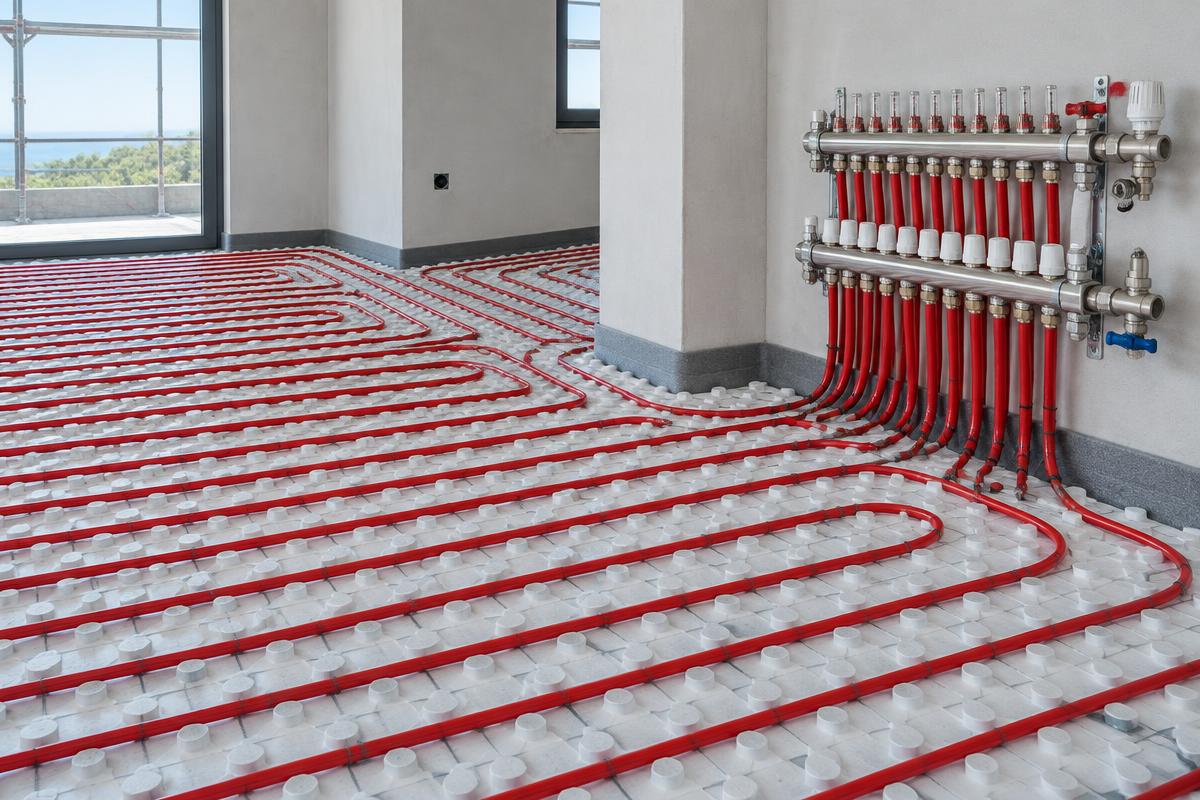
This is the traditional method where pipes (usually PEX-a or Pert 16-17mm) are placed on thermal insulation studded panels and covered with thermal screed (cement mortar). It requires a total height of 7-10 cm, which is often difficult in older apartments due to interior door frames.
2. Dry Installation & Low-Profile Systems
This is the ideal solution for renovations. Special low-profile panels (from 12mm to 20mm) and thinner pipes (e.g., 10mm or 12mm) are used. The total thickness, including the covering, may not exceed 2.5-4 cm. Their advantage is low thermal inertia, which means the room heats up much faster than with the classic system.
Installation stages step-by-step
Proper work sequence ensures the longevity of the system and prevents future leaks:
- Removal of old flooring: Removal of tiles or wood and cleaning the base.
- Leveling: If the substrate is not level, a self-leveling material is required.
- Installation of perimeter edge insulation: A critical step to absorb floor expansion.
- Laying insulation and piping: Positioning panels and laying out circuits according to the design (usually in a snail/spiral pattern).
- Pressure testing: Before covering, the system is pressurized at 6 bar for at least 24 hours.
- Final covering: Application of special screed or tile adhesive.
Cost analysis: What you will pay in Greece
The cost of underfloor heating in a renovation varies depending on the materials and the scope of the project. Note that the prices below are market estimates (excluding VAT):
- Materials & Labor (Classic): €35 - €50 per sq.m. (including insulation and manifold).
- Dry Installation Systems: €55 - €85 per sq.m. due to the higher cost of specialized panels.
- Thermal Screed/Mortar: €8 - €15 per sq.m.
- Heat Pump: For a 100 sq.m. house, the purchase and connection cost of a pump ranges from €4,500 to €7,500.
Overall, for an average 100 sq.m. apartment, a full installation with a heat pump can cost between €9,000 and €13,000, offering payback in 5-7 years through fuel savings.
Pitfalls and technical mistakes to avoid
As technicians, we often encounter mistakes that could have been prevented during the design phase:
- Insufficient insulation under the pipes: If you don't insulate properly, some heat will be lost to the floor slab below.
- Not using expansion joints: On surfaces over 30-40 sq.m. or lengths over 8 meters, joints are mandatory to prevent tiles from cracking.
- Wrong final flooring choice: Not all laminate or wooden floors are suitable. Look for the compatibility symbol for underfloor heating.
- Omission of heat loss calculation: Underfloor heating is not "magic." If the house has old frames and poor insulation, the system might not be able to cover losses on very cold days.
Frequently Asked Questions (FAQ)
1. Can I install underfloor heating over my old mosaic floor?
Yes, it is possible with low-profile systems, provided the mosaic is stable and a suitable adhesion primer is used.
2. How much will my floor be raised?
In the best-case scenario (dry installation system), the floor will be raised by about 3-4 cm in total, including the final tile.
3. Does underfloor heating require maintenance?
Maintenance is minimal. A check of the circulators and a chemical cleaning of the circuits (sludge removal) is required every 5-8 years to maintain efficiency.
4. Can it be combined with a natural gas boiler?
Certainly. However, it requires the installation of a mixing assembly (mixing valve) so that the water entering the floor does not exceed 45°C, while the boiler operates at higher temperatures.
Conclusion
Installing underfloor heating in a renovation is an investment that upgrades the quality of life and the value of the property. Although the initial cost is higher than classic radiators, the comfort and low consumption make it the ideal solution for the modern Greek home. The key to success lies in the right choice of system (classic vs. dry installation) and insisting on a proper heat loss study before starting the work.