
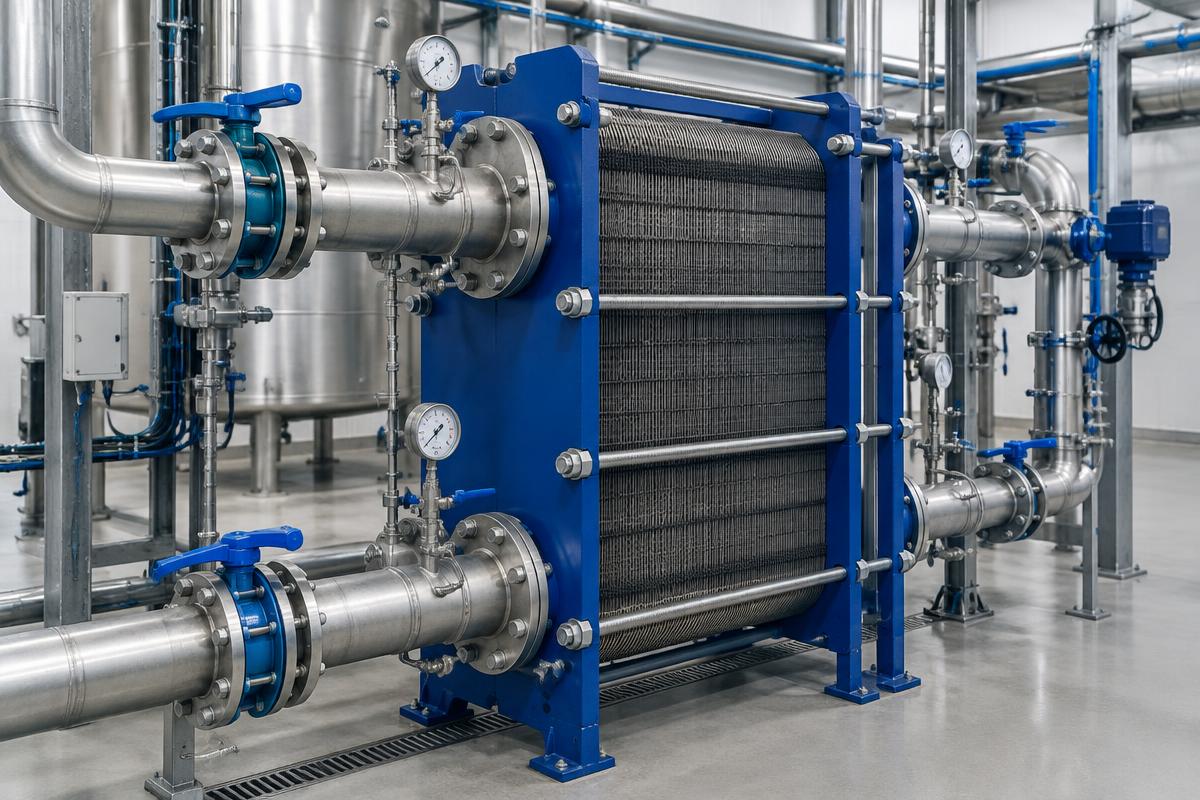
Introduction to how heat exchangers work
In modern heating and Domestic Hot Water (DHW) production systems, the heat exchanger is the heart of energy transfer. Its primary function is to transfer heat from one medium (e.g., boiler water) to another (e.g., tap water or water circulating in radiators) without the two fluids coming into direct contact. For a homeowner, a well-maintained heat exchanger means low fuel consumption and an immediate hot water response. For a technician, it is the component that requires the most careful maintenance due to its sensitivity to limescale deposits.
Key types of heat exchangers in residential and industrial systems
There are various exchanger technologies, each with specific applications:
- Plate Heat Exchangers: The most common type in wall-mounted gas boilers. They consist of thin stainless steel plates, which are either brazed or gasketed. They offer a huge heat exchange surface area in a very small volume.
- Shell and Tube Heat Exchangers: Used primarily in large installations and industries. They are more resistant to high pressures but occupy a lot of space and are less efficient on a small scale.
- Coaxial Heat Exchangers: Usually found in heat pumps, where one pipe is located inside another, allowing heat exchange between the refrigerant and water.
Why does the plate heat exchanger excel in modern heating?
High efficiency and economy
Due to the corrugated design of the plates, intense turbulence is created in the water. This increases the heat transfer coefficient, allowing the system to produce hot water almost instantaneously. Additionally, the low water content means the boiler does not waste energy heating large masses of liquid that will remain unused.
Compact dimensions
A plate heat exchanger the size of a small book can transfer the same amount of heat as a tubular exchanger two meters in length. This has enabled the construction of the wall-mounted boilers we all know, which can be easily installed on balconies and in kitchens.
The problem of fouling and limescale
In Greece, water in many areas (especially in Attica, the Peloponnese, and the islands) is classified as “hard,” meaning it has a high concentration of calcium and magnesium salts. When water is heated above 55-60°C, these salts crystallize and adhere to the plates of the heat exchanger. This is what we call “fouling.”
The consequences of fouling are:
- Reduced efficiency: The limescale acts as an insulating material. The boiler works harder and consumes more gas, but the tap water comes out lukewarm.
- Temperature fluctuations: The classic phenomenon where the water in the shower alternates between hot and cold.
- Noise and overheating: The circulator struggles to push water through the narrow passages that have become clogged, leading to premature wear of components.
Plate heat exchanger cleaning process
Cleaning must be performed exclusively by a licensed technician, as it involves the use of chemicals and the disassembly of boiler components. The process usually follows these steps:
1. Isolation and removal
Shut off the water supply valves and drain the boiler circuit. Remove the heat exchanger (usually held by two torx screws or clips). Care must be taken with the O-rings, which should be checked for damage.
2. Chemical circulation (Descaling)
For a plate heat exchanger that is not completely clogged, we use a special cleaning pump. We circulate a mild acid solution (usually citric or phosphoric acid with corrosion inhibitors) for 30-60 minutes. The acid dissolves the calcium carbonate (limescale), turning it into carbon dioxide and soluble salts.
3. Neutralization and rinsing
After the acid treatment, it is necessary to pass an alkaline solution to neutralize any residual acidity that could corrode the stainless steel. Finally, rinse with plenty of clean water.
Frequently Asked Questions (FAQ)
How often should the heat exchanger be cleaned?
There is no standard time, as it depends on the water hardness of the area. In areas with very hard water, a check every 2 years is necessary. If you notice a drop in hot water pressure, that is the first indication.
Can I use plain vinegar for cleaning?
Vinegar is too weak for the hard deposits that build up in a boiler. Furthermore, it does not contain corrosion inhibitors, which can damage the copper/silver brazing of the heat exchanger.
How can I prevent the buildup of limescale?
The best solution is to install a polyphosphate crystal filter on the cold water inlet of the boiler or a central water softener if the problem is severe throughout the house.
Conclusion
The plate heat exchanger is a marvel of thermal engineering that provides us with comfort and economy. However, its “Achilles' heel” is limescale. Proper maintenance, timely chemical cleaning, and the use of protective filters are the three keys to ensuring your boiler operates efficiently for many years, avoiding costly component replacements.