
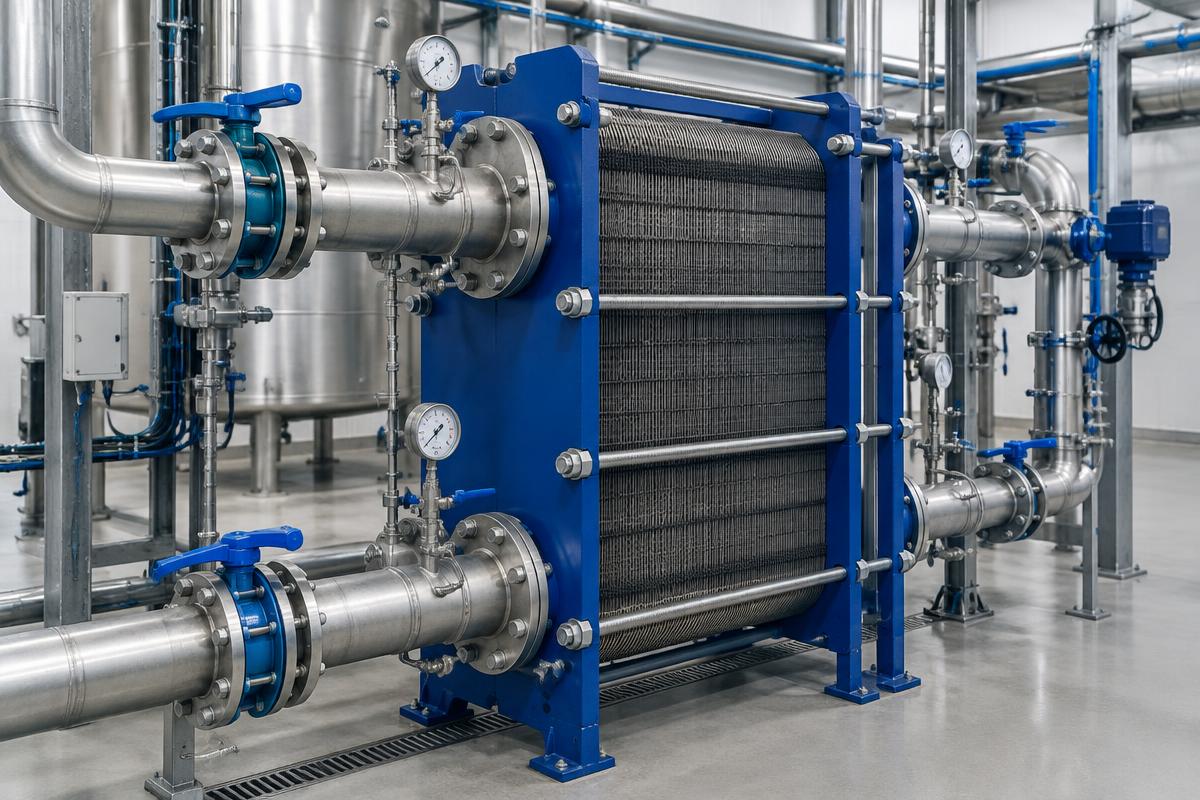
How the performance of a heat exchanger is affected
A heat exchanger transfers energy between two fluids, usually without mixing them. In an industrial installation, it may heat process water, cool oil, or recover heat from a hot stream. Its performance depends on the heat transfer surface, inlet temperatures, flow rates, and the condition of the surfaces separating the fluids.
Under steady operation, the transferred thermal power is described by the relation Q = U × A × ΔTlm. U is the overall heat transfer coefficient, A is the heat transfer surface, and ΔTlm is the logarithmic mean temperature difference between the streams. Depending on the flow arrangement, a correction factor may also be required. Deposits add thermal resistance and reduce U, limiting the heat transferred under the same operating conditions.
Practically, this may appear as an inability to reach the desired outlet temperature, longer heating times, or increased demand on boilers and chillers. However, the same symptom can arise from a load change or insufficient flow. Therefore, diagnosis should not be based solely on the observation that "the water is not getting warm enough."
The main causes of reduced heat transfer
Surface pollution, also known as fouling, does not have a single form. The composition of the fluids, wall temperatures, flow velocities, and downtime periods affect the type and rate of deposit formation.
- Scale and inorganic deposits: often appear in water circuits, depending on hardness, chemistry, and operating temperatures.
- Sludge and suspended solids: particles, rust, and corrosion products accumulate in tubes or channels, especially where velocity is low.
- Biological fouling: under suitable conditions, microorganisms form biofilms, mainly in open cooling circuits.
- Organic deposits: oils, fats, or production residues adhere to surfaces and hinder heat transfer.
- Corrosion and mechanical damage: worn plates, tubes, or gaskets can cause leakage, internal bypass, or fluid mixing.
However, it is not always a problem with the exchanger itself. A clogged filter, a partially closed valve, air in the circuit, or a pump malfunction reduce flow and directly affect performance. In steam systems, problems with condensate removal or non-condensable gases can also limit heating.
Which measurements indicate the need for inspection
The most useful reference is a set of measurements taken when the exchanger is clean and operating correctly. Inlet and outlet temperatures on both sides, flow rates, pressure drop on each side, and installation load are recorded. Subsequent measurements are compared under similar conditions, not just at the same time on different days.
An increase in pressure drop at the same flow rate is an indication of cross-section restriction due to deposits or blockage. However, it is necessary to check the measuring points to ensure that the resistance of an external filter or valve is not included. Furthermore, pressure drop is affected by fluid temperature and viscosity, especially in oils.
Reduced thermal power under comparable conditions indicates degradation of heat transfer. For a fluid without phase change, power is estimated from mass flow, specific heat capacity, and the inlet-outlet temperature difference. A temperature difference by itself is not enough: it can increase because the flow rate decreased, without an increase in the power delivered.
A thin layer of scale can significantly reduce thermal efficiency without a large change in pressure drop. Conversely, intense hydraulic resistance does not by itself prove a problem of thermal conductivity. A combined evaluation of temperatures, flows, and pressures is safer than any single symptom.
When is cleaning needed and how is the method selected?
Cleaning is necessary when technical evaluation shows that deposits are restricting operation or when required by the process's hygiene standards. There is no universal interval for all exchangers. Priority is given to manufacturer limits, production requirements, and the trend of measurement changes.
Before work is scheduled, filters, valves, pumps, sensors, and supply conditions are checked. Once fouling is confirmed, a method compatible with the exchanger type, construction materials, gaskets, and nature of the deposits is selected.
- Chemical cleaning with circulation: applied where on-site cleaning is permitted, with an approved solution and controlled parameters. Proper flushing and waste management are required.
- Mechanical cleaning: used on accessible surfaces or tubes, with tools that do not damage the metal. Pressure and tools are selected according to specifications.
- Disassembly: in gasketed plate heat exchangers, it allows for inspection of plates and gaskets. Reassembly requires the correct sequence of plates and adherence to the specified tightening dimension.
Not all acids are suitable for all metals. Improper chemistry can attack stainless surfaces, brazing, or elastomers. Work must be performed by qualified personnel, with isolation and lockout/tagout of energy sources, pressure relief, safe temperatures, and personal protective equipment. If there is a suspicion of leakage or fluid mixing, integrity testing is required, not just cleaning.
Prevention and confirmation of restoration
After cleaning, restarting is not enough. Tightness, proper operation, and thermal and hydraulic performance under comparable conditions are checked. The new record becomes a reference point for maintenance. If performance does not return to normal, residual deposits, incorrect assembly, internal bypass, or different actual load requirements are examined.
Prevention includes proper filtration, water treatment based on analysis, corrosion control, and maintenance of specified flow rates. In open circuits, organized management of biological fouling is also needed. Frequent water makeup in a closed circuit must be investigated, as it can introduce additional scale and oxygen.
A measurement log helps schedule maintenance before production is affected. The goal is not the most frequent cleaning possible, but timely intervention with the least necessary stress on the equipment.
Frequently Asked Questions
How often should a heat exchanger be cleaned?
The interval depends on the fluids, water quality, operating hours, and application requirements. It is determined by the manufacturer's instructions and recorded performance changes, not by a general rule of annual cleaning.
Can there be scale without an increase in pressure drop?
Yes. A thin but thermally insulating deposit can limit heat transfer without significant blockage. This is why differential pressure must be evaluated together with temperatures and flows.
Are all plate heat exchangers cleaned by opening them?
No. Gasketed plate heat exchangers can usually be disassembled according to their instructions. Brazed and other non-dismountable types do not open for routine maintenance and require a compatible cleaning method, if permitted.
When is cleaning not enough?
When there are perforations, cracks, severe corrosion, gasket failure, or insufficient sizing. Then repair, component replacement, or a review of the heat exchanger selection is needed, following a technical diagnosis.