
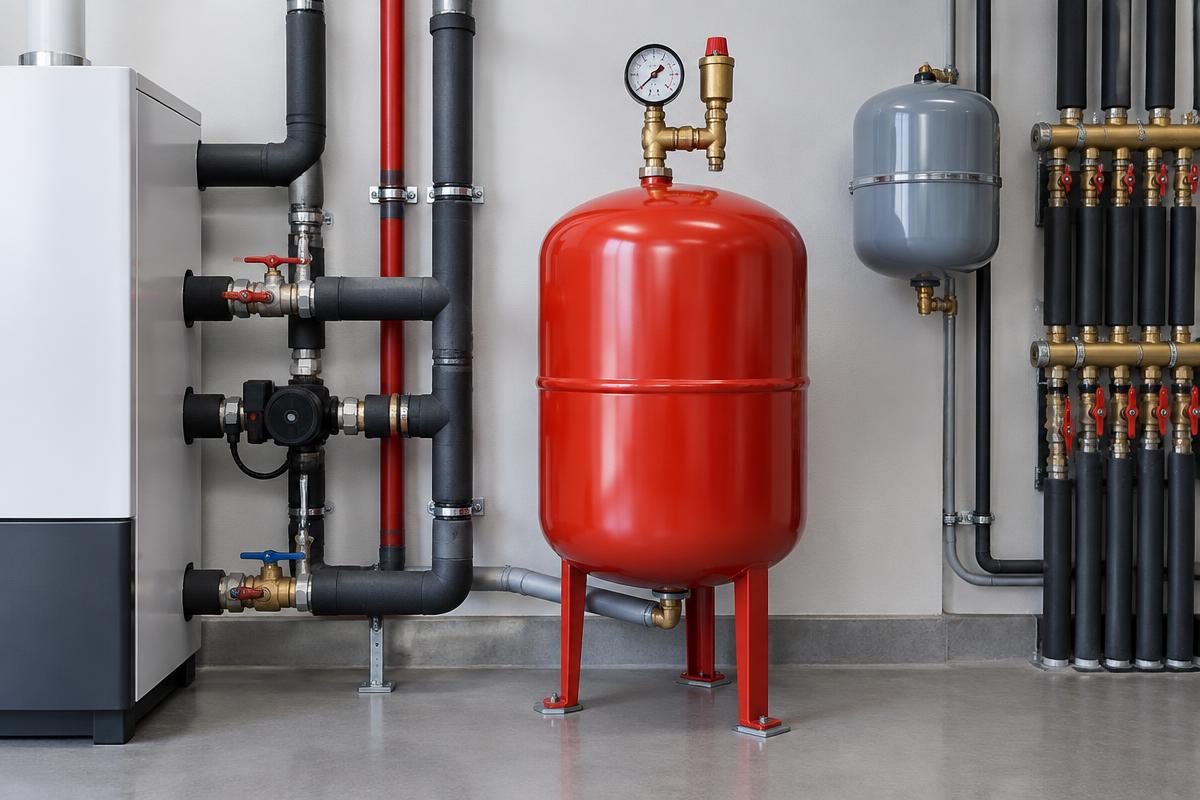
Introduction to the operation of the expansion vessel
One of the most critical components in any closed heating circuit, whether it is an oil boiler, gas boiler, or heat pump, is the expansion vessel. Its function is simple but vital: it absorbs changes in water volume as it heats up. According to the laws of physics, water expands when heated. In a closed piping system, if there were no space for this extra mass, the pressure would rise sharply, causing damage to radiators, piping, or the boiler itself.
As a technician, I often see owners panic when they see the pressure gauge hitting the "red zone" or the safety valve dripping. In most cases, the culprit is a deflated or punctured expansion vessel.
Why does the pressure in the circuit rise?
The pressure in a properly adjusted system typically fluctuates between 1.2 and 1.5 bar when the water is cold. When the heating is running, it is normal for it to rise slightly (e.g., to 1.8 - 2.0 bar). However, if the pressure exceeds 2.5 or 3 bar, we have a problem.
Air loss in the vessel
Inside the vessel, there is an elastic membrane that separates the water from the compressed air (or nitrogen). Over time, air can leak from the valve (similar to a car tire valve) located at the back of the vessel. Without this air "cushion," the water has nowhere to expand, causing the pressure to spike immediately as soon as the burner ignites.
Punctured membrane
If the elastic membrane is punctured, the vessel fills entirely with water. In this case, the vessel becomes completely useless, and the system pressure becomes uncontrollable.
Problem with the automatic filler
Sometimes the pressure rises because the automatic filler (the valve that adds water to the network) is faulty and continuously lets in water from the supply, even when the system is cold.
How to tell if the expansion vessel has a problem
There are some classic signs that indicate a malfunction of the vessel:
- The safety valve is dripping: When the pressure exceeds 3 bar, the valve opens to protect the system.
- Large pressure fluctuations: The pressure is 1 bar when the system is cold and goes to 2.8 bar as soon as the radiators heat up.
- Frequent need for bleeding: If the vessel has lost air, air pockets may form at the highest points of the installation.
- "Clinking" sound: If you tap the vessel lightly and it sounds "full" (like tapping a wall) over its entire surface, then it has most likely filled with water.
Step-by-step: How to check and inflate the vessel
Checking the expansion vessel should be done at least once a year during maintenance. Follow these steps:
1. Isolation and decompression
We cannot accurately measure the air pressure if the vessel is under the pressure of the mains water. We must close the boiler valves and drain water from the network (e.g., from a radiator or the drain valve) until the pressure gauge reads 0 bar.
2. Measuring air pressure
Using a precision pressure gauge (like those for tires), we measure the pressure at the vessel valve. If water comes out of the valve, the membrane is punctured, and the vessel needs replacement.
3. Inflation
If the pressure is low (e.g., 0.5 bar), we use a pump or compressor to bring it to the desired value. The correct air pressure for an average home is usually 1.2 - 1.5 bar, depending on the building's static height.
4. System restoration
After inflating the vessel, we open the automatic filler to bring the water pressure to 1.5 bar and bleed the radiators.
When is replacement required?
An expansion vessel has an average lifespan of 5 to 10 years. Replacement is mandatory when:
- The membrane is punctured (water comes out of the air valve).
- The vessel body shows severe rust or corrosion.
- The vessel loses its air very quickly (e.g., within a month) despite tightening the valve.
Technician's tip: When replacing, choose a vessel with the appropriate capacity (liters). A vessel that is too small will be constantly strained, while a larger one offers greater safety.
Frequently Asked Questions (FAQ)
How much pressure should the expansion vessel have?
Typically, the air pre-charge pressure should be 0.2 bar less than the operating water pressure (cold system). For a two-story residence, 1.2 - 1.5 bar is the ideal value.
Why does the safety valve drip while the pressure is at 2 bar?
This happens if the safety valve has "seated" due to scale build-up or if its spring has weakened due to frequent activations. In this case, the valve must be replaced.
Can I inflate the vessel myself?
If you have basic knowledge and the right tools (pump, pressure gauge), you can. However, the correct decompression of water before inflation is the step where most people fail, leading to incorrect readings.
Conclusion
The expansion vessel is the "lung" of your heating system. Proper maintenance prevents water waste, protects the boiler from overpressure, and ensures the silent operation of the pipes. Do not neglect checking it during your annual burner maintenance.