
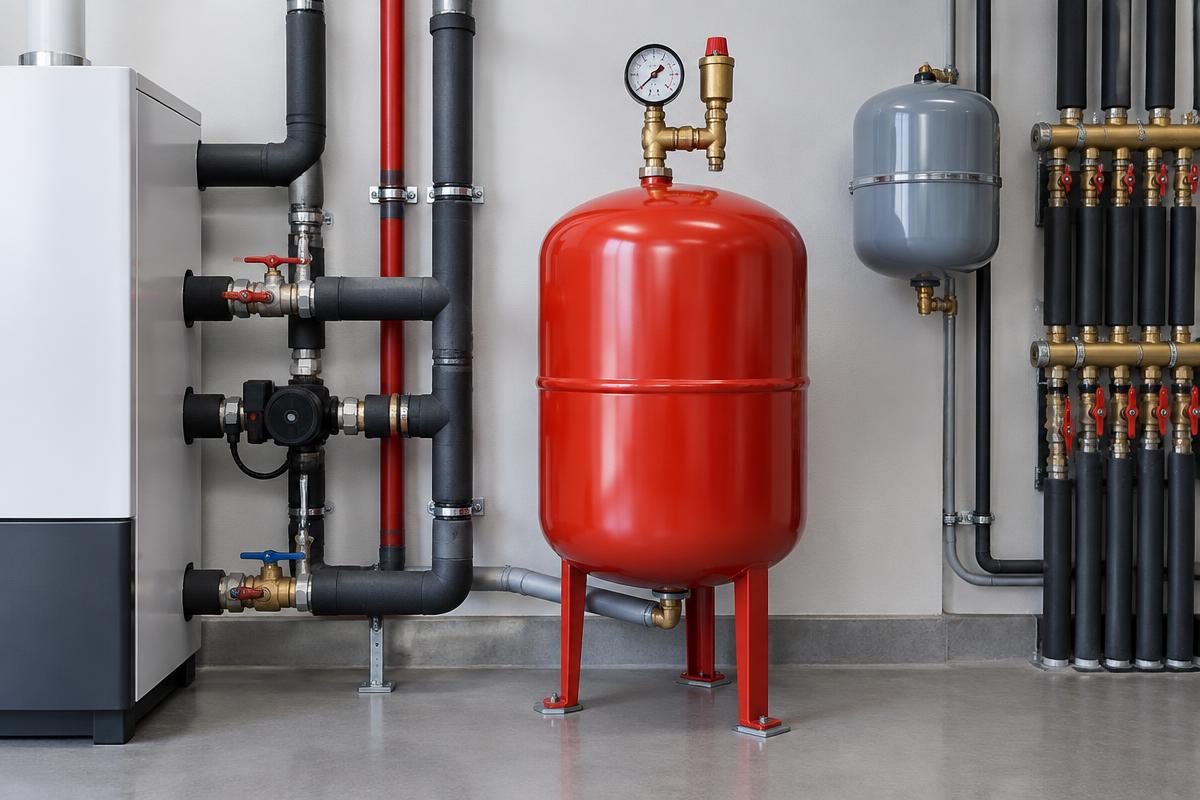
How an expansion vessel works in heating
Water increases in volume when heated. In a closed heating circuit, this change needs space to expand; otherwise, pressure rises sharply. The expansion vessel absorbs the volume increase and helps the installation operate within the specified pressure limits.
In standard closed vessels, a diaphragm divides the interior into two sides: the water side and the gas side. The latter has an initial pressure, the pre-charge, usually with nitrogen from the factory. As water enters the vessel, the gas is compressed, creating the necessary elastic margin.
Therefore, the fact that a vessel contains water does not in itself mean it is faulty. A problem exists when the useful expansion margin is lost, for example, because the pre-charge is low, the diaphragm is ruptured, or the vessel is too small for the installation.
Typical symptoms include a large pressure difference between cold and hot circuits, discharge from the safety valve, and the need for frequent water top-ups. However, none of these alone prove that a vessel replacement is needed.
Before measuring: cold circuit and zero water pressure
The pre-charge is only measured correctly when the water side of the vessel is not under pressure. If the circuit remains full and pressurized, the reading on the gas valve is affected by the hydraulic pressure and does not reliably reveal the actual pre-charge.
Before any work, the heating system is switched off according to the equipment instructions and the water is left to cool. Hot water and uncontrolled discharge can cause burns. Do not unscrew connections or valves on a pressurized system.
If there is an appropriate isolation and draining arrangement for the vessel, the technician can work locally. Otherwise, the corresponding circuit must be depressurized. It is not enough to simply close a valve: the water trapped between the valve and the vessel must also be released.
A suitable low-pressure gauge, access to the gas valve, and the technical specifications of the vessel are required. For a built-in boiler vessel, when access requires opening the equipment, the task should be assigned to a qualified technician.
How to check nitrogen pressure step by step
- Locate specifications: check the vessel label, capacity, factory pre-charge, and maximum permissible pressure. The factory setting is not necessarily the correct one for every installation.
- Depressurize the water side: the vessel is isolated and drained via the prescribed procedure, or the circuit is depressurized. The connection to the appropriate discharge point remains open during checking and adjustment so that no backpressure is created.
- Measure at the gas valve: remove the protective cap and connect the gauge to the Schrader-type valve, where present. Compare the reading with the required pre-charge of the installation.
- Check for water: if water appears from the gas valve, there is a strong indication of a ruptured diaphragm. Simple recharging with gas will not repair this fault.
- Adjustment and leak check: if the vessel is suitable for continued operation, set the pre-charge and check the valve and pressure retention.
The valve should not be pressed repeatedly for quick tests. Each release removes gas and can noticeably alter the pre-charge, especially in small vessels. A simple gauge measures pressure, not the composition of the gas: it does not confirm that only nitrogen is inside.
For recharging, follow the manufacturer's instructions. When nitrogen is specified, use appropriate equipment with a pressure regulator operated by a technician. Never use oxygen or flammable gases.
Why the expansion vessel fills with water
Loss of pre-charge: over time, gas may be lost through the valve or due to the permeability of the diaphragm. Circuit pressure pushes more water into the vessel and reduces the available margin for absorbing expansion. This does not necessarily mean the diaphragm has torn.
Diaphragm rupture: when the separation between water and gas is lost, the vessel ceases to function as designed. Water in the gas valve is a characteristic finding. Usually, replacement of the vessel or the diaphragm is required, only if the specific model has a replaceable diaphragm.
Incorrect setting or insufficient capacity: excessively low pre-charge or high fill pressure consume part of the available capacity already in the cold state. A small vessel may also be insufficient after adding radiators, adding a buffer tank, or other increases in total water volume.
Problem outside the vessel: a closed valve or blocked connection prevents communication with the circuit. If the pressure rises even without heating, the filling mechanism and, where such an arrangement exists, a potential internal communication with the water supply network via a heat exchanger should also be investigated.
What pressure is needed and what to check afterwards
There is no single correct nitrogen pressure for all vessels. The pre-charge is determined based on the static height above the connection point, equipment requirements, and the system design study. As an indication, every meter of water column corresponds to approximately 0.1 bar of static pressure. This is a basis for calculation, not a fixed setting value.
The filling pressure with cold water is coordinated with the pre-charge and is usually set higher, according to design instructions. At the same time, it is verified that the required margin remains at maximum operating temperature before the safety valve activates. Capacity is selected considering water volume, temperatures, pressures, and any antifreeze.
After adjustment, communication between the vessel and the circuit is restored, filling and venting are performed, and the cold pressure is re-checked. A heating test follows, monitoring the pressure rise and checking for leaks. The vessel must not be left isolated during operation and the safety valve must never be blocked.
Frequently Asked Questions
Can I measure the pre-charge with a full installation?
Only if the vessel is properly isolated and its water side is fully drained. Otherwise, the measurement is affected by the circuit pressure and is not reliable as a pre-charge measurement.
If water comes out of the nitrogen valve, is it enough to add nitrogen?
No. This finding indicates a possible diaphragm rupture and requires technical verification. Adding gas does not repair the diaphragm nor does it ensure safe, stable operation.
Can I detect the fault by tapping the vessel?
Sound is not a reliable diagnostic method. It is influenced by construction, position, and the amount of water. A proper pre-charge measurement and checking the system's behavior are necessary.
How often is a check needed?
Follow the manufacturer's maintenance schedule, usually as part of the annual heating maintenance. An extraordinary check is needed when large pressure changes, frequent top-ups, or discharges from the safety valve occur.