
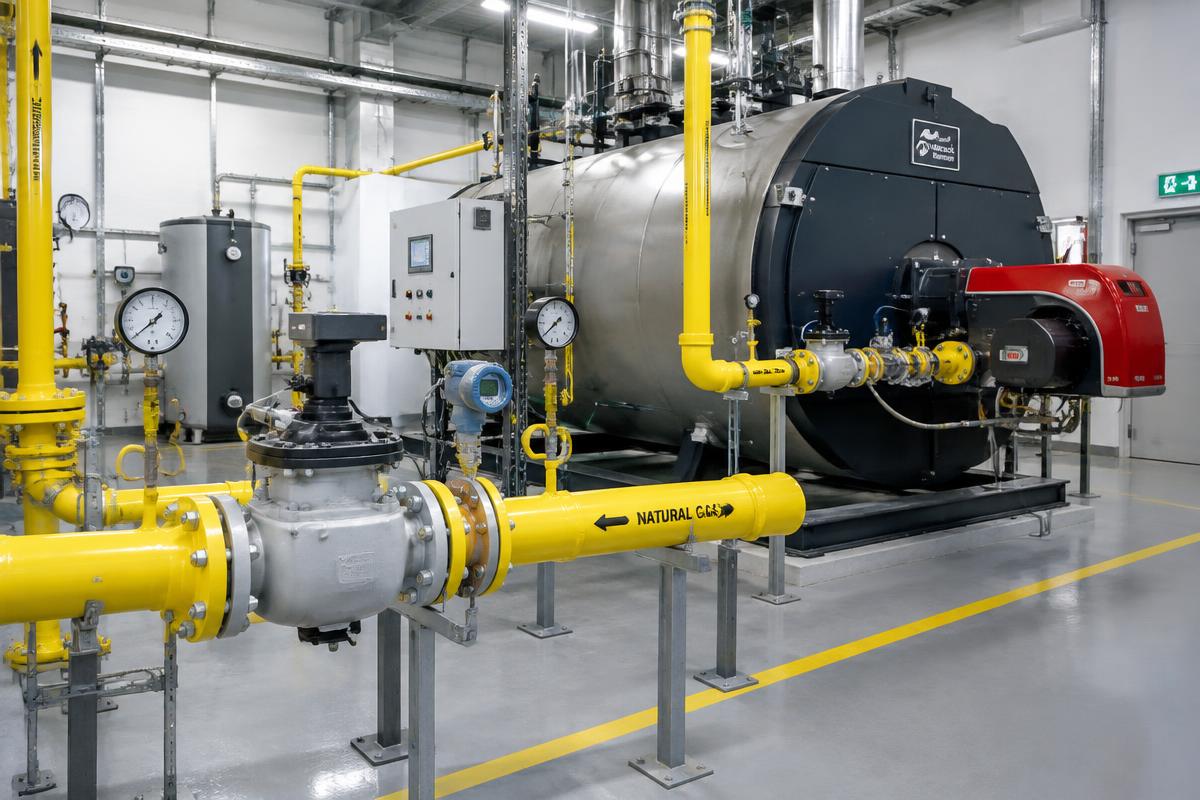
In an industrial setting, it is common for several boilers or other consumers to be supplied by the same central network. The fact that each burner operates correctly on its own does not necessarily mean the system will function properly when they all start at the same time.
What is simultaneous demand
The total supply required by the network depends on how many consumers are operating at the same time and at what load. Two large burners starting simultaneously may create a much higher instantaneous demand than usual.
How pressure is affected
If the central regulator, network supply, or piping cannot provide the required flow, the pressure in individual branches drops. This may trigger low-pressure switches (pressostats) or cause failed startups.
Why one burner affects another
All consumers share a portion of the same supply line. Thus, a large increase in flow in one branch can alter the pressure in the others as well.
Symptoms of insufficient common supply
Typical symptoms include: a burner operates normally on its own but trips when a second one starts, pressure drops sharply during peak hours, or startups become unstable when production load changes rapidly.
How to conduct a proper investigation
It requires simultaneous pressure monitoring at key points in the network and logging of consumer status. A single reading next to one burner is not always enough to identify the root cause.
Operational scheduling
In some facilities, staggered startup of large consumers reduces sudden load fluctuations. However, this is an operational strategy and not a substitute for an inadequately dimensioned network.
Conclusion
Industrial natural gas supply must be examined as a single system. When problems only appear with multiple consumers in operation, simultaneous demand is one of the first factors that should be analyzed.