
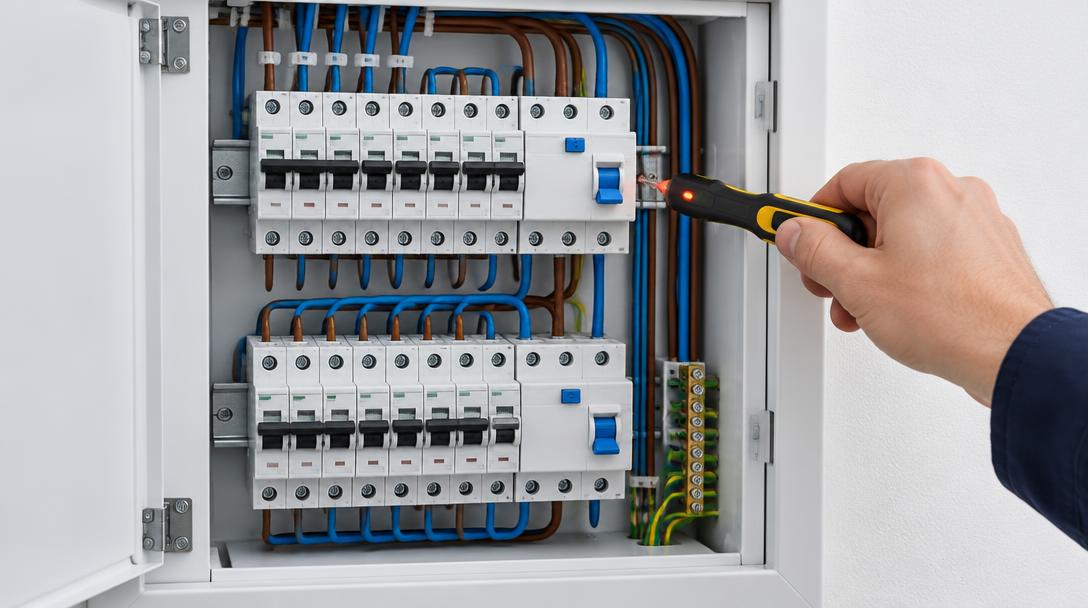
What does it mean when the automatic circuit breaker trips?
When an automatic circuit breaker frequently cuts off power, it is not just a nuisance that can be solved by simply flipping the switch back on. The protection device is reacting to a condition that requires investigation. Multiple devices might be running on the same line, there could be a fault in a device or cable, or a problem in the electrical panel itself. Repeated resetting without checking does not address the cause.
First, it must be clarified which device is tripping. What we refer to daily as a "fuse" is not always the same component:
- Miniature Circuit Breaker (MCB): protects the line from overload and short circuits. Usually marked with labels like B16 or C16.
- Residual Current Device (RCD): known as an RCD or GFCI, it detects differential current that may be due to a ground fault. It features a test button, usually marked TEST or T.
- Combined device, RCBO: provides protection from both overcurrent and leakage.
The distinction determines the correct diagnosis. The test button alone does not distinguish an RCD from an RCBO. Also, a 40 A rating on a simple RCD does not mean it protects against overload at 40 A. If you do not recognize the device, request identification from an electrician without removing the panel cover.
Overload: when the same line supplies too many loads
An overload occurs when the current on a line exceeds its designed operating capacity for a sustained period. A common example is the simultaneous use of a kettle, portable heater, and other high-power appliances on outlets belonging to the same circuit. A different outlet, even in another room, does not necessarily mean a different electrical line.
The MCB features a thermal mechanism that reacts to overload. This is why it may trip after a few minutes and not immediately. The time depends on the magnitude of the overcurrent, temperature, and whether the switch was already hot. A delayed trip is an indication of a possible overload, not proof.
For an indicative estimate on a 230 V single-phase supply, a nearly resistive load of 2,000 W draws approximately 8.7 A. Two such loads on the same line exceed a total of 17 A. The calculation is not an approval for use: the allowable load depends on the cables, installation method, outlets, and the protection device. For motors and other devices, additional characteristics are taken into account.
The solution may be to limit simultaneous operation or to install an independent line after a study. A power strip does not increase available power and is not a solution for concentrating heavy loads.
Short circuit, leakage, or faulty connection?
When the breaker trips instantly upon switching on a device, there is a suspicion of a short circuit or another severe electrical event. The short circuit may be in the power cord, the plug, the device itself, or the permanent installation. The magnetic protection of the MCB activates very quickly at high currents.
However, an instantaneous trip can also be related to high inrush current, as in motors or certain electronic power supplies. Choosing a different operating curve should not be done empirically. It requires verification to ensure the line remains properly protected and the required automatic disconnection in case of a fault is guaranteed.
If the RCD trips, different causes are examined: insulation degradation, moisture in an outdoor light fixture, a faulty water heater element, or a device leakage. Sometimes small leakages from several devices simultaneously contribute. Therefore, the trip does not necessarily mean that excessive power is being consumed.
Loose or oxidized connections can also cause dangerous local overheating. It is not guaranteed that such a fault will trip the MCB. A burning smell, discoloration, crackling sounds, or deformation in an outlet or the panel need immediate assessment, even if the power remains available.
What you can safely check
Safe user inspection is limited to observation and the normal handling of accessible switches and intact plugs. It does not include opening the panel, dismantling outlets, tightening terminals, or taking measurements on active circuits. The tripping of a switch does not prove that the entire panel is de-energized.
- Record the incident: which device tripped, which appliances were operating, and whether the trip occurred immediately or later.
- Observe conditions: was there rain, humidity, recent work, or the connection of a new device?
- Stop using the suspicious device: disconnect it only if the plug and outlet are intact, dry, and safely accessible. Do not touch charred or wet components.
- Avoid repeated tests: do not reconnect a device to confirm that it causes the trip.
Only when there is a clear case of overload, without smell, noise, moisture, or visible damage, can a reset be attempted after disconnecting the extra loads. If the device trips again or does not remain in the operating position, leave it off and call an electrician.
In the event of smoke, sparks, or a strong burning smell, move away from the area. Disconnect the supply only if this can be done without approaching the hazardous part. In case of fire, call emergency services and do not use water.
How diagnosis and proper restoration are performed
A licensed electrician does not only check if "the breaker is broken." They examine the matching of the MCB and wiring, the condition of connections, actual loads, and the operation of protections. Depending on the symptom, they perform measurements of current, insulation resistance, protective conductor continuity, fault loop, and RCD operation.
The solution may be repairing a device, replacing a worn outlet, fixing a connection, or creating a new circuit. If a defect is found in the MCB, it is replaced with a suitable device based on the installation's characteristics, not just any switch that fits in the panel.
Never install a larger breaker just to stop it from tripping. Increasing the nominal current without verification can leave the cable inadequately protected. Also, do not bypass the RCD and do not disconnect the grounding. For repeated trips, the technically correct solution is identifying the cause.
Frequently Asked Questions
Why does the breaker trip after a few minutes?
A common cause is an overload and the activation of thermal protection. However, it may be caused by a device that malfunctions when it heats up or another overheating condition. The trip time helps the diagnosis, but it is not sufficient on its own.
Why does the breaker trip without connected devices?
There may be hard-wired loads, such as a water heater or lighting, which have not been isolated. Possible causes are also wiring damage, moisture, or a problem with the device itself. Leave the circuit out of operation until it is checked.
Can I change a 16 A breaker to 20 A?
Not without a technical inspection. The choice depends on the cross-section and installation method of the conductors, the circuit components, and protection requirements. A higher nominal current does not fix a fault.
If the RCD trips, is one device always to blame?
No. The cause can be in a device, the permanent installation, or cumulative leakages from many loads. Proper measurements are needed for a safe conclusion, especially when the phenomenon appears intermittently or after rain.