Introduction to Industrial Pumps
In the world of industry and large building facilities, pumps are the "heart" of every fluid handling system. Whether dealing with heating and cooling circuits, wastewater treatment, or chemical transport, the correct pump selection determines not only the efficiency of the installation but also the long-term operational costs. As technicians, we know that an incorrect choice can lead to cavitation, premature wear of seals, and energy waste.
Main Types of Industrial Pumps
Pump categorization is primarily based on how they transfer energy to the fluid. The two main categories found in the market are:
1. Centrifugal Pumps
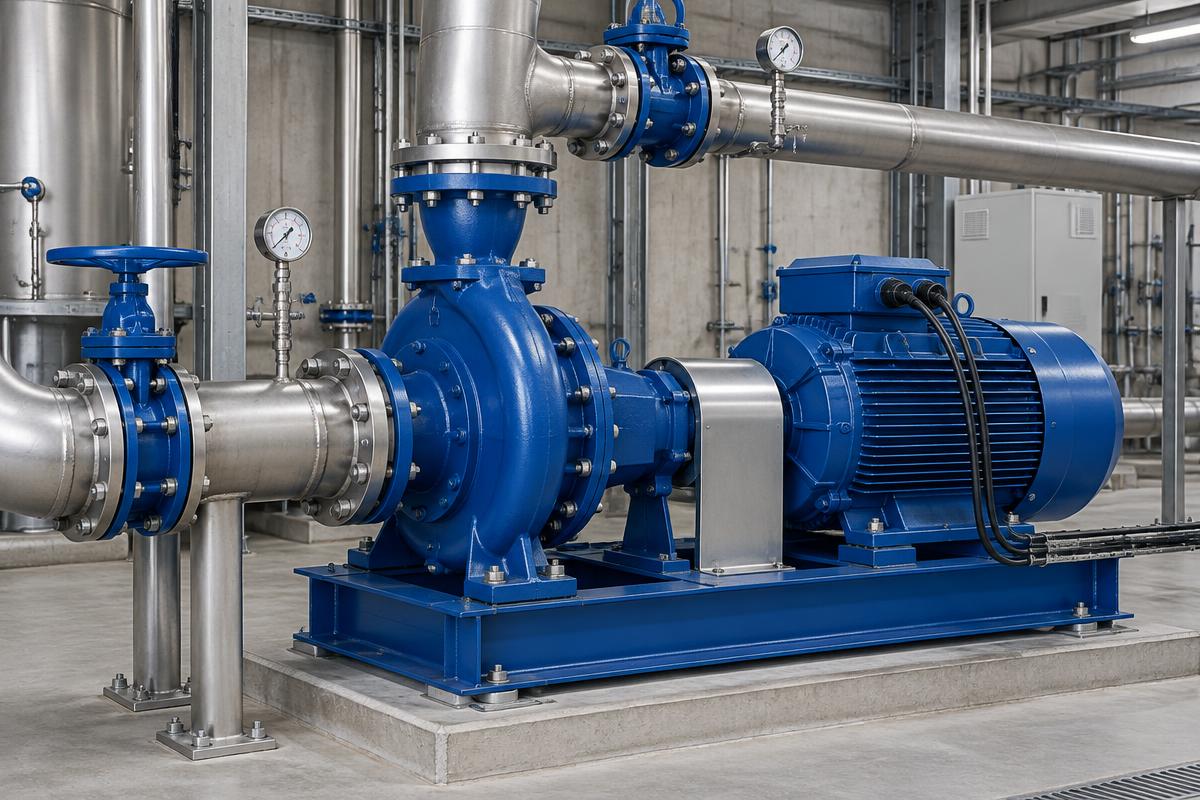
This is the most common type in industrial applications due to their simplicity and reliability. They operate by converting the kinetic energy of the impeller into pressure.
- Inline Pumps: Ideal for water circulation in HVAC systems.
- Multistage Pumps: Used where high head is required, such as in booster sets.
- Split-case Pumps: For very large water flow rates.
2. Positive Displacement Pumps
These pumps transfer a constant volume of fluid per cycle, regardless of discharge pressure. They are essential for high-viscosity fluids or precise dosing.
- Gear Pumps: For oils and viscous liquids.
- Piston Pumps: For extremely high-pressure applications.
- Diaphragm Pumps (AODD): Operated by compressed air, ideal for explosive or corrosive environments.
Selection Criteria for the Appropriate Pump
Selection should not be based solely on purchase price. There are critical technical factors that must be evaluated:
Flow Rate (Q) and Head (H)
These are the two basic elements. Flow rate is usually measured in m³/h (cubic meters per hour) and head in m.W.C. (meters of water column). The technician must calculate friction losses in piping, elbows, and valves to determine the actual Duty Point.
Nature of the Fluid
The liquid to be pumped determines the construction materials. For example:
- Heating water: Requires resistance to temperatures up to 110°C.
- Seawater: Requires pumps made of brass or high-quality stainless steel (e.g., AISI 316).
- Chemicals: Require special linings or seals made of Viton or Teflon.
NPSH (Net Positive Suction Head)
One of the most common mistakes is neglecting NPSH. If the available suction pressure is lower than the pump's required pressure, cavitation will occur, which destroys the impeller in a very short time.
Energy Efficiency and Inverters
In modern industry, the use of variable frequency drives (Inverters) is now mandatory. A pump operating at 80% speed consumes approximately 50% of the energy compared to full power. Choosing IE3 or IE4 class motors ensures compliance with European eco-design standards and drastically reduces operating costs.
Maintenance and Troubleshooting
Preventive maintenance is the only way to avoid expensive downtime. A proper plan includes:
- Checking bearing temperatures.
- Checking for leaks at the mechanical seal.
- Alignment of the coupling between the motor and the pump.
- Measuring vibrations to detect imbalances.
Frequently Asked Questions (FAQ)
1. Why is my pump making a loud noise as if there are stones inside?
This is a classic symptom of cavitation. It happens when liquid vaporizes due to low suction pressure. Check if suction filters are clogged or if the pump is oversized for the application.
2. When should I prefer a pump with a mechanical seal over gland packing?
A mechanical seal offers zero leakage and less maintenance, while gland packing is now mainly used in older applications or cases where controlled leakage is necessary for cooling.
3. What is the ideal operating point on the pump curve?
The ideal point is the BEP (Best Efficiency Point), where the pump has maximum efficiency. Operating too far to the left or right of the curve increases wear.
Conclusion
Selecting an industrial pump is not a simple equipment purchase process, but a technical study. By taking into account the system requirements, fluid type, and energy efficiency, you can ensure an installation that will operate seamlessly for decades. Always consult the manufacturer's charts and do not neglect regular maintenance.