
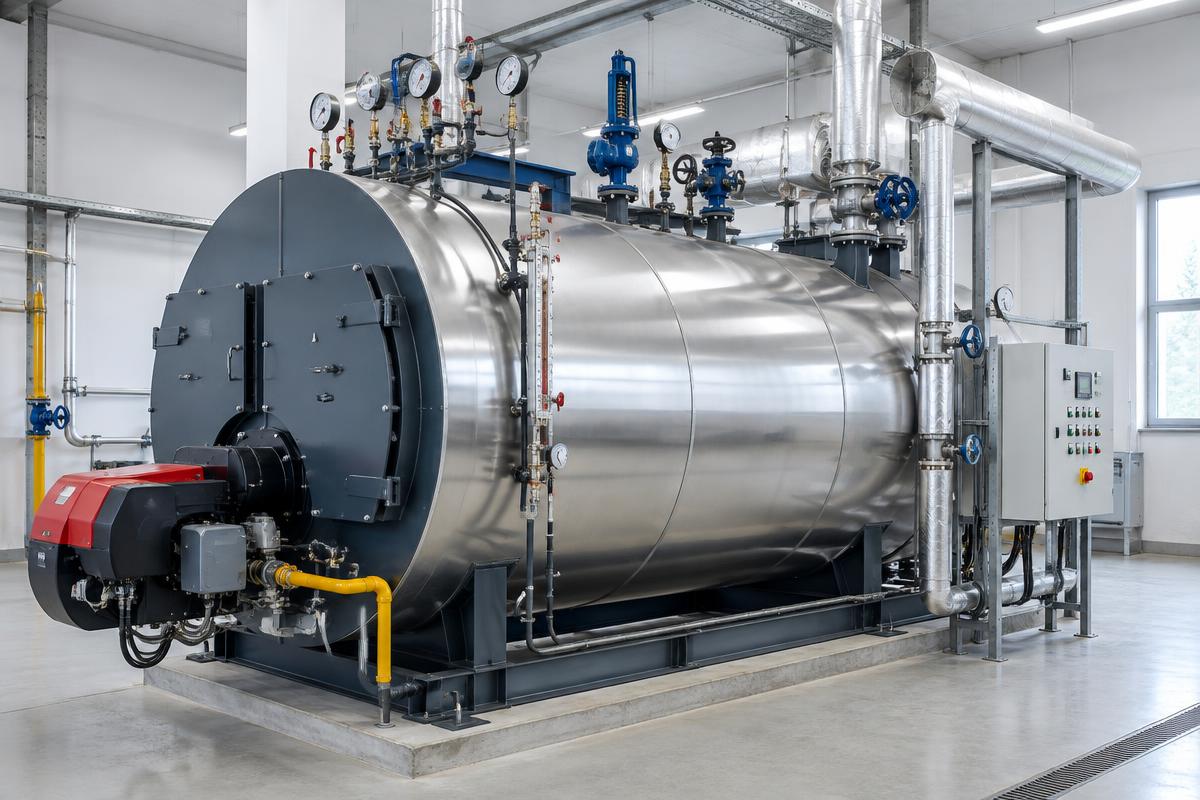
Introduction to Industrial Steam Production
The industrial steam boiler is the heart of the production process in sectors such as the food industry, textiles, chemical plants, and hospitals. Selecting the appropriate type of boiler is not just a matter of power capacity, but concerns energy efficiency, equipment longevity, and, above all, the safety of personnel and facilities.
In the Greek market, correct sizing and fuel selection (natural gas, LPG, or oil) directly affect operating costs. In this guide, we will analyze the technical specifications, categories, and critical control points for a steam boiler.
Basic Types of Steam Boilers
The categorization of steam boilers is mainly based on how heat is transferred from flue gases to the water. There are two main technologies:
1. Fire-tube Boilers
In fire-tube boilers, hot flue gases pass through tubes that are submerged in water. It is the most common type for small and medium industrial needs in Greece.
- Advantages: Robust construction, ease of maintenance, ability to handle sudden increases in steam demand (steam swings).
- Applications: Laundries, small dairy units, workshops.
2. Water-tube Boilers
Here, water circulates inside the tubes, and the flue gases are on the outside. They are mainly used in large industries that require steam at very high pressures (over 20-25 bar).
- Advantages: Rapid steam production, ability to operate at extreme pressures, high thermal efficiency.
- Disadvantages: Require very strict water treatment and have higher construction costs.
Energy Efficiency and Conservation
The efficiency of a modern industrial boiler ranges between 88% and 95%. However, the actual efficiency depends on additional heat recovery equipment:
- Economizers: Exchangers that use flue gas heat to preheat feed water. This can improve efficiency by 3-5%.
- Air preheaters: Use flue gases to heat the combustion air entering the burner.
- Excess air control: The use of O2 sensors in the chimney ensures that combustion takes place with the optimal air/fuel ratio, reducing losses.
- Insulation: Proper insulation of the boiler body and steam piping minimizes radiation losses.
Safety Rules and Legislation
A steam boiler is a pressure vessel, and its safe operation is strictly regulated by Greek and European legislation (e.g., PED 2014/68/EU directive). Critical safety systems include:
- Safety valves: Release pressure if it exceeds the design limit. They must be inspected and certified annually.
- Level indicators and low-water cut-offs: Operation without water (dry running) can lead to boiler failure.
- Safety pressure switches: Shut down the burner in case of overpressure.
- Periodic inspections: Inspection by a notified certification body is mandatory every 1 to 5 years, depending on age and type.
The Importance of Water Treatment
Mains water contains salts and dissolved gases that are enemies of the steam boiler. Without proper treatment, scale (limescale) is created, which acts as an insulator, reducing efficiency and causing metal overheating.
A complete system must include: Water softener for removing calcium and magnesium, Deaerator for removing oxygen and CO2 (which cause corrosion), and Chemical treatment with additives to maintain pH at alkaline levels.
Frequently Asked Questions (FAQ)
How often should the flue gas side be cleaned?
Usually once a year. The accumulation of just 1mm of soot can reduce efficiency by 2-3%. In oil-fired boilers, cleaning should be more frequent.
What is 'Blowdown' and why is it necessary?
It is the process of removing water from the bottom of the boiler to reduce the concentration of total dissolved solids (TDS). If TDS levels are high, foaming occurs, and water is carried over into the steam piping (priming).
Which fuel is more economical for steam production in Greece?
Natural gas remains the most efficient and clean solution, as it requires less maintenance and allows for the use of condensing boilers or advanced economizers. LPG is the alternative in areas without a gas network.
Conclusion
Investing in a modern industrial steam boiler requires careful planning. Proper selection of type, addition of heat recovery systems, and strict adherence to the maintenance and water treatment schedule ensure that your unit will operate with the lowest possible cost and maximum safety for many years.