
Why is annual maintenance essential?
Natural gas burner maintenance is not just a formal obligation imposed by law, but a critical process for the longevity of the heating system and the safety of the residents. Unlike oil, natural gas is a "clean" fuel, but this does not mean that the equipment does not wear out or accumulate pollutants.
A well-maintained burner ensures:
- Reduced consumption: Proper adjustment can reduce operating costs by up to 15%.
- Reliability: Prevention of breakdowns that usually occur on the coldest days of winter.
- Safety: Checking for gas leaks and proper exhaust ventilation to prevent carbon monoxide poisoning.
Stages of technical maintenance
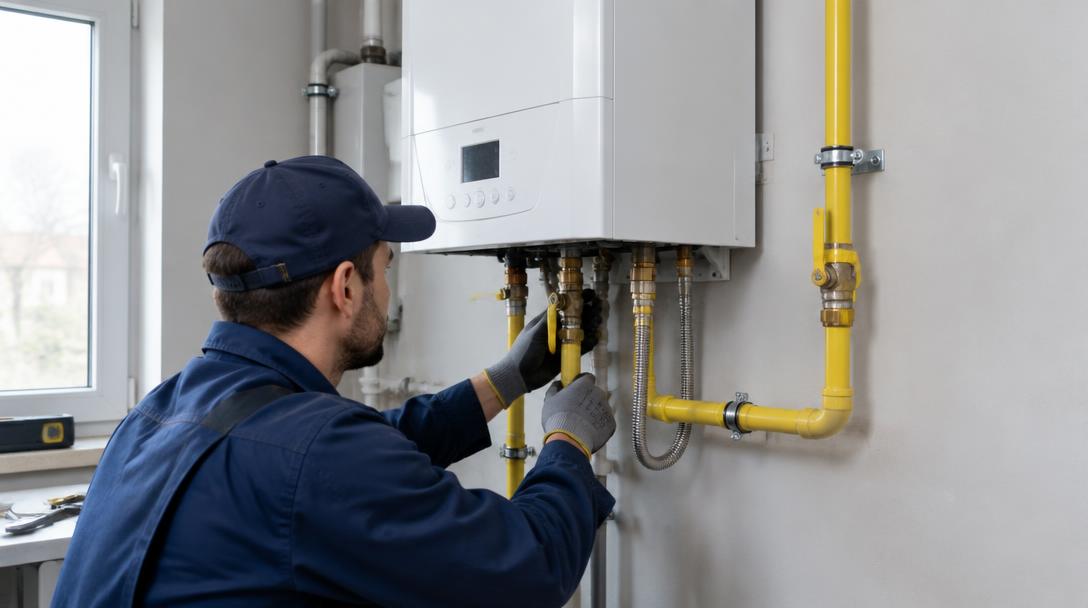
The process must be performed exclusively by a licensed gas fuel technician. Maintenance includes a series of actions concerning both the burner and the boiler.
Cleaning and component inspection
The technician begins by cleaning the combustion head and the ignition and ionization electrodes. The electrodes are vital, as one provides the spark to initiate combustion and the other "reads" the flame to keep the solenoid valve open. If they are covered in limescale or deposits, the boiler will frequently show errors (reset).
Cleaning the heat exchanger
In condensing boilers, the exchanger is the point where heat is transferred to the radiator water. Due to the nature of combustion, condensates (liquids) are created that can clog the passages. Cleaning with special brushes and water is necessary to maintain high efficiency.
Critical combustion adjustment
Combustion adjustment is the most technical part of the visit. The goal is to achieve the perfect air-to-fuel ratio. If there is too much air (excess), heat escapes through the chimney. If there is too little air, combustion is incomplete, producing dangerous carbon monoxide (CO) and soot.
The technician uses a digital flue gas analyzer, which measures:
- The percentage of Carbon Dioxide (CO2) or Oxygen (O2).
- The concentration of Carbon Monoxide (CO) in parts per million (ppm).
- The flue gas temperature.
- The combustion efficiency.
These values are compared with the manufacturer's specifications, and the technician adjusts the air supply and gas pressure at the valve outlet.
Safety and leak testing
No maintenance is considered complete without checking the piping for leaks. Using a special leak detection spray or a digital flammable gas detector, all connections from the meter to the burner are inspected.
Additionally, the following are checked:
- The expansion tank: Must have the correct nitrogen/air pressure to absorb water expansion.
- The safety valve: To ensure it will release pressure if necessary.
- The flow sensor and safety thermostat: Which stop operation in case of overheating.
The Inspection Sheet: The boiler's "passport"
Upon completion of the work, the technician must issue the Operation Inspection Sheet. This document lists the analyzer readings, efficiency, and the work performed. It is the official document certifying that the installation is safe and compliant with the guidelines of the EDA (Gas Distribution Company).
Frequently Asked Questions (FAQ)
How often should maintenance be performed?
Maintenance should be performed once a year, ideally before the start of the heating season (September - October), so that the device is ready for continuous operation.
What is a condensing boiler and does its maintenance differ?
Condensing boilers utilize the heat from water vapor in the flue gases. Their maintenance is more demanding, as it requires cleaning the condensate siphon and checking the seals (gaskets) that seal the combustion chamber.
Can I perform the maintenance myself?
No. Tampering with gas appliances by unlicensed individuals is illegal and extremely dangerous. It requires special tools (flue gas analyzer, precision manometers) that cost thousands of euros.
How long does a proper maintenance take?
A complete maintenance on a wall-hung gas boiler usually lasts from 45 to 90 minutes, depending on the machine's condition and accessibility.
Conclusion
Maintenance and combustion adjustment of the natural gas burner is an investment that pays for itself quickly through fuel savings. By choosing a specialized technician, you ensure that your home remains warm, economical, and, above all, safe for you and your family.