
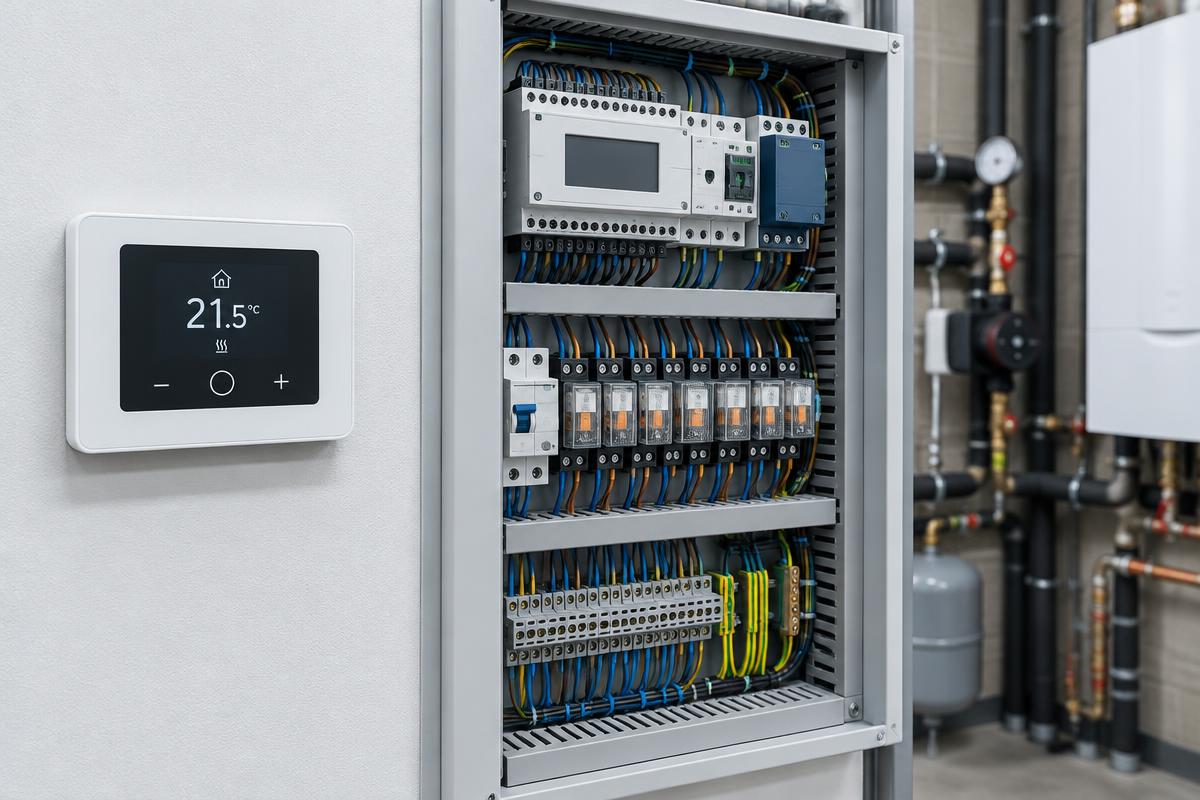
A programmable thermostat reduces waste by adjusting heating to the actual hours the home is in use. However, setting a low temperature is not enough: it requires a proper schedule, appropriate placement, and settings compatible with your heating system. An apartment with radiators reacts differently than a home with underfloor heating.
Maximum savings are not achieved through a “magic” setting, but by avoiding unnecessary heating without compromising comfort. The following values are starting points and require adjustment based on insulation, climate, and the needs of the occupants.
1. Which temperatures to choose
For a home with a boiler and radiators, you can start with the following room temperatures:
- Presence and daily activity: 20–21 °C.
- Sleep: 18–19 °C, provided comfort is maintained.
- Absence for several hours: 16–18 °C, depending on how quickly the house cools down.
- Multi-day absence: indicatively 14–16 °C, while monitoring humidity and the risk of freezing.
For the elderly, infants, or individuals with health issues, adjust the temperature to their specific needs, following medical advice where necessary. Economy should not be pursued at the expense of health.
A lower indoor temperature generally reduces heat loss, but there is no fixed percentage of savings per degree for every home. Furthermore, frost protection mode is not a comfort setting nor does it guarantee protection for all pipes, especially in exposed areas.
2. How to create a practical weekly schedule
First, record when you wake up, when the last occupant leaves, and when the first one returns. Then, create a different schedule for weekdays and weekends. Usually, four periods per day are sufficient.
Example for a working household with radiators
- 06:30–08:30: 20 °C for waking up in the morning.
- 08:30–17:00: 17 °C while the house remains empty.
- 17:00–23:00: 20–21 °C for evening occupancy.
- 23:00–06:30: 18 °C for the night.
The times are indicative. If you return at 17:00 and the room takes 45 minutes to warm up, the comfort period must start earlier. Test a 30–60 minute pre-heating period initially and adjust based on actual measurements. In a cold or poorly insulated house, more may be required.
If there is an adaptive start function, check the manual: in many models, you set the time by which you want the temperature to be reached, not the activation time.
For a short trip out, a large reduction is not necessary. Use a temporary override with an automatic return to the schedule, instead of a permanent manual mode that is easily forgotten.
3. Different settings per heating system
Boiler with radiators
Radiators usually allow for a more flexible schedule than underfloor heating. A reduction of 2–3 °C during a long absence is a reasonable starting point. However, the room thermostat does not necessarily regulate the boiler's water temperature. This requires separate adjustment, depending on the installation and the manufacturer's instructions.
In a condensing boiler, a lower return temperature promotes condensation. Therefore, do not arbitrarily increase the water temperature to compensate for an excessively deep night setback.
Heat pump
A heat pump often operates more efficiently with more stable conditions and a low supply temperature. Start with a small reduction, about 0.5–1 °C, or no reduction in a high-thermal-inertia installation. Rapid reheating can lead to a higher supply temperature or, depending on the settings, the activation of auxiliary heaters.
Underfloor and central heating
Underfloor heating usually has high thermal inertia: changes may be felt only after hours. Prefer mild changes and avoid many short heating periods. In central heating for an apartment building, the personal schedule only works within the available operating hours and in accordance with the method of autonomy and billing.
4. Thermostat position and useful features
A correct schedule fails if the temperature reading is inaccurate. The thermostat is usually placed on an interior wall, approximately 1.2–1.5 m from the floor, according to the manufacturer's instructions, in a representative location of the room.
- Avoid direct sunlight, proximity to radiators, the kitchen, or heat-emitting appliances.
- Do not hide it behind curtains or furniture.
- Avoid drafts from doors and windows.
- For wireless models, check batteries and communication with the receiver.
Open window detection can limit wasteful operation during ventilation. Geofencing helps with irregular schedules but must take all occupants into account.
Also, check compatibility: on/off contacts, digital communication, and proprietary protocols are not equivalent. Replacing an analog controller with a simple on/off one might eliminate useful functions. The electrical connection and installer parameters should be checked by a qualified technician.
5. Monitoring consumption and costly mistakes
Change one parameter at a time and monitor the result for several days. Record room temperature, comfort, external conditions, and consumption in kWh or the corresponding meter unit. Do not automatically attribute a reduction in your bill to the thermostat if it coincided with milder weather or a different energy price.
- Do not raise to 25 °C for faster heating: in simple on/off control, the power does not increase; it simply delays the cutoff.
- Do not close the radiator in the reference room: the thermostat might continuously request heat because the target is never met.
- Do not arbitrarily tamper with the hysteresis: a very tight differential setting can cause frequent cycling.
- Do not ignore the installation: bleeding, hydraulic balancing, and maintenance affect efficiency.
If there is a thermostatic radiator valve in the room with the central thermostat, it needs coordination so it does not prematurely restrict heating there. If the boiler makes continuous short cycles, a technical inspection is required, not just a schedule change.
Frequently asked questions
Is it better to leave the heating on all day?
Not as a general rule. Reducing the temperature during absence limits losses. However, with heat pumps and high-inertia systems, a more stable operation may better serve overall efficiency and comfort.
How much money does a programmable thermostat save?
There is no reliable universal amount. The benefit depends on previous usage, insulation, fuel, and the system. If you already manage your heating correctly manually, the additional financial benefit may be small.
Is a Wi-Fi connection needed for economy?
No. A simple weekly thermostat is sufficient when the schedule is fixed. Wi-Fi primarily offers remote control and ease of changes, not an automatic guarantee of savings.
What do I do if the house does not reach the desired temperature?
First, check the available schedule, the measurement position, and whether the radiators are heating normally. If the problem persists, a technician must examine the supply, water temperature, balancing, and power capacity.
Conclusion: Start with realistic temperatures, a simple weekly schedule, and mild corrections. The right thermostat saves energy when it works in sync with your installation and daily life, not when it forces extreme changes.