Introduction to choosing boiler capacity
The question "how many kW do I need for 100 square meters" is perhaps the most common one I receive as a heating technician. Many owners believe there is a magic formula that links square footage to boiler capacity. In reality, the boiler does not heat the square meters, but rather compensates for the heat losses of the house's volume to the external environment.
Choosing the correct capacity is critical. A boiler that is too small will never heat the house on cold winter days, while an oversized boiler will perform constant starts (short-cycling), increasing consumption and component wear.
Factors that determine thermal needs
Before we look at the numbers, we must understand what affects the required power for a 100 sq.m. house in Greece:
- Insulation: A house built according to the KENAK standard after 2010 has half the requirements of a detached house from 1980 without thermal facade insulation.
- Climatic Zone: An apartment in Glyfada (Zone A) has different requirements than a residence in Kozani (Zone D).
- Orientation and openings: Large window frames and a north-facing orientation increase the requirements.
- Ceiling height: A house with a height of 3 meters has 20% more air volume to heat than one with 2.5 meters.
The general rule of Watts per square meter
Although a heating study by a mechanical engineer is the only safe method, we use some empirical rules for a first estimate:
1. Homes with good insulation (Newly built)
For a modern 100 sq.m. house with double glazing and thermal facade, we need about 60-80 W/sq.m. That is, an 8-10 kW boiler is theoretically sufficient for heating.
2. Homes with moderate insulation (90s - 00s decade)
Here we estimate about 100-120 W/sq.m. For 100 sq.m., we need about 12-14 kW of power.
3. Old homes without insulation
In old detached houses, the needs can skyrocket to 150-180 W/sq.m. In this case, an 18-24 kW boiler is necessary.
Natural Gas vs. Oil Boilers: The difference in power
There is a misunderstanding here that must be resolved. With natural gas, most wall-mounted boilers start at 24 kW. Why is this, if a house only needs 12 kW?
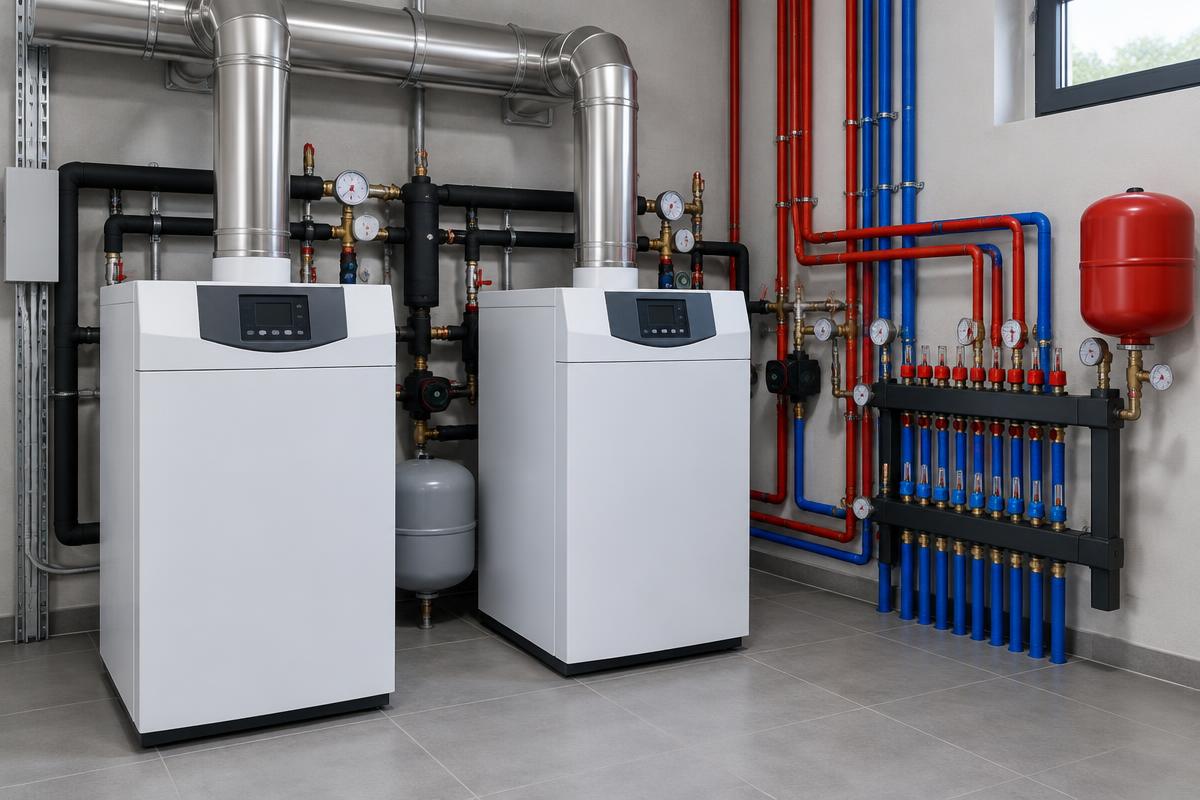
The answer lies in Domestic Hot Water (DHW). To have immediate hot water flow in the shower at a constant temperature, the boiler needs high instantaneous power (at least 20-24 kW). Therefore, even if your house is 100 sq.m. and very well insulated, you will end up with a 24 kW boiler, which, however, has the ability of "modulation" to drop to 3 or 4 kW when operating only for heating.
With oil, because we usually have a separate boiler, we can choose a boiler closer to the actual losses of the house, e.g., an individual boiler of 15,000 - 20,000 calories (kcal/h).
Why you should not oversize the boiler
Many old-school technicians suggested: "put in a 30kW one just to be safe." This is wrong for three reasons:
- Low efficiency: The boiler never reaches its ideal operating temperature before the thermostat turns off.
- Wear: Constant starts strain the electronic board and the igniter.
- Comfort: Sudden temperature fluctuations occur in the radiators, resulting in contraction-expansion noises.
Frequently Asked Questions (FAQ)
1. Is 24 kW enough for 100 sq.m. with panel radiators?
Yes, it is more than enough. Even in a house without insulation, 24 kW covers the heating needs, while simultaneously ensuring abundant domestic hot water.
2. How do I convert calories (kcal) to kW?
The relationship is simple: 1 kW = 860 kcal/h. If a boiler is 20,000 calories, we divide by 860 and find that it is approximately 23.2 kW.
3. If I install a heat pump, do the same kW apply?
Not exactly. For heat pumps, the study must be precise, because their power varies depending on the external temperature. For 100 sq.m., a 7-9 kW pump is usually required, depending on the insulation.
4. Does the number of radiators play a role?
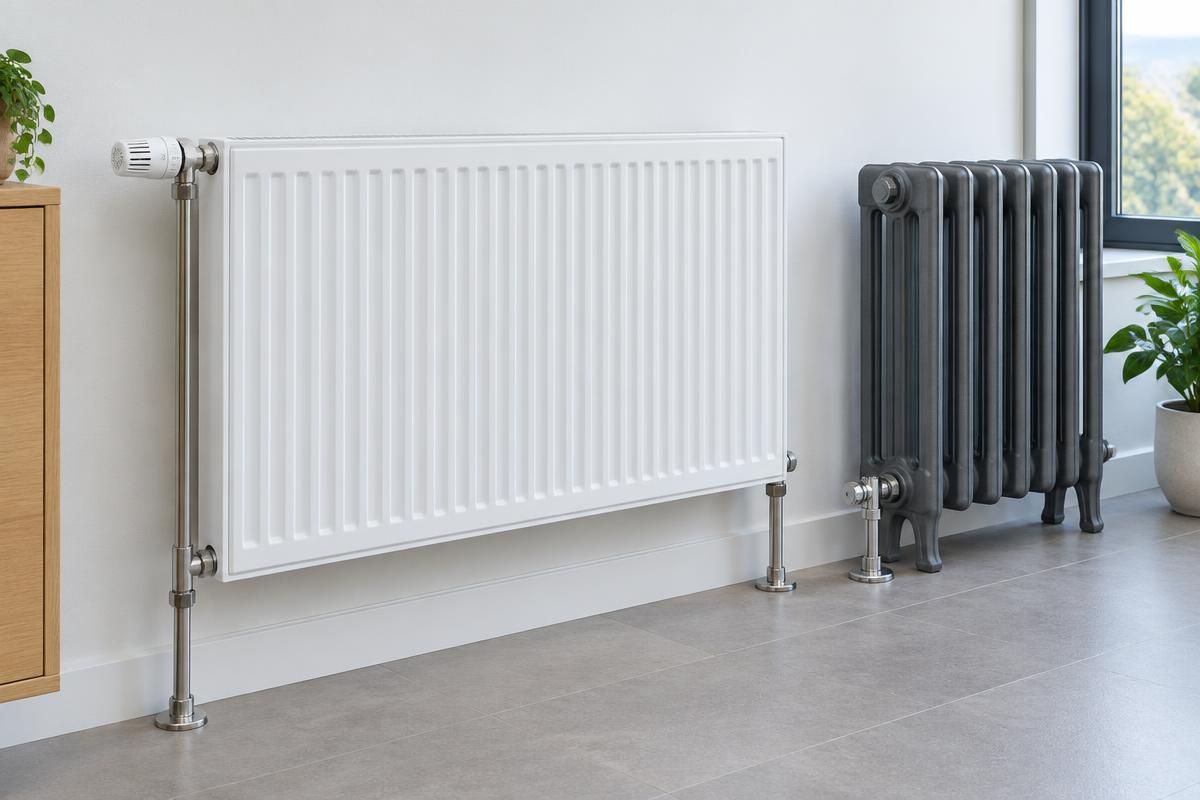
Of course. The power of the boiler must be equal to or slightly higher than the total power of the heating bodies (panel radiators or cast iron segments) installed in the house.
Conclusion
For a typical Greek 100 sq.m. house, the power of 12-15 kW for heating is the golden ratio. However, due to hot water needs, most wall-mounted gas boilers on the market at 24 kW are the standard and perfectly safe choice. Before buying, always ask a licensed technician to measure the calories of your radiators to ensure the system is balanced.