
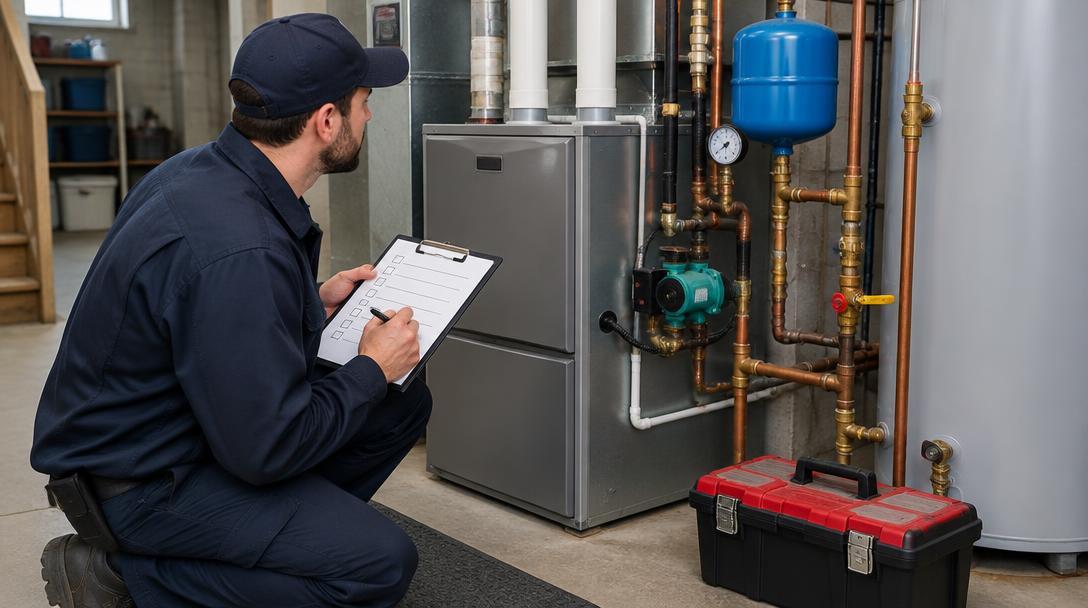
Introduction: When the heating stops on the coldest day
It is every homeowner's nightmare: you come home, turn on the thermostat, and the radiators remain cold. Before you panic and call a technician, there are some basic checks you can perform yourself. Often, the cause is something simple, such as a pressure drop or a miscalibrated thermostat. In this guide, we will look step-by-step at what you need to check on an oil or gas boiler, when a reset is sufficient, and when the intervention of a licensed technician is necessary.
1. Checking Power and Fuel Supply
It seems obvious, but in many cases, the solution is the most apparent one. Before examining internal components, ensure the boiler has fuel to burn.
Electrical power
- Check if a circuit breaker has tripped in the electrical panel.
- Ensure the (bipolar) switch next to the boiler is in the ON position.
- If the boiler has a display, is it lit? If not, there might be a blown fuse on the control board.
Fuel sufficiency
- Oil: Check the level in the tank. Do not always trust the gauge; use a dipstick. If the level is very low, the burner may have drawn "sludge" from the bottom.
- Natural Gas: Ensure the yellow supply valve is open and there is no service interruption from the distribution company (EDA).
2. Water Pressure: The number one "culprit"
Almost all modern wall-mounted gas boilers and oil units feature a pressure sensor (pressure switch). If the pressure drops below a certain limit, the machine locks out for safety reasons.
- Check the pressure gauge (the circular dial or digital display).
- The ideal pressure in a cold state should be between 1.2 and 1.5 bar.
- If the reading is below 0.5 bar, the boiler will not start.
- Solution: Carefully open the filling valve (usually a small black or blue tap at the bottom) until the pressure reaches 1.5 bar, then close it tightly.
3. The Room Thermostat and its Settings
Often the boiler is in perfect condition but never receives the command to start. The thermostat is the "brain" of the installation.
- Batteries: If the thermostat display is blank or the battery icon is flashing, replace them with new alkaline ones.
- Temperature setting: Ensure the desired temperature is at least 2-3 degrees higher than the current room temperature.
- Summer/Winter mode: On gas boilers, ensure the selector is on the "snowflake" or "radiator" symbol, not just the tap (domestic hot water) symbol.
4. Understanding Error Codes
Modern boilers (Vaillant, Baxi, Buderus, Viessmann, etc.) communicate with us via codes. If you see a letter and a number flashing (e.g., E10, F28, AL5):
- Refer to the user manual.
- Reset: Try pressing the Reset button (often represented by an 'R' or a crossed-out flame). Do not do this more than 2-3 times.
- If the error persists, note down the code. This will help the technician arrive prepared with the appropriate spare parts.
5. Problems with the Burner and Flue
If you hear the boiler attempting to start (you hear the spark or the fan) but then it "cuts out," the problem may be mechanical.
- Burner lockout (red light): On oil units, press the button on the burner. If it sparks and then stops, the nozzle or the filter may be clogged.
- Flue gas exhaust: If the chimney is blocked (e.g., by a bird's nest) or if the exhaust fan is not working, the flow sensor will stop operation to prevent asphyxiation.
- Air in the system: If you hear loud "gurgling" noises, the radiators may need bleeding, or the circulator pump may be stuck after a long period of inactivity.
Frequently Asked Questions (FAQ)
Why does the boiler pressure drop often?
If you need to add water every week, there is a leak. It could be a small leak in a radiator valve, piping, or, most commonly, the boiler's expansion vessel needs nitrogen replenishment or replacement.
Can I perform a reset if I smell gas?
No. If there is a smell of gas, immediately shut off the main supply, open windows, and call a technician. Do not activate any electrical appliances or the boiler.
How often should maintenance be performed?
Annual maintenance is necessary for both safety and economy (up to 15% lower consumption). For natural gas, a maintenance report is issued, while for oil, cleaning the boiler and adjusting the burner prevents "clogging."
Conclusion
A boiler that won't start does not always mean an expensive repair. By starting with water pressure, thermostat batteries, and fuel supply, you can save time and unnecessary expenses. However, remember: internal intervention on burner components or the control board must be done exclusively by a qualified, licensed technician, as incorrect settings carry risks to the safety of your home.