
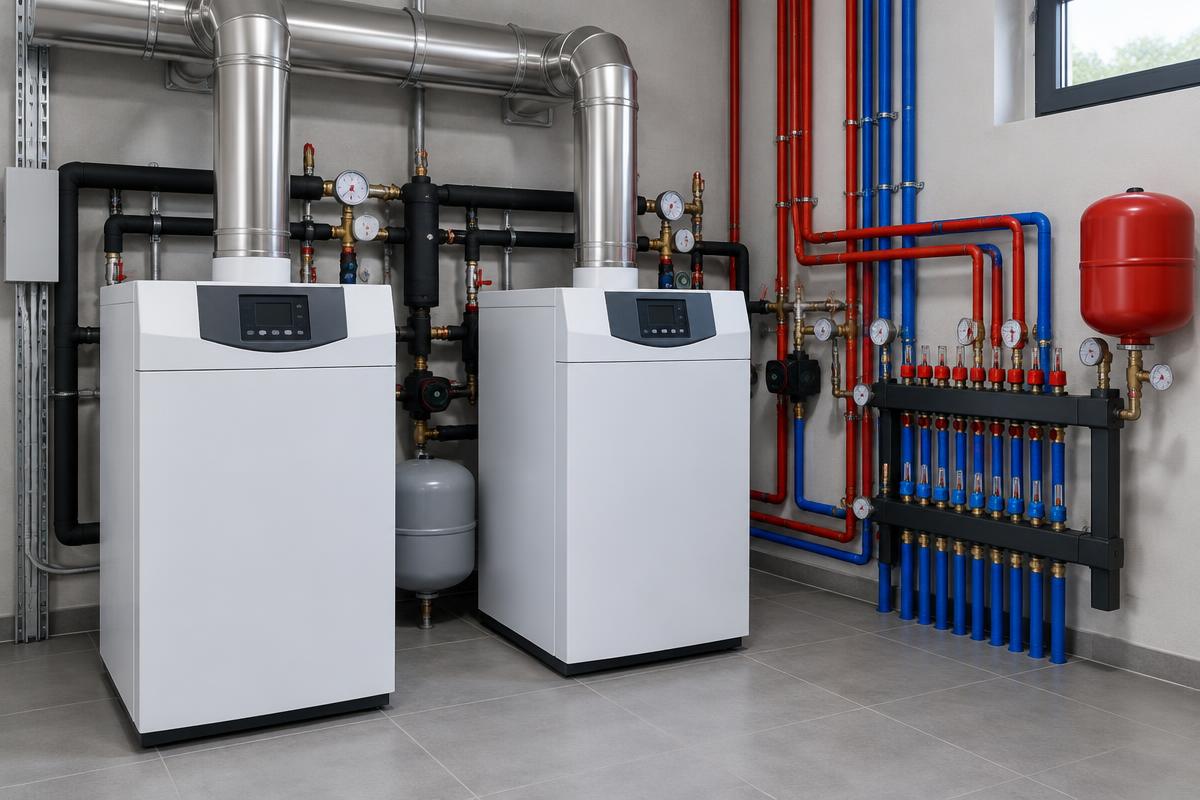
A pellet burner can be a practical central heating solution, especially in homes with a boiler room and available storage space. However, it is not a device that can be installed on any boiler and operate economically without other requirements. Actual efficiency depends on equipment compatibility, fuel quality, settings, and maintenance.
To properly evaluate the investment, you need to consider not only the purchase price of the pellets but also the cost per useful kilowatt-hour of heat, installation labor, and daily care.
1. How a pellet burner works
The burner burns compressed wood pellets. An auger transports the fuel from the storage tank to the combustion chamber, while a fan provides the necessary air. Ignition is usually performed by an electric heating element, and an electronic controller regulates fuel feed and airflow.
Heat is transferred to the water via the boiler and then to radiators or another appropriately designed network. The burner should not be confused with a complete pellet boiler: the latter features a heat exchanger and combustion chamber designed as a single unit for the specific fuel.
Can it be installed in an oil boiler?
In some cases yes, but not without technical inspection. It requires a suitable combustion chamber, sufficient space for the flame and ash, cleaning access, and a compatible chimney. The ability to mount it to the door does not in itself prove suitability. The installer must check the manufacturer's instructions and determine if the specific combination is permitted and can operate safely.
2. Key benefits
- Competitive heat cost: depending on the market price and seasonal efficiency, pellets can offer economical heating. Comparison requires a common basis, i.e., euros per useful kWh.
- Automatic operation: feeding and ignition are performed without manual lighting. Many models adjust their output to demand.
- Utilizing an existing network: radiators and pipes usually remain, provided the hydraulic network is suitable and functional.
- Supply flexibility: the fuel is usually available in 15 kg bags, pallets, or in bulk, where infrastructure exists.
- Biomass fuel: it can utilize wood processing residues when sourced from responsibly controlled production.
Biomass, however, does not mean zero emissions. Combustion produces carbon dioxide and atmospheric pollutants. The environmental outcome is affected by the wood's origin, transport, efficiency, and combustion quality.
3. Disadvantages and practical requirements
The main disadvantage is the increased care required compared to systems that do not involve solid fuel management. The tank needs refilling, ash needs to be removed, and heat exchange surfaces require regular cleaning.
- Storage space: a dry area, protected from moisture and water, is required. Wet pellets swell, crumble, and cause feeding problems.
- Dust and transport: handling many bags is an essential task, especially when the boiler room is in a basement without easy access.
- Electricity dependency: automation, the auger, the fan, and the circulator require power.
- Variable quality: excessive dust, high ash content, or unsuitable fuel can create deposits and clinker in the combustion chamber.
- Noise: the fan and auger make noise, which matters near bedrooms.
Cleaning frequency is not the same for all machines. It is determined by the manual, consumption, and pellet quality. In systems without effective self-cleaning, inspection or cleaning may be required several times a week.
4. Purchase and operating costs
How much does installation cost?
For residential applications of approximately 20–40 kW, an indicative range for a burner with basic automation and a feeding system is 1,200–2,800 euros. A complete conversion of a suitable existing boiler can range from approximately 2,000–4,500 euros, depending on the tank, labor, and safety devices.
These amounts are budgetary ranges and not a current price list. Significant chimney reconstruction, a new boiler, or a buffer tank can increase the cost substantially. Ask for a written offer with clear mention of VAT, transport, installation, and initial setup.
Calculating cost per kWh
For an indicative calculation, let's use a pellet price of 0.34–0.46 €/kg, i.e., 5.10–6.90 euros per 15 kg bag, a lower heating value of 4.8 kWh/kg, and a boiler-burner seasonal efficiency of 80–90%. These are calculation assumptions, not guaranteed prices or efficiencies. In a problematic conversion, seasonal efficiency may be lower.
Useful heat cost = price per kg ÷ (heating value × seasonal efficiency).
With the above assumptions, the fuel-only cost is approximately 0.079–0.120 €/kWh. This does not include electricity consumption, maintenance, or distribution network losses.
Annual consumption example
For an annual requirement of 15,000 kWh at the boiler output, a price of 0.38 €/kg, and a seasonal efficiency of 85%:
- Useful heat per kg: 4.8 × 0.85 = 4.08 kWh/kg.
- Annual consumption: 15,000 ÷ 4.08 ≈ 3.676 kg, approximately 245 bags.
- Annual fuel cost: 3.676 × 0.38 ≈ 1.397 euros.
In your budget, add an indicative 100–220 euros for scheduled maintenance and 60–140 euros for chimney cleaning, depending on access and region. Electricity consumption depends on operating hours, ignitions, and the circulator, and must be calculated based on the installation's actual specifications.
5. What to check before buying
- Heat loss study: power selection should not be based solely on square footage. Oversizing causes frequent starts and reduces economy.
- Minimum output: this is important on mild days. A buffer tank is recommended when required by the manufacturer or the hydraulic study.
- Chimney and ventilation: draft, airtightness, cross-section, and suitability for actual flue gas temperatures must be checked.
- Safety: required overheating and flame-back protection, an appropriate expansion vessel, and a safety valve are necessary.
- Fuel and support: choose pellets of the specification defined by the manufacturer, often ENplus A1 for domestic systems, and ensure spare parts and a technician are available in the area.
Initial setup requires measurements with a flue gas analyzer, not just visual assessment of the flame. A suitable carbon monoxide detector, installed according to its instructions, offers additional protection but does not replace proper installation. Closed bulk storage rooms require special ventilation provisions, as pellets can emit carbon monoxide.
Frequently Asked Questions
How many kg of pellets does a 100 sq.m. house need?
There is no reliable answer based solely on surface area. Insulation, climate, room temperature, and operating hours change consumption significantly. An estimate of annual thermal demand and seasonal efficiency is required.
Is it cheaper than oil?
It can be, but not always. Compare the cost per useful kWh using actual market prices and the efficiency of each system, including maintenance and initial investment.
Can I burn olive pits or other material?
Only if the specific model is designed and approved by the manufacturer for that fuel. Otherwise, damage, increased emissions, and dangerous operation may occur.
When does the conversion pay off?
Divide the additional investment by the net annual savings. For a cost of 3,000 euros and a real annual benefit of 500 euros, the simple payback period is six years, without accounting for price fluctuations or emergency repairs.
Conclusion: A pellet burner is worth considering when there is a suitable boiler, a dry storage room, and the willingness for regular care. Proper sizing, safe installation, and total cost calculation are more important than a low purchase price.