
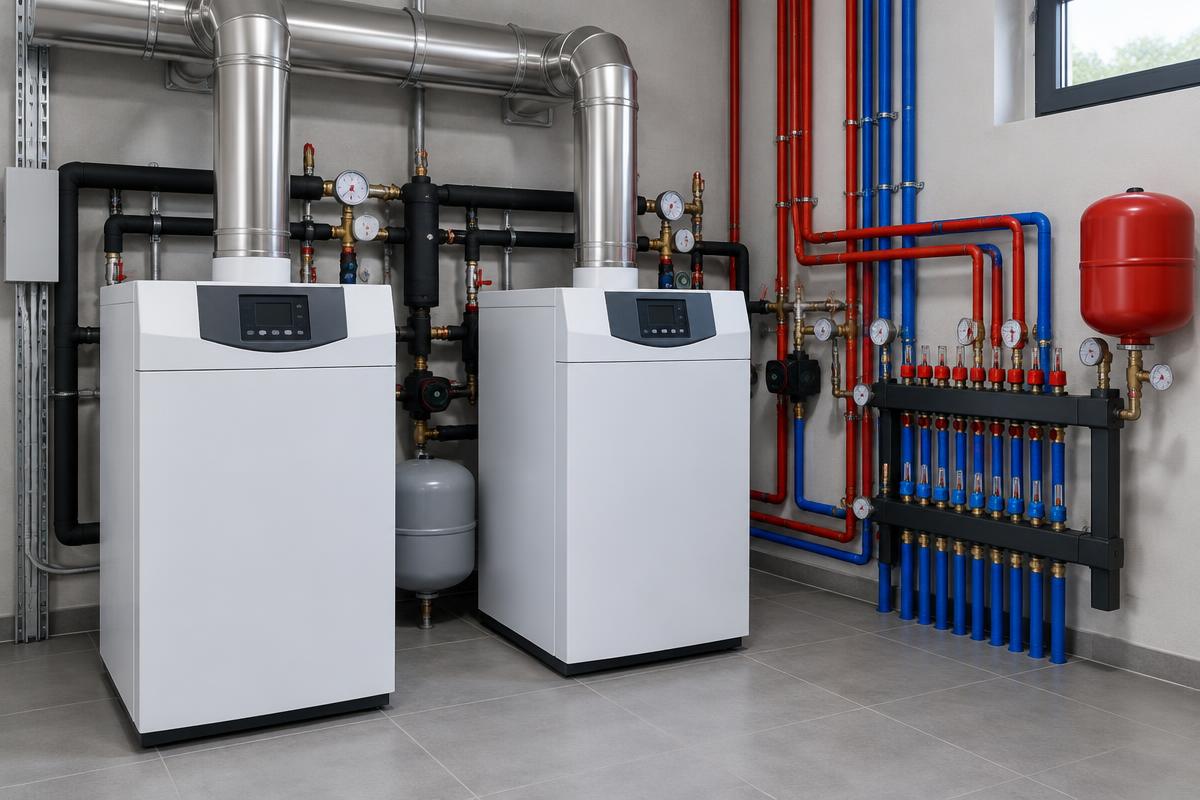
The choice between an oil boiler and a natural gas boiler is not determined solely by the fuel price. It depends on the actual efficiency of the installation, the conversion cost, the needs of the home, and the availability of a gas network connection. A properly adjusted oil boiler can be more economical to maintain than an expensive conversion that is rarely used. Conversely, a condensing gas boiler can substantially limit consumption if installed and configured correctly.
A fair comparison is made in euros per useful kilowatt-hour of heat, not per liter of oil or cubic meter of gas. Below are the basic parameters, using indicative assumptions rather than claiming they represent current market prices.
1. Efficiency: what changes in actual operation
The efficiency rating shows how much of the fuel's energy is converted into useful heat. However, a snapshot flue gas measurement is not identical to seasonal efficiency: during winter, standby losses, frequent cycling, and operation at inappropriate temperatures add up.
For an indicative comparison, using the higher heating value of the fuel as a common basis, the following assumptions can be used:
- Old oil boiler with significant losses: seasonal efficiency of about 70–80%, potentially lower in problematic installations.
- Maintained conventional oil boiler, properly sized: about 80–88%.
- Condensing natural gas boiler: about 88–95%, depending on water temperatures, settings, and load.
The above are calculation values, not guaranteed performances for every device. There are also condensing oil boilers, so the comparison relates to specific technologies and not just different fuels.
Why return temperature matters
A condensing gas boiler recovers part of the heat from the flue gas water vapor. The process is favored when the water return is below approximately 55°C and becomes more effective at lower temperatures. Existing radiators do not rule out condensation: with weather compensation and sufficient radiator surface area, the system can operate at lower temperatures most days.
2. Consumption cost: comparison using common units
For oil, the energy content is about 10 kWh per liter with the lower heating value or about 10.6 kWh per liter with the higher one. Here we use the latter value to align with the efficiency basis and the typical pricing of natural gas in kWh.
Cost of useful heat = fuel energy cost ÷ seasonal efficiency rating.
Let’s consider a home that needs 15,000 kWh of useful heat annually for heating. This need is hypothetical and does not result only from the square footage: it is strongly affected by climate, insulation, and operating hours.
- Oil: with a price of 1.25 €/liter and 85% efficiency, each liter yields about 9.01 kWh. About 1,665 liters are needed, with an annual cost of about 2,080 €.
- Natural gas: with a total variable charge of 0.09 €/kWh and 92% efficiency, about 16,304 kWh of fuel is required. The annual variable cost is about 1,470 €.
In the example, the difference is about 610 € per year in favor of gas, before fixed charges, maintenance, and auxiliary electricity consumption. The cost of useful heat works out to approximately 0.139 €/kWh for oil and 0.098 €/kWh for gas.
For a real gas offer, include supply, variable regulated charges, and applicable taxes, with the same VAT treatment for both fuels. Add fixed charges separately. An advertised supply price is not necessarily the final consumption price.
3. Installation, conversion, and payback period
In a small residence with a ready radiator network, replacing a conventional oil boiler and burner may, indicatively, require a budget of about 2,500–4,500 €. A wall-mounted condensing gas boiler installation often requires a budget of about 3,000–5,500 €, when including the device and standard connection work.
These are approximate ranges including VAT, not binding offers. Long piping runs, complex chimneys, a new tank, or extensive building work can significantly increase the cost. Ask for details on what is included.
- Network availability, meter location, and any gas connection fees.
- Design and construction of internal gas installations where required.
- Certified flue gas exhaust and combustion air supply system.
- Condensate drainage and neutralization where prescribed.
- System cleaning, filters, automation, and commissioning.
If the net savings are 500 € per year and the conversion costs 4,000 €, the simple payback is about eight years. However, if the existing boiler needs replacement anyway, mainly compare the investment difference between the two solutions. This calculation does not include price changes, financing, or future repairs.
4. Maintenance and factors determining the choice
Both systems need periodic maintenance according to the manufacturer and applicable requirements. For oil, the burner, nozzles, filters, and exchanger deposits are checked, among other things. For gas, combustion, the exchanger, tightness, safety devices, and condensate drainage are checked.
For a small residential installation, a budget of about 80–160 € per routine maintenance is an indicative starting point, excluding major spare parts or additional work. The region, access, and the scope of the inspection affect the final charge.
- High annual usage: increases the importance of lower operating costs.
- Limited usage: makes the payback of an expensive conversion difficult.
- Healthy existing boiler: it is worth first checking settings, pipe insulation, and automation.
- Oversizing: causes frequent cycling. Power selection needs heat loss calculation, not just square footage.
- Apartment building: requires checking technical capabilities, regulations, and legal procedures before seeking autonomy.
For technicians, the boiler’s minimum modulation power, hydraulic balancing, and the correct compensation curve are of particular importance. Changing the device without these interventions can leave significant savings potential unexploited. Work on gas, burners, and chimneys is performed by appropriately licensed professionals.
5. Frequently asked questions
Is natural gas always cheaper?
No. It depends on the final charge, fixed costs, and efficiency. With the example’s assumptions, the variable cost equivalence is at about 0.128 €/kWh of gas. Fixed costs and other expenses change the overall result.
Do I need to change the radiators for a condensing boiler?
Not necessarily. It is checked whether the existing radiators cover the losses at lower water temperatures. Even if they require a high supply in very cold weather, condensation can still be achieved for a large part of the heating season.
Can an existing oil boiler be converted to gas?
On some boilers, a suitable gas burner is allowed, only if there is documented compatibility and installation requirements are met. Changing the burner does not convert a conventional boiler into a condensing one.
Why is efficiency over 100% mentioned?
Because some technical data use the lower heating value as a basis, which does not include the latent heat of water vapor. No extra energy is created. Compare efficiencies only when they have the same reference basis and corresponding measurement conditions.
6. Conclusion
Condensing natural gas can offer lower operating costs, but it is not automatically the most economical overall choice. Gather real consumption data, final fuel prices, and two detailed offers. With a heat loss check and a realistic payback calculation, you will distinguish whether it is worth converting or improving the existing oil installation.