
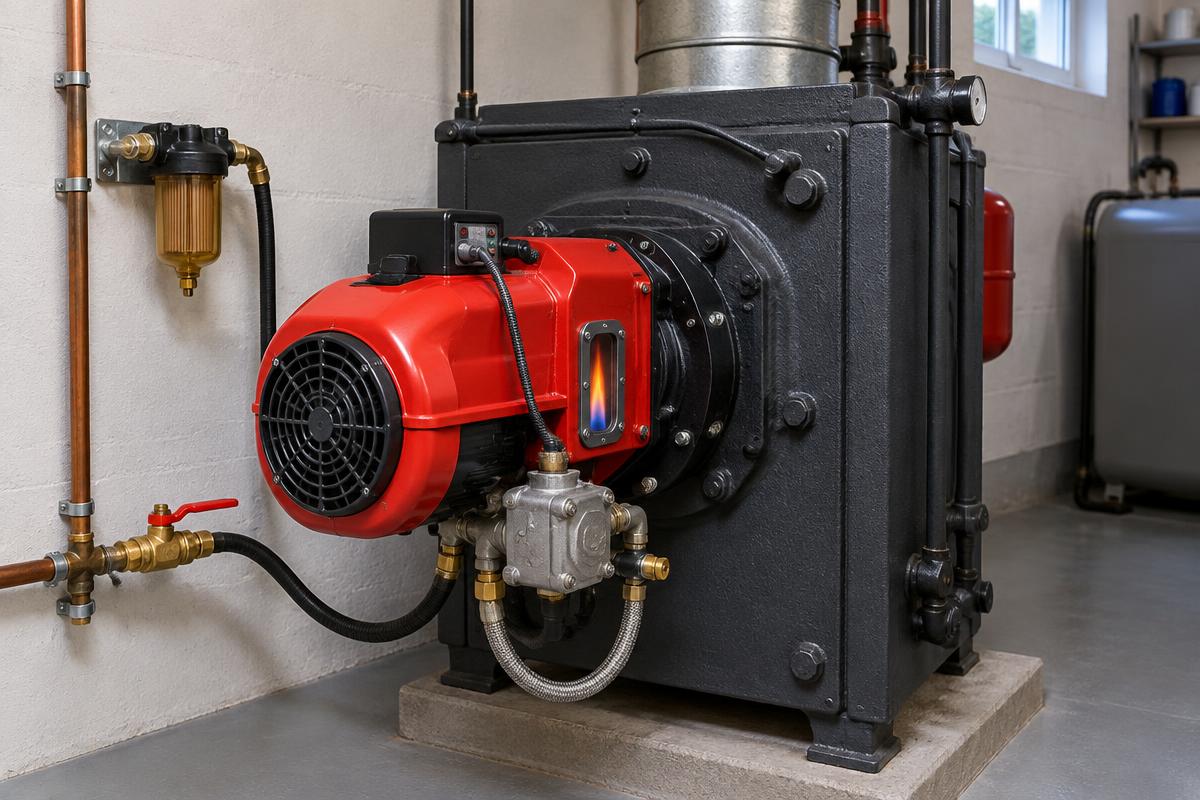
Introduction to Industrial Burner Selection
Choosing an industrial burner is not a simple equipment purchasing process, but a critical technical decision that directly impacts operating costs, boiler longevity, and installation safety. In the industrial sector, requirements differ significantly from residential applications, as burners often operate under high combustion chamber pressure and require precise control of the fuel-air ratio.
As technicians, we know that an oversized burner leads to frequent start-stop cycles (short cycling), increased consumption, and premature wear, while an undersized burner fails to cover peak loads, causing production issues.
1. Understanding Nominal vs. Actual Capacity
The first step is to distinguish between the boiler's capacity and the thermal capacity the burner must deliver. The capacity indicated on the boiler's nameplate (e.g., in kW or kcal/h) is the useful heat transferred to the water or steam.
The role of efficiency
To calculate the required burner capacity, we must divide the boiler capacity by its efficiency. For example, if we have a 500 kW boiler with 90% efficiency, the burner must have a minimum input capacity of:
- 500 / 0.90 = 555.5 kW
In the Greek market, industrial boilers typically range between 88% and 94% efficiency, depending on their technology and maintenance.
2. Combustion Chamber Pressure and the Operating Curve
Perhaps the most critical factor that many owners overlook is the backpressure of the combustion chamber. Every burner comes with a working diagram (flow-pressure chart). The burner's capacity decreases as the pressure it must overcome within the combustion chamber increases.
- Combustion Chamber Pressure: Measured in mbar or mmH2O. If the boiler has high resistance in the flue gas path, the burner must have a powerful fan.
- Selection from Chart: You must always select the burner so that your operating point is in the center of the chart and not at its limits, to allow for adjustment margin.
3. Fuel Type and Environmental Conditions
A burner's capacity is affected by the type of fuel (natural gas, LPG, diesel oil, or heavy fuel oil) and environmental conditions.
Altitude and Temperature
In Greece, an installation in a mountainous area (above 500-600 meters) requires adaptation. The air there is less dense, meaning the burner fan provides less oxygen for combustion. This leads to the need for a larger burner to achieve the same thermal output.
Fuel Quality
The Lower Heating Value (LHV) of the fuel is the basis for calculations. For natural gas in Greece, we calculate approximately 9.5 to 10.5 kWh per cubic meter (Nm3).
4. Type of Regulation: Single-stage, Two-stage, or Modulating?
Capacity is not just a matter of size, but also of delivery method. In industrial applications, the choice of operating mode is decisive:
- Single-stage (On-Off): Used only in very small applications.
- Two-stage (High-Low): Feature two stages of operation. They offer better load adaptation but remain limited.
- Modulating: The golden mean for industry. The burner continuously adjusts its capacity (e.g., from 20% to 100%) depending on demand. This ensures stable steam pressure or water temperature and maximum fuel savings.
Frequently Asked Questions (FAQ)
1. What happens if the burner is too large for the boiler?
You will experience very short operating cycles. This causes incomplete combustion during startup, increased pollutant emissions, and significant stress on mechanical parts and the ignition transformer.
2. How does combustion air temperature affect capacity?
If the intake air is very hot (e.g., in a closed engine room in summer), its density decreases, reducing the burner's efficiency. Proper ventilation of the space is essential.
3. Can I use a natural gas burner on an oil boiler?
Yes, provided the capacity and flame geometry match the boiler's combustion chamber. Careful study of the burner blast tube length is required.
4. What is the combustion head and why does it matter for capacity?
The head (blast tube) is the part that enters the boiler. Its length must exceed the thickness of the boiler door so that the flame develops correctly within the chamber and does not damage the insulating material.
Conclusion
Correctly selecting the capacity of an industrial burner requires a combination of the installation's thermal needs, the boiler's technical characteristics (chamber pressure, efficiency), and environmental conditions. A well-designed installation with a modulating burner can recoup its purchase cost in less than two years solely through fuel savings. Always consult the manufacturer's operating charts and rely on licensed technicians for adjustment using a flue gas analyzer.