
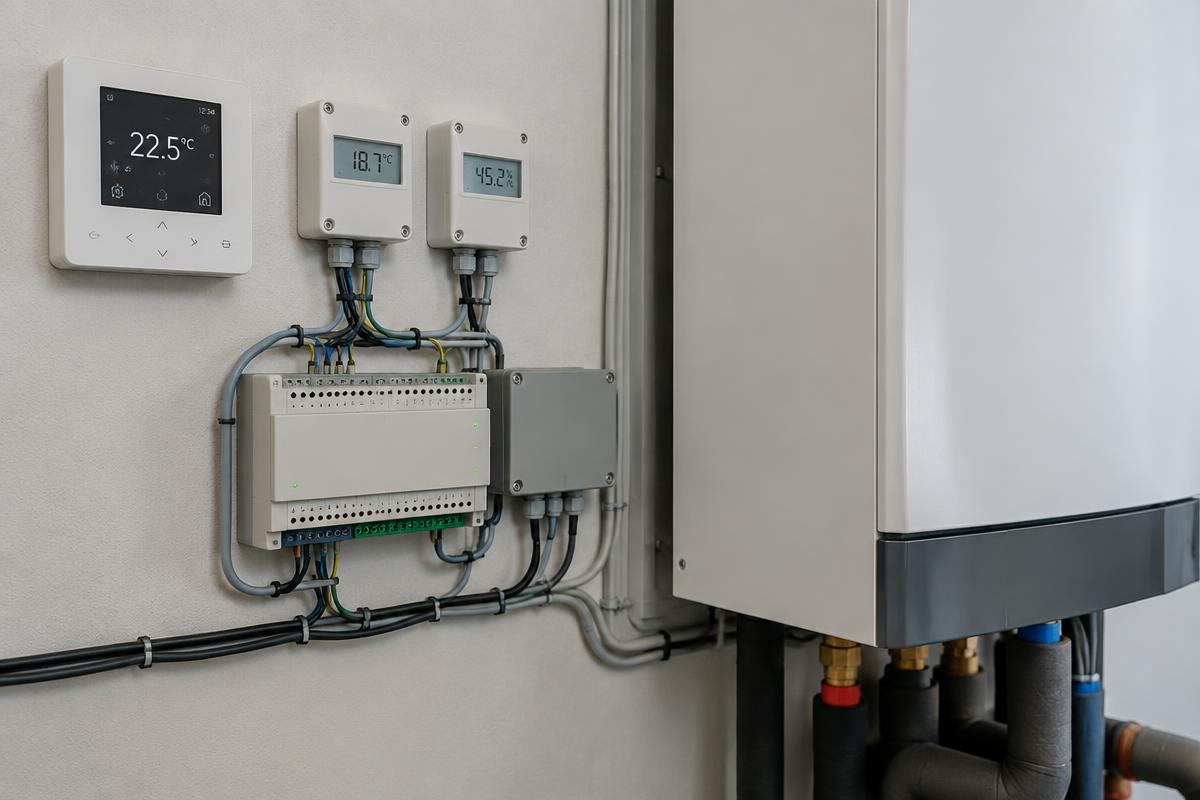
Introduction to the Importance of Heat Pump Control
Installing a heat pump is one of the most efficient investments for a modern home in Greece. However, simply installing the machine does not guarantee the lowest possible operating costs on its own. True economy lies in the automations and sensors that manage its operation. Without proper control, a heat pump may function like a simple electric boiler, wasting energy unnecessarily.
In this article, we will analyze the critical components and settings that ensure your system operates at its optimal Coefficient of Performance (COP), offering comfort and lower electricity bills.
The Heart of Economy: Weather Compensation
Weather compensation is perhaps the most important automation in a heat pump. Instead of the system operating at a fixed water flow temperature (e.g., 45°C or 55°C), weather compensation adjusts the water temperature based on external conditions.
How does the heating curve work?
The external temperature sensor informs the heat pump's controller about how cold it is outside. The milder the weather, the lower the water temperature the pump sends to the radiators or underfloor heating system. For example:
- Outside temperature 15°C: Water flow 30°C.
- Outside temperature 0°C: Water flow 45°C.
Each degree of reduction in the water flow temperature can improve the pump's efficiency by approximately 2-3%. In the Greek context, where winter has many days with mild weather, weather compensation is essential.
Room Sensors and Smart Thermostats
Many owners make the mistake of connecting a high-tech heat pump to an old on/off thermostat. This limits the machine's capabilities.
Flow and Return Sensors
The heat pump's internal sensors monitor the temperature difference (ΔT) between the water flow and return. An ideal difference for radiator systems is 5-7°C. If the water flow is not correctly adjusted via the circulator, the pump may experience frequent start/stop cycles (short cycling), which increases wear and energy consumption.
Modulating Thermostats
Using thermostats that communicate via protocols (such as OpenTherm or the manufacturer's own Bus) allows the pump to reduce its output (inverter) as it approaches the desired room temperature, rather than switching off completely. This maintains constant thermal comfort and minimizes electricity consumption spikes.
Domestic Hot Water (DHW) Management
Producing hot water is a demanding process for a heat pump, as it requires high temperatures. The right settings here can save significant amounts of money.
- Boiler sensor: Must be positioned at the correct height within the boiler's thermowell for accurate reading.
- Time scheduling: Schedule DHW production during midday hours when the outside temperature is higher. The pump will operate much more efficiently than on freezing nights.
- Legionella function: Set the disinfection automation to run once a week, preferably with the help of the sun (if a solar water heater is present) or during low-tariff electricity hours.
Zoning and Solenoid Valves
In larger homes, division into zones (e.g., bedrooms and living room) is necessary. However, the use of multiple solenoid valves requires a zone controller that communicates directly with the heat pump.
It is critical that a "by-pass" route or a buffer tank always exists, so that if all zones close, the pump is not damaged by a lack of flow. Modern controllers can adjust the circulator speed depending on how many zones are open, keeping the pressure stable.
Frequently Asked Questions (FAQ)
1. What is the ideal setting for the heating curve in Greece?
There is no single "magic" value, but for homes with classic radiators, a curve starting at 35°C (at 15°C outside) and reaching 50-55°C (at 0°C outside) is a good baseline. For underfloor heating, values are much lower (25-35°C).
2. Why does my pump keep starting and stopping?
This is called short cycling. It usually happens when the pump is oversized, when the thermostat is on/off with low hysteresis, or when water flow is restricted. A technician should check the circulator settings and the buffer tank.
3. Do I need WiFi sensors?
WiFi sensors offer convenience and remote control, but the main economy comes from the local logic of weather compensation, not from whether you can turn off the heating from your mobile phone.
4. What role does the humidity sensor play?
In cooling systems (cooling via underfloor), the humidity sensor is necessary to prevent water vapor condensation on the floor, by stopping the supply of cold water if the humidity rises above a limit (e.g., 65-70%).
Conclusion
Investing in correct automation and proper sensor parameterization is just as important as buying the heat pump itself. Well-adjusted weather compensation and the use of modern controllers can reduce annual consumption by up to 20%, ensuring that your system pays for itself much faster while protecting your equipment from unnecessary strain.