Introduction to the modern heating dilemma
The energy crisis and the need to move away from fossil fuels have brought heat pumps to the forefront of the Greek market. When an owner decides to invest in a high-efficiency system, the main question that arises is: Air-to-water heat pump or Geothermal?
Both systems are based on the same thermodynamic principle, but they differ radically in terms of energy source, installation cost, and performance in extreme conditions. In this article, we will technically analyze the two options to help you make the most advantageous decision for your property.
Air-to-Water Heat Pump: The flexible solution
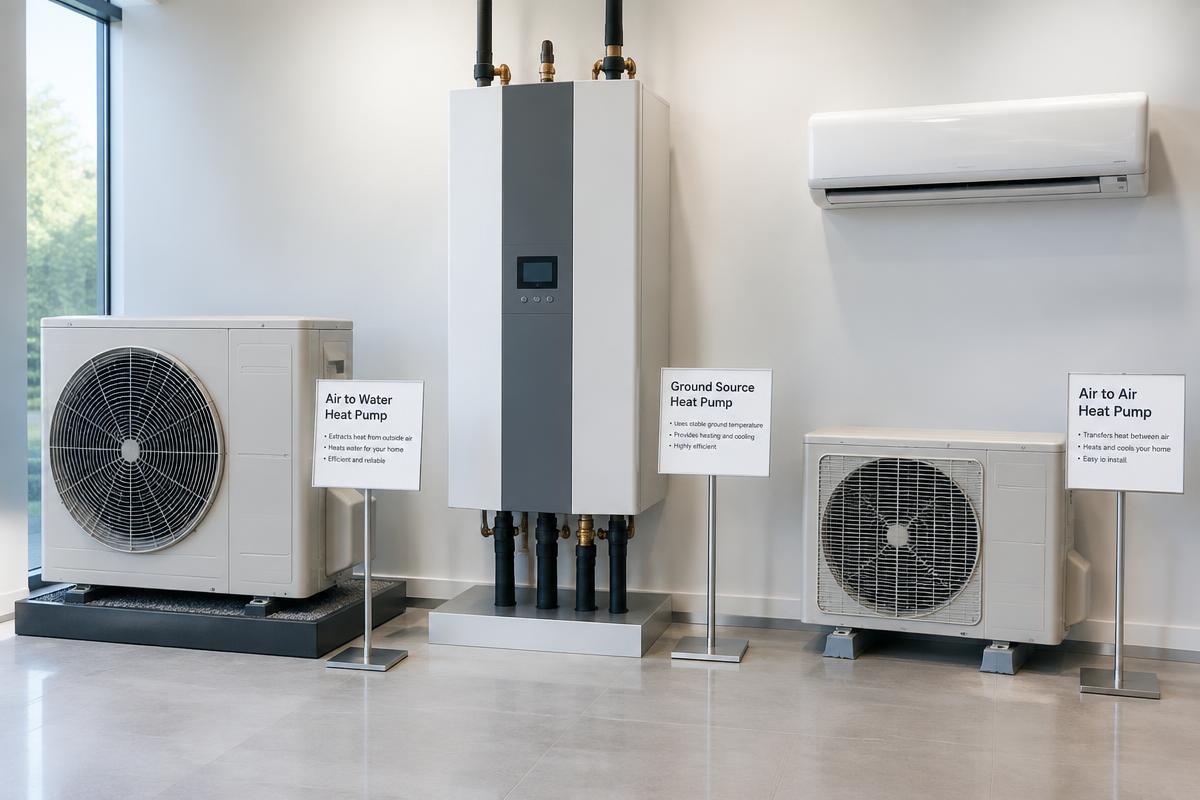
The air-to-water heat pump draws energy from the outside air and transfers it to the heating network water (radiators, underfloor, or fan coils). It is the most popular choice in Greece due to its easy installation.
Advantages and technical features
- Ease of installation: Requires only an outdoor space (balcony or terrace) and a connection to the hydraulic network.
- Lower initial cost: A quality pump for a 100-120 sq.m. home usually ranges between 5,000€ and 8,500€ (equipment and labor).
- Efficiency (COP): In the Greek climate, the seasonal coefficient of performance (SCOP) typically ranges between 3.5 and 4.5.
Its disadvantage is that its performance decreases when the outside temperature drops below 0°C or when there is high humidity, as the machine enters a defrost cycle.
Geothermal Heat Pump: The ultimate performance
Geothermal energy exploits the constant temperature of the subsoil (approximately 17-19°C in Greece throughout the year). Through a network of pipes (ground heat exchanger), it transfers heat from the earth into the home.
Types of ground heat exchanger
- Horizontal network: Requires a large plot of land where pipes are buried at a depth of 1.5 - 2 meters.
- Vertical network: Requires drilling at depths of 60-100 meters. It is ideal for limited spaces but more expensive.
- Open circuit: Use of water from a well or aquifer (provided it is permitted and there is availability).
The main advantage is the constant COP coefficient, which can exceed 5.0 regardless of whether there is snow or a heatwave outside, as the earth acts as a huge energy storage facility.
Cost and Amortization Comparison
The choice between the two systems is often economic. Let's look at the realistic data for the Greek reality:
| Feature | Air-to-Water | Geothermal |
|---|---|---|
| Initial Cost | Low to Medium | High (double or triple) |
| Need for digging | No | Yes (Drilling/Excavations) |
| Maintenance Cost | Low (annual service) | Very low |
| Lifespan | 15-20 years | 25+ years (50 for the exchanger) |
Geothermal energy requires an investment that often starts from 15,000€ and can exceed 25,000€ for a detached house, due to the cost of drilling. The amortization of the cost difference compared to an air pump can take from 8 to 12 years, depending on electricity prices.
When to choose each system?
Prefer an Air-to-Water Pump if:
- You are renovating an apartment or house in an urban area with no available surrounding space.
- Your budget is limited and you want an immediate transition from oil.
- Your area has a mild climate (e.g., Attica, Crete, Islands).
Prefer Geothermal if:
- You are building a new house and have a large plot of land or the possibility of drilling.
- The property is located in an area with a very heavy winter (e.g., Western Macedonia, mountainous Arcadia).
- You want the lowest possible operating cost and maximum resale value of the property.
- The building is large (>250 sq.m.), where the difference in electricity consumption becomes noticeable.
Frequently Asked Questions (FAQ)
1. Do I need a special permit for geothermal energy?
Yes, for the installation of a geothermal system, a permit is required from the Development Directorate of the local Region, especially if it involves a vertical ground heat exchanger or the use of an aquifer.
2. Can they be connected to my old radiators?
The high-temperature air-to-water pump can yield 65-70°C and operate with classic radiators. Geothermal is preferred to be combined with low-temperature systems (underfloor) for maximum economy, although it can also perform in radiators with slightly lower efficiency.
3. Which system is quieter?
The geothermal pump is quieter as it does not have an outdoor fan. The unit is placed in an indoor machine room and sounds about as loud as a modern refrigerator.
4. What maintenance do they need?
The air pump needs annual cleaning of the outdoor unit's coil and checking of the refrigerant fluid. In geothermal, the ground heat exchanger is practically maintenance-free, while the indoor unit requires minimal care.
Conclusion
The choice between an air-to-water heat pump and geothermal energy depends on the balance between initial capital and long-term performance. For the average Greek residence, the air-to-water pump is the most rational solution due to cost and ease. However, for large constructions in areas with extreme temperatures, geothermal remains the top technological choice that offers absolute energy independence.