
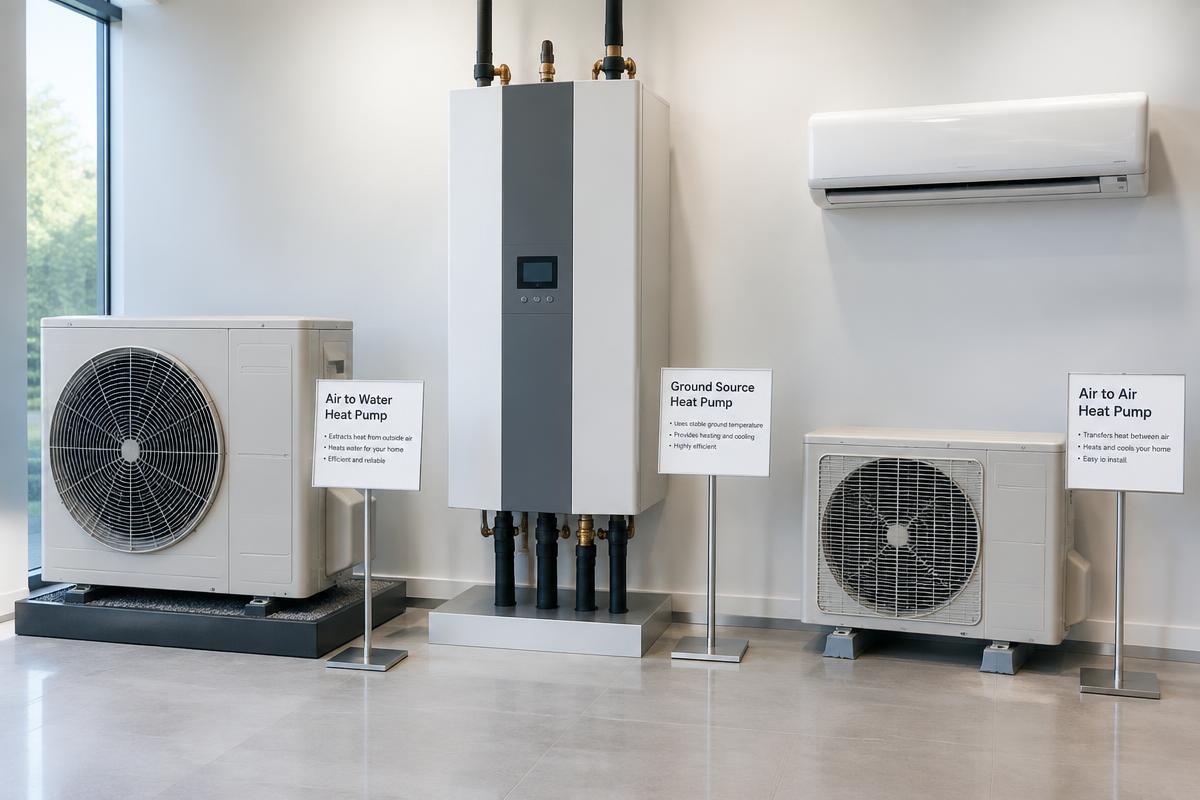
An air-to-water heat pump extracts heat from the outside air and transfers it to the heating system's water. This hot water circulates through underfloor pipes, radiators, or fan coils to heat the home. Depending on the equipment, the same system can provide cooling and domestic hot water.
The main difference from a boiler is that it does not burn fuel to produce heat. It uses electricity primarily to transfer it. For this reason, it can deliver more thermal energy than the electricity it consumes, although cost-efficiency varies by home.
1. How it works, using the refrigerator example
A refrigerator removes heat from its interior and releases it into the room. A heat pump uses the same principle, but in heating mode, it draws energy from the outside and delivers it into the home. Even when the air is cold, it contains thermal energy that can be utilized.
A refrigerant circulates inside the unit in a separate circuit from the heating water. The cycle includes four basic stages:
- Evaporation: The refrigerant absorbs heat from the outside air via a heat exchanger.
- Compression: The compressor increases the pressure and temperature of the refrigerant, consuming electricity.
- Condensation: A second heat exchanger transfers the heat to the system's water.
- Expansion: The refrigerant pressure drops, and the cycle repeats.
The circulator sends the hot water to the rooms. The water returns colder and is reheated. The refrigerant does not mix with the radiator water or tap water.
2. What it connects to and what temperatures are needed
A heat pump usually performs better when it needs to heat water to a relatively low temperature. The greater the difference between the outside air and the required water temperature, the more difficult its operation becomes.
- Underfloor heating: Often operates with a supply of approximately 30–40 °C, depending on the design and floor type.
- Fan coils: Can cover heating requirements with water at approximately 35–45 °C, provided they were selected for these conditions.
- Radiators: May require 45–60 °C or more, depending on their size and building heat loss.
The above values are indicative, not universal settings. An old radiator that was sufficient with a boiler at 75 °C performs significantly less at 45 °C. Before replacing a boiler, the capacity of the radiators at the new temperatures must be checked.
Cooling and domestic hot water
A reversible heat pump can cool water during the summer. For practical cooling, fan coils with condensate drainage and appropriately insulated piping are usually used. Standard radiators are not suitable for this task. Underfloor cooling requires humidity and dew point control to prevent condensation on the floor.
For domestic hot water, a suitable storage tank with a heat exchanger of sufficient surface area is required. Temperature and thermal disinfection cycles are adjusted according to the study and manufacturer's instructions, potentially with the aid of a booster heater.
3. What COP and SCOP mean for consumption
COP is the ratio of delivered thermal power to consumed electrical power under specific test conditions. A COP of 4 means that for every 1 kWh of electricity, 4 kWh of heat is delivered under those conditions. The extra energy comes from the air.
SCOP describes seasonal efficiency under standardized conditions. It is more useful for comparisons, provided the same climate zone and temperature application (e.g., 35 °C or 55 °C) are examined. It is not a guarantee for the actual bill of a specific home.
A simple cost example
If a home needs 12,000 kWh of heat per year and the system achieves a real seasonal efficiency of 3, it will consume approximately 4,000 kWh of electricity for that heating. With a hypothetical variable electricity cost of 0.20–0.30 €/kWh, this results in approximately 800–1,200 € annually. This excludes fixed charges, additional hot water needs, or cooling.
In practice, consumption is influenced by insulation, weather, room temperature, settings, and the use of a backup heater. In cold and humid environments, the outdoor unit periodically performs defrosting to remove ice from the heat exchanger. This is normal operation but affects overall efficiency.
4. What is needed for correct selection and installation
Power selection should not be based solely on square footage. Two 100 m² homes may have very different needs due to the region, insulation, window frames, and exposed surfaces.
- Heat loss calculation: Preferably room-by-room, at the design temperature of the region.
- Actual capacity check: Based on the manufacturer's charts at the low outdoor temperature and required supply, not just at nominal conditions.
- Hydraulic check: Proper flow rates, pipe diameters, balancing, network cleaning, and appropriate filtration.
- Electrical check: Sufficiency of power supply, wiring, and protection, along with the potential operation of electric heaters.
- Correct unit placement: Free airflow, maintenance access, vibration reduction, and safe drainage of defrost water.
Weather compensation adjusts the water temperature to the outside weather. When conditions are milder, it lowers the supply temperature, assisting with cost-efficient operation. Conversely, oversizing can cause frequent starts and stops, especially when the unit's minimum capacity exceeds requirements.
A buffer tank is not mandatory in every installation. It is used when required by minimum water volume, flow rate, or hydraulic layout. For monobloc units, where water circulates outside the building, special anti-freeze precautions are required, even during power outages.
5. Indicative cost and basic maintenance
For a residential installation of approximately 6–12 kW in Greece, an indicative budget range is 7,000–14,000 € including VAT for the unit and basic installation. This is not a binding price: hot water tanks, radiator changes, new fan coils, electrical work, or difficult pipe routing can significantly increase the total. A written offer with clear inclusions and exclusions is required.
Maintenance follows the manufacturer's schedule and usually includes periodic checks for heat exchanger cleanliness, filters, water pressure, tightness, and settings. The owner can keep the area around the unit clear. Work on the refrigerant circuit and electrical components must be entrusted to appropriately licensed professionals.
Frequently Asked Questions
Does it work when the temperature drops below zero?
Yes, many units operate at sub-zero outdoor temperatures. However, available capacity and efficiency change. Selection must be based on the technical specifications of the specific model and the local climate.
Can I keep my existing radiators?
Often yes, but their performance at lower water temperatures needs to be calculated. Insulation upgrades or replacing some radiators with larger ones may be sufficient.
Is a three-phase power supply strictly necessary?
No. There are single-phase and three-phase units. The choice depends on electrical power, auxiliary heating, and other household loads, after an electrician's check.
Is it always cheaper than a boiler?
Not in every case. The comparison requires actual energy prices, seasonal efficiency, and installation costs. A properly designed low-temperature application usually has more favorable conditions for savings.
Conclusion: An air-to-water heat pump transfers heat rather than relying on combustion. Good results depend on the combination of building, heating surfaces, correct sizing, and settings — not just the device's characteristics.