
Introduction: The invisible threat in your walls
In Greece, a large percentage of residential buildings were constructed before 1980. This means that many electrical installations are now 40 or even 50 years old. While a house may appear well-maintained, the wiring hidden behind the walls has an expiration date. The aging of materials, combined with the increased demands of modern appliances, makes replacing the installation not just a matter of functionality, but primarily one of safety.
When is wiring replacement mandatory?
There are specific signs indicating that your installation has reached its limits. If you notice any of the following, you should immediately call a licensed electrician:
- Frequent circuit breaker trips: If the panel "trips" every time you turn on the oven and the air conditioner simultaneously.
- Burning smell: A characteristic "fishy" or burning plastic odor near sockets or the distribution board.
- Flickering lights: Often indicates loose connections or circuit overloading.
- Sockets that are "loose" or hot to the touch: If a socket is warm to the touch, there is a fire risk due to poor contact.
- Absence of a Residual Current Device (RCD): If your panel does not feature a life-saving RCD (anti-electrocution switch), the installation is dangerous.
The risks of old materials: From fabric to PVC
Cables with rubber or fabric insulation
In homes from the 50s and 60s, we often find fabric-covered wiring. Over the decades, this insulation dries out and crumbles, leaving the copper exposed. This can cause short circuits or fire within the conduits (Bergman tubes).
Absence of earthing
Many old networks lacked a grounding conductor in all locations (e.g., at light fixtures or some sockets). The lack of grounding means that in the event of a fault, the electrical discharge will pass through the human body or destroy your sensitive electronic devices.
The total replacement process
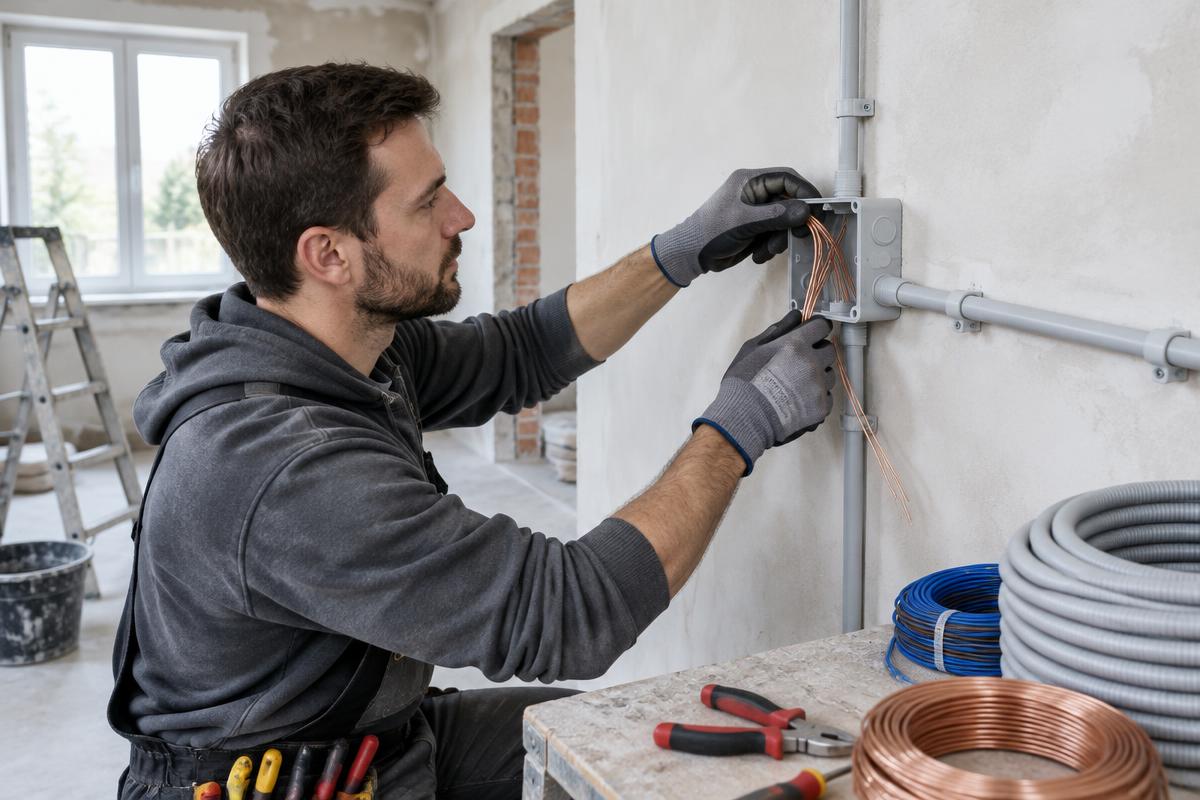
Replacing an installation is not a simple task, but a radical intervention in your home. It includes the following stages:
- Load study: Calculation of needs for air conditioners, induction hobs, dryers, and electric vehicle charging.
- Removal of old cables: Old cables are pulled out of the conduits.
- Installing new conductors: Use of modern NYA type cables with the correct cross-section (1.5mm² for lights, 2.5mm² for sockets, 4mm² or 6mm² for heavy appliances).
- New Electrical Panel: Installation of a panel with branded circuit breakers, an RCD, and potentially lightning protection.
- Testing and Handover Protocol: Measurements with specialized instruments to confirm proper operation.
Cost and duration of works in Greece
The cost for a complete electrical upgrade in an 80-90 sq.m. apartment usually ranges between 2,500€ and 4,500€, depending on the number of points (sockets, switches) and the quality of materials. The work takes approximately 5 to 10 days. It is important to know that if the old conduits in the walls are clogged or damaged, new chasing might be required, which increases the cost of plaster repair and painting.
Frequently Asked Questions (FAQ)
1. Can I just change the distribution board and not the cables?
It is a good first step for safety (adding an RCD), but it does not solve the problem of worn cables inside the walls. If the cables are brittle, the RCD will trip constantly, indicating that the installation needs a total replacement.
2. How often should the installation be checked?
According to legislation (ELOT HD 384), residential inspections by a licensed electrician must be conducted at least every 10 years in order to issue the new Responsible Installer's Declaration (YDE) for HEDNO (DEDDIE).
3. Does it matter if I don't have grounding on some sockets?
Yes, it is extremely dangerous. Appliances with metal casings (refrigerators, washing machines) can "carry" current to their chassis, causing fatal electrocution to anyone who touches them.
4. What is an RCD and why is it necessary?
It is a mechanism that cuts the power in fractions of a second if it detects a leak to the ground or a human body. It is the most important safety feature in every modern home.
Conclusion
The electrical installation is the "nervous system" of your home. Investing in its replacement is not just about comfort, but about protecting your life and your property from short circuits and fires. Do not neglect signs of wear and trust only certified technicians for such work.