
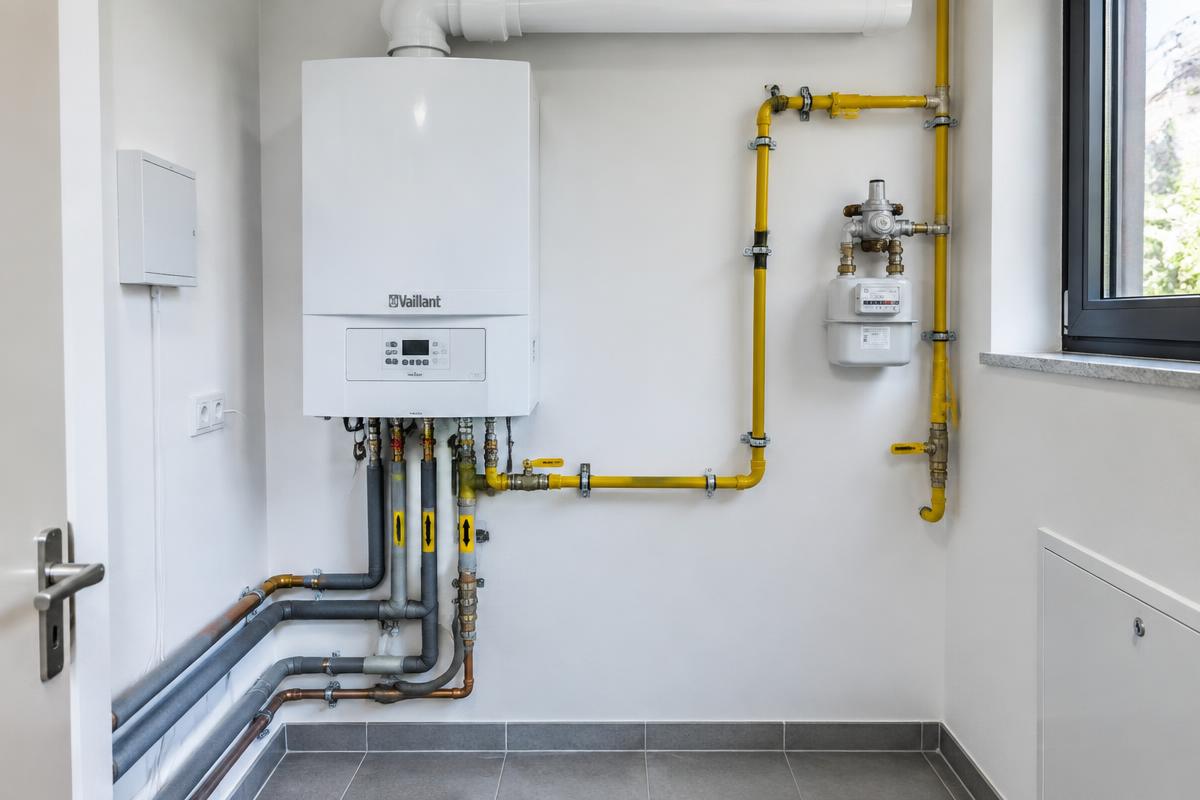
Autonomous heating with natural gas in an apartment building allows each apartment to choose when to heat and how much energy to consume. Independence, however, is not guaranteed simply by purchasing a wall-mounted boiler. It requires checking network availability, a proper disconnection procedure, a study, and safe installation.
The final cost depends mainly on the piping, the ability to utilize existing radiators, and flue gas exhaust requirements. The prices below serve as an indicative budget for a residence in Greece, not as a binding offer.
1. What applies to becoming independent in an apartment building
First, we clarify the difference between central heating with autonomy and a fully independent installation. In the first case, apartments share a common boiler and pay based on expense allocation. In the second, the apartment has its own boiler and gas meter, with a separate supply contract.
For disconnection from central heating, a specific legislative framework applies, primarily Article 127 of Law 4495/2017, as in force. A procedure for autonomy is provided even without a positive decision from the assembly, under specific conditions. This does not mean that the owner can proceed without written actions or technical documentation.
- A written request is submitted to the building manager to convene an assembly.
- The decision or failure to reach a decision is recorded, and the stipulated deadlines are observed.
- The required documentation for improving energy efficiency according to KENAK (Building Energy Performance Regulation) is checked.
- Before works begin, the required data, such as pipe routing and the project schedule, must be disclosed.
- Disconnection is carried out without affecting the heating of other properties, with proper insulation of central heating pipes remaining inside the apartment.
An engineer must inspect the specific case and any required approvals. If there is a dispute over common areas or building regulations, a legal review is also needed. A tenant should not commission permanent modifications without consultation with the property owner.
2. Technical inspection before any purchase
Network availability and equipment location
The existence of a natural gas pipeline on the street is not enough on its own. The competent distribution network operator must confirm the connection capability, the location of the meter, and the terms of the supply construction. The network operator is different from the supplier that issues the consumption invoice.
Simultaneously, the legal location of the boiler, the routing of the gas line, and the flue gas exhaust are checked. We do not arbitrarily choose an outlet next to a window or inside a light well. Distances and layout are determined by regulation, the study, and manufacturer instructions. A condensing boiler also requires suitable condensate drainage, with neutralization provisions where necessary.
Radiators, piping, and boiler power
Existing radiators can often be kept. However, it is not a given that the entire network will be maintained. In an old apartment building with vertical columns supplying different apartments, a new independent network inside the residence is usually needed.
Heating power is selected based on heat loss, not just square footage. A boiler with a nominal power of approximately 24 kW may be chosen for domestic hot water production, while heating needs are much lower. That is why a low minimum operating power is important, to limit continuous start-ups.
3. Step-by-step installation process
- On-site inspection: heating needs, hydraulic network, electrical supply, drainage, and potential routing are recorded.
- Apartment building procedure: written actions, notifications, and approval checks are completed.
- Connection request: technical and financial supply terms are received from the network operator.
- Study and offer: materials, boiler, flue, gas routing, and disconnection works are specified.
- Construction: licensed professionals carry out the gas installation and hydraulic connections.
- Checks and activation: required tests are performed, necessary documents are submitted, and the supply process is completed.
- Commissioning: adjustments, combustion checks, and delivery of instructions and documents take place.
Works inside the apartment are often completed in a few working days. Total time, however, can be several weeks or more, depending on network supply and outstanding building issues. Do not dismantle existing heating before securing a realistic schedule.
4. How much does autonomous gas heating cost?
For an apartment of approximately 80–100 m², the following order of magnitude includes 24% VAT, where applicable. They refer to standard works without particular construction difficulties:
- Wall-mounted condensing boiler: approximately 1,200–2,300 € for the device, depending on equipment and capabilities.
- Study, technical file, and related services: approximately 250–600 €, depending on the scope of the engagement.
- Internal gas line: approximately 400–1,200 €, with significant impact from length, diameter, and access.
- Installation, basic hydraulic connections, flue, and condensate drainage: approximately 700–1,500 €.
- Thermostat and additional automations: approximately 100–350 €.
- New heating network and radiators, if required: an additional 2,000–4,500 €.
A practical total budget is approximately 3,000–6,000 € utilizing a suitable existing network and radiators. With a new network and radiators, it can be around 5,000–10,000 €. Individual charges are often grouped into packages, so they should not be added mechanically without checking their content.
The above does not assume network connection fees, scaffolding, extensive restorations, or a difficult chimney. Request written confirmation for any connection offer: a free supply connection does not mean free internal installation.
Compare at least two detailed offers with the same scope. They must state materials, pipe lengths, automations, tests, warranties, VAT, and exclusions.
5. Consumption, maintenance, and shared fees
There is no reliable single monthly cost for all homes. The area, insulation, floor, operating hours, and desired temperature decisively affect consumption. For tariff comparison, we examine the total cost per kWh, fixed charges, regulated charges, and discount terms.
The condensing boiler performs best with a low return temperature, usually below approximately 55°C. Weather compensation and proper hydraulic balancing help, provided radiators meet space needs at the corresponding water temperatures.
- Budget approximately 80–150 € for standard annual maintenance, excluding spare parts, depending on the area and work.
- Request a combustion check and the required maintenance log.
- Follow the manufacturer's inspection intervals and applicable requirements.
Legal autonomy does not automatically mean zero shared heating costs. In the case of autonomy covered by the relevant provision, exemption from fuel costs is provided, but participation in preventive maintenance and emergency expenses of the central system is still required, unless full exemption is decided as permitted. Allocation should be checked for the specific case.
Frequently asked questions
Do I absolutely need the consent of all owners?
No, unanimity is generally not required. There is a special legal process, even without a positive assembly decision, but compliance with requirements, deadlines, and notifications is necessary.
Can I keep the old radiators?
Often yes, after checking for leaks, capacity, and condition. Network cleaning, a magnetic filter, and new piping may be required to form an independent circuit.
Will I also have domestic hot water?
Yes, provided a suitable dual-function boiler is chosen and necessary connections are made. For simultaneous use of multiple bathrooms, supply checks and potentially a storage tank solution are needed.
Is it always cheaper than central heating?
Not necessarily. The advantage is primarily independent control. Savings depend on the previous system, usage, energy prices, and investment costs.
Conclusion: Proper autonomy starts with an on-site inspection and procedure check, not with choosing a boiler. Secure a clear technical solution, a detailed offer, and documented handling of shared fees so that the installation is safe and the budget is realistic.