Why a water filter cartridge needs replacement
A water filter retains or reduces specific substances, depending on its technology and specifications. Its cartridge, however, has a limited operational life. With use, it can become clogged with particles, its adsorption capacity can be exhausted, or it may stop performing as intended. Timely replacement is essential for the proper functioning of the installation, even when the water appears clean.
Not all filters work in the same way. A sediment filter traps suspended solids like sand and rust. An activated carbon filter is typically used for chlorine, taste, and odor reduction, while special cartridges target other substances. In reverse osmosis, there are different stages with separate maintenance requirements.
Good taste does not prove that the filter is still providing the intended treatment. Some contaminants cannot be detected by the senses. Therefore, the decision to replace must be based primarily on the manufacturer's instructions and not solely on the appearance of the water.
How often should a water filter cartridge be changed?
There is no single replacement interval that applies to all water filters. The manufacturer usually specifies a maximum service time, a maximum volume of filtered water, or specific operating criteria. When both time and volumetric limits are provided, replacement must be performed as soon as either one is reached first.
For example, if a cartridge requires replacement at six months or 4,000 liters, do not wait for the six-month period to pass if the declared capacity has already been exhausted. This example is not a general rule: always check the manual and the exact code for your specific cartridge.
The actual service life is primarily affected by:
- The quality of incoming water: increased suspended solids can accelerate the clogging of a pre-filter.
- Consumption: a household with more people or commercial use exhausts the volumetric capacity faster.
- Operating flow: exceeding the nominal flow rate can degrade treatment effectiveness.
- Installation conditions: temperature, pressure, and prolonged inactivity require attention according to the system's instructions.
Limited use does not automatically extend the time limit for replacement. In summer homes or spaces that remain closed, returning to operation may require flushing, disinfection, or replacement, depending on the duration of inactivity and the manufacturer's instructions.
What signs indicate the filter needs checking?
Reduced flow at the tap: when water runs noticeably slower, the cartridge may be clogged. Before attributing the problem to the filter, check for general pressure drops, a partially closed valve, or a clogged aerator at the tap. If the reduction only appears at the filtered water outlet, the filter is a likely cause.
Return of taste or odor: the return of chlorine odor in an activated carbon system may indicate material exhaustion, increased flow, or a change in the feed water. An unusual or intense odor requires investigation, not just a cartridge change without checking the cause.
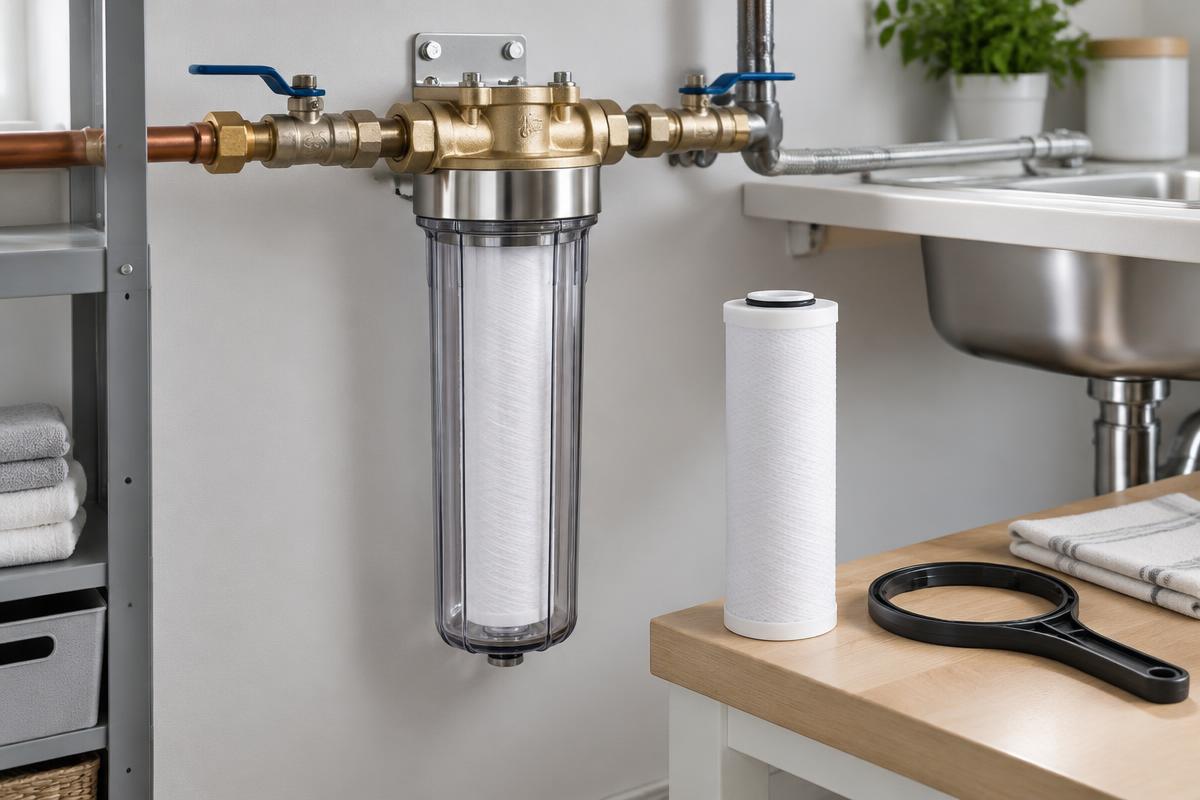
Visible particle accumulation: in a transparent pre-filter housing, heavy buildup of rust or silt justifies an inspection. Color alone, however, does not measure the remaining capacity of an activated carbon filter and does not accurately determine the replacement time.
Maintenance indicator or increased differential pressure: some systems feature a timer, volume counter, or pressure gauges before and after the filter. The pressure difference, at a comparable flow rate, helps evaluate clogging. The acceptable limit is determined by the manufacturer. A simple light reminder is usually not a water quality sensor.
If sudden cloudiness, unusual color, or suspected contamination occurs, do not assume a new residential filter is sufficient. Avoid consuming the suspicious water until the cause is clarified and follow the instructions of the water utility provider or the relevant authorities.
How to properly replace the cartridge
The procedure differs between countertop, undersink, whole-house, and reverse osmosis systems. Follow the manual for your specific model. If you do not know how to isolate and safely depressurize the system, entrust the task to a technician.
- Verify the correct cartridge: check the code, dimensions, connection type, flow rate, and compatibility with the housing.
- Shut off the supply and release pressure: use the provided valve and the depressurization procedure. Do not open a housing under pressure.
- Remove the old element: with clean hands and tools, avoiding contact with clean water outlet surfaces.
- Inspect the housing and seals: clean or disinfect only with approved means and replace worn O-rings.
- Install and restart: observe the flow direction, avoid overtightening, and gradually turn on the supply.
- Perform the required flushing: discard the initial water for the time or volume stated by the manufacturer and check for leaks.
In carbon filters, fine carbon particles may initially appear, which are removed by the required flushing. If the appearance of the water does not clear up, stop usage and check the installation. Record the change date and reset the reminder only after the replacement is complete.
How to choose a cartridge and organize maintenance
The appropriate cartridge is not chosen solely by size or micron rating. Nominal and absolute retention capacities are not identical, and a smaller pore size does not always mean a better choice: it can increase resistance and limit flow.
Check which specific substance reductions the product is documented or certified for. A common activated carbon filter should not be considered a softener or disinfection medium. For well water, water of unknown origin, or water with a specific problem, a proper water analysis and technical treatment selection should come first.
A simple maintenance file with dates, cartridge codes, and consumption indicators reduces omissions. For multi-stage systems, keep a separate schedule for pre-filters, the membrane, and the final filter, as they do not necessarily have the same service life.
Frequently Asked Questions
Do I need to change the filter if the water still tastes good?
Yes, provided the manufacturer's time or volumetric limit has been reached. Taste does not reveal all contaminants nor does it prove remaining treatment capacity.
Can I wash the cartridge and reuse it?
Only if it is explicitly designed as washable or reusable. Standard activated carbon cartridges and many sediment filters do not recover their performance with a rinse.
Does a TDS meter show when a change is needed?
Not for every filter. TDS meters estimate dissolved solids via conductivity and do not generally detect microbes or specific dangerous contaminants. In reverse osmosis, comparative input and output measurements help evaluate the membrane, along with other checks.
If I change the cartridge, is low pressure always solved?
No. The cause may lie in the tap, the pipes, the pressure regulator, or the supply. If flow is not restored after proper replacement and flushing, a technical inspection is needed.