
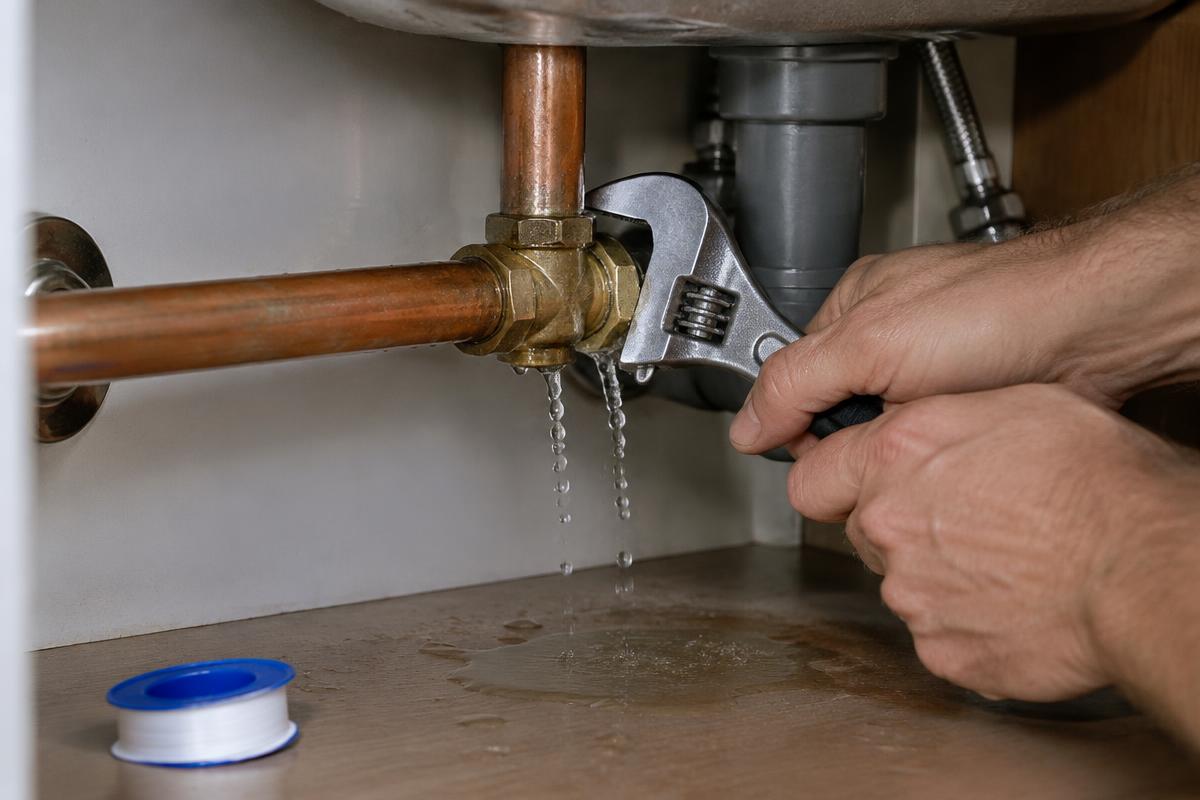
What signs indicate a water leak in the wall?
A stain behind the shower, blistered paint in an adjacent room, or grout that remains wet can indicate a hidden leak. However, these do not prove that a pipe has burst. Moisture can originate from a waterproofing failure, problematic drainage, condensation, or even from a neighboring apartment. Proper diagnosis must precede any demolition.
Signs that require investigation include the reappearance of stains after painting, plaster peeling, efflorescence on the surface, a musty odor, and an unexplained increase in water consumption. Similarly, a repetitive pressure drop in a closed heating circuit can be related to water loss, but also to other installation issues.
A visible sign is not necessarily located directly across from the damage. Water travels through mortars, joints, and voids, appearing quite far from the source. This is why random tile removal often increases the damage without solving the problem.
What to do immediately and what checks you can perform
If there is active flow or the stain is growing quickly, shut off the water supply to the apartment, provided the valve is safely accessible. Stop using the suspected installation and inform the building manager or neighbor when communal areas or another apartment are affected. Cutting off the supply does not necessarily stop water coming from drainage, heating, or another property.
If moisture is near power outlets, switches, or electrical appliances, do not touch wet components. Isolate the corresponding circuit only from a dry, safely accessible panel. If this is not possible, move away from the area and call an electrician. Do not drill into the wall looking for the leak.
For an initial check of the plumbing, turn off all consumption and ensure that the toilet is not filling and that neither the washing machine nor automatic irrigation is running. Photograph the meter reading and monitor if it changes during a period of non-use. Movement of the meter indicates consumption or a potential loss downstream, not its exact location.
If the meter remains stationary, a drainage leak, waterproofing failure, or a small, intermittent loss cannot be ruled out. Record when the stain appears: after a shower, regardless of use, when the heating is on, or after rain. This information significantly narrows down the search.
How to perform leak detection without extensive demolition
Professional detection combines inspection, measurements, and controlled tests. No single instrument detects all faults with the same reliability. The choice of method depends on the material and depth of the pipes, operating pressure, and wall structure.
- Moisture meter: helps map moisture and compare suspected areas with dry ones. Metals, salts, and different materials can affect readings, so a single measurement is not sufficient.
- Thermographic camera: records surface temperature differences that may be related to water or evaporation. It does not “see through the wall” and does not prove a leak on its own. Thermal bridges, heating pipes, and environmental conditions require careful interpretation.
- Acoustic detection: looks for the noise of water escaping from a pressurized pipe. Effectiveness is affected by pipe material, the size of the leak, and ambient noise.
- Pressure testing: by isolating individual branches and using proper procedures, it is checked whether a section loses pressure. This is done by a technician with limits compatible with the components and system guidelines, not with arbitrary overpressure.
- Tracer gas: in appropriate cases, a special test mixture and detector are used to narrow down the leak area. This requires specialized equipment and proper isolation of the installation; it is not a test involving fuel gas.
- Inspection camera or endoscope: can be used in accessible drainage or voids. Access is gained from an existing opening or, where necessary, a small targeted hole.
The highest reliability is obtained when different findings converge. For example, a pressure drop in a specific branch combined with localized moisture justifies a more targeted intervention than a stain or a thermal image alone.
Plumbing, drainage, or waterproofing: why the distinction matters
Plumbing leak: can continue as long as the problematic branch is under pressure, even with taps closed. The technician checks cold and hot water separately, where isolation is possible, as well as accessible connections, flexible hoses, faucets, and flush tanks.
Drainage leak: usually manifests when water passes through a specific plumbing fixture. Controlled use of each point separately helps investigate traps, connections, and pipes. It is not recommended to repeatedly dump large amounts of water when damage is already occurring.
Waterproofing failure: is often associated with wet flooring or shower walls. Damaged silicone and cracked grout need checking, but tiles and grout do not replace the waterproofing layer. A surface coating can temporarily hide the symptom without fixing the cause.
Targeted repair and proper wall restoration
Detection without extensive demolition does not always mean repair without any opening at all. If an embedded pipe or fitting has failed, local access is usually required. The goal is to choose the smallest practically necessary opening, possibly from the adjacent room, provided it is technically safe and less destructive.
Before intervention, ask for an explanation of findings and a separation of tasks: diagnosis, hydraulic repair, waterproofing, and surface restoration. In an old network with recurring faults, an assessment of a wider section may be needed rather than successive local patches.
After the repair, a leak test is performed before closing the wall. Drying and moisture measurements follow before plastering, tiling, or painting. The time required depends on the materials and their saturation, not a fixed number of days. Extensive mold or contamination from sewage requires appropriate professional remediation.
Frequently Asked Questions
Can every leak be found without breaking tiles?
Not in every case. Non-destructive methods often significantly limit the search area, but a small exploratory opening may be needed for confirmation or access to the repair.
Is one thermography scan enough for a secure diagnosis?
No. Thermography shows temperature differences, not the leak itself. It is evaluated together with moisture measurements, the history of appearance, and, where necessary, a leak test.
Why does the stain remain after the pipe was repaired?
Building materials may have stored water and are drying slowly. Progress is checked with repeated measurements. If moisture increases or returns, new investigation is needed, not just painting.
What determines the cost of detection and repair?
Access, the number of circuits checked, the methods required, and the extent of restoration. Ask for a clear quote that separates the diagnostic check from the repair and finishing work.