
Hybrid Heat Pump with a Boiler: How It Works, Costs and When It Makes Sense
Replacing an existing boiler with a heat pump is not the only way to upgrade a building’s heating system.
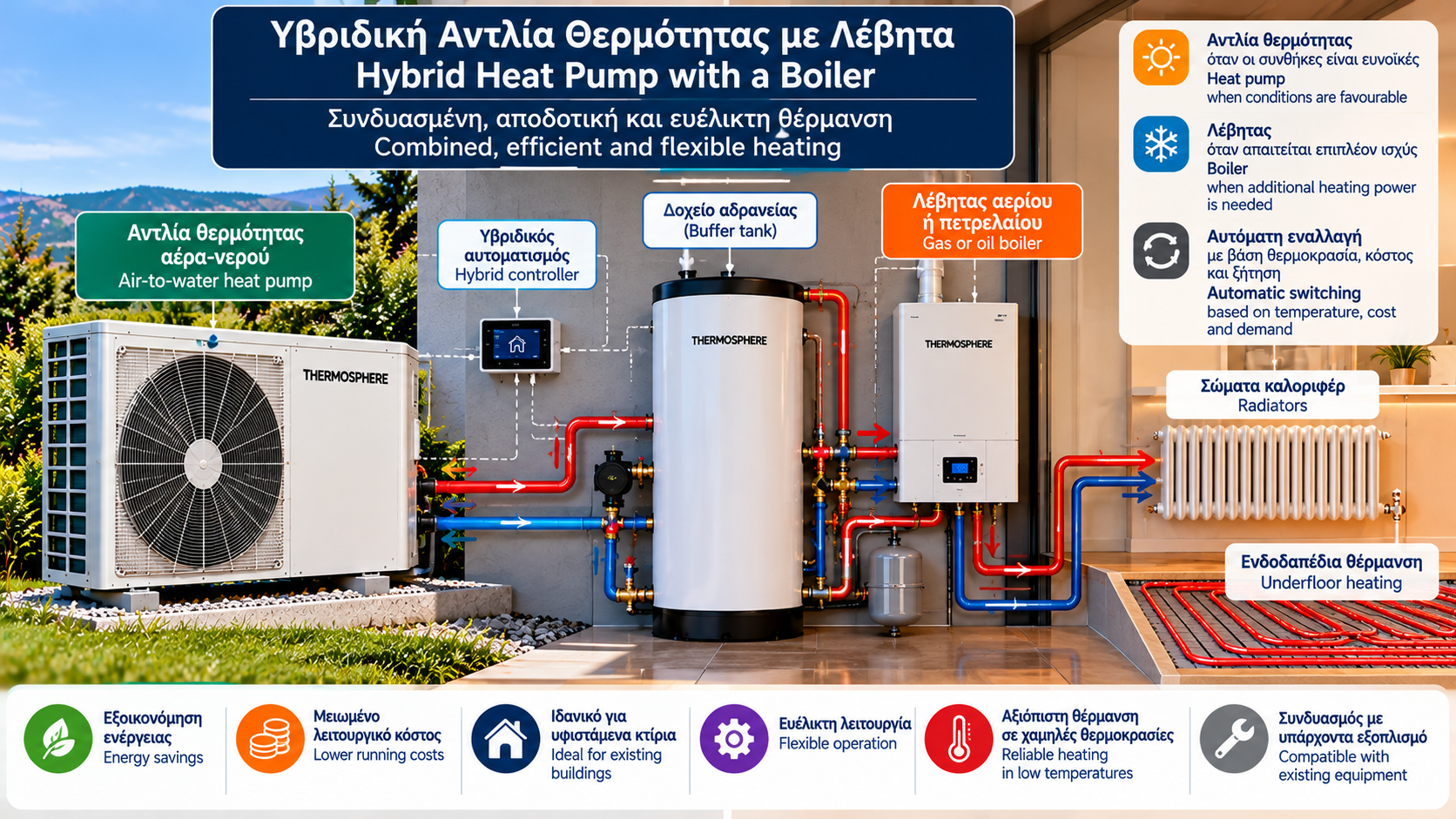
In some properties, a hybrid heating system can combine an electric heat pump with an existing or new gas or oil boiler.
The objective is to use each heat source under suitable operating conditions, taking account of outdoor temperature, heating demand and energy prices.
However, hybrid heating is not automatically cheaper or more efficient than a standalone heat pump. Its success depends on correct system design, equipment compatibility and control strategy.
1. What Is a Hybrid Heat Pump?
A hybrid heat pump system combines two heat sources:
An electrically driven heat pump.
A boiler, typically operating on natural gas or heating oil.
The sources may operate alternately or, where the system design permits, contribute heat simultaneously.
Some manufacturers offer integrated hybrid packages. Other installations combine compatible equipment through a purpose-designed hydraulic and control arrangement.
Retrofitting an existing boiler requires careful assessment of its condition, hydraulic compatibility and control capabilities.
2. How Does a Hybrid Heating System Work?
A typical operating strategy might be:
Mild outdoor conditions: The heat pump meets the heating demand when it can operate efficiently.
Colder outdoor conditions: The controller may activate the boiler if the heat pump cannot meet the load or if boiler operation is more economical under the programmed assumptions.
High heating demand: Some systems allow both heat sources to contribute simultaneously.
The exact sequence depends on the manufacturer and system configuration.
Not every hybrid system supports simultaneous operation.
3. Hybrid Heating and Dual-Fuel Heating
The terms hybrid heating and dual-fuel heating often describe systems combining an electric heat pump with a fuel-fired boiler.
However, the underlying arrangements can differ.
Some systems switch between heat sources, while others permit parallel operation.
Before selecting equipment, confirm:
Whether simultaneous operation is supported.
Which source receives priority.
How switching decisions are made.
Whether electricity and fuel prices can be entered.
How domestic hot water is produced.
4. What Is the Bivalent Temperature?
The bivalent temperature is an outdoor temperature used in the design or control of a heating system with two heat sources.
It is often associated with the point below which the heat pump cannot independently meet the building’s entire heating demand.
This should not be confused with the economic switching point, at which the controller selects the lower-cost heat source.
The capacity-based bivalent temperature and economic switching point may differ.
There is no universal bivalent temperature suitable for every building.
5. When Does Keeping an Existing Boiler Make Sense?
Hybrid heating may be worth investigating when:
A suitable, well-maintained boiler is already installed.
The building has substantial heat losses during very cold weather.
Existing radiators require relatively high water temperatures at peak load.
Full system conversion would require extensive modifications.
An engineering assessment identifies a genuine economic or operational advantage.
Keeping an old boiler is not automatically beneficial. Its safety, efficiency, condition and maintenance costs must be evaluated.
6. When Might Hybrid Heating Be Unnecessary?
A hybrid arrangement may be less attractive when:
A properly sized heat pump can meet the complete heating demand efficiently.
The existing boiler requires expensive repairs.
Maintaining two heat sources adds significant cost.
Installation space is limited.
Hydraulic modifications are extensive.
Projected running-cost savings do not justify the investment.
In a well-insulated building with low-temperature heating, a standalone heat pump may offer a simpler solution.
7. Heat Pump Combined with a Gas Boiler
A hybrid system with a gas boiler retains gas heating as an alternative or supplementary heat source.
The controller may consider:
Outdoor temperature.
Required supply water temperature.
Available heat pump capacity.
Electricity prices.
Gas prices.
Boiler efficiency.
Fixed gas connection charges should also be considered when evaluating total annual costs.
8. Heat Pump Combined with an Oil Boiler
Combining a heat pump with an oil boiler is also technically possible when the equipment and installation are suitable.
Important considerations include:
Actual boiler efficiency.
Burner condition.
Flue maintenance.
Fuel storage.
Heating oil prices.
Safe hydraulic separation and source control.
An existing oil boiler should not be assumed suitable without inspection.
9. Which Heat Source Is Cheaper to Operate?
A useful starting point is the cost of producing one kilowatt-hour of useful heat.
For a heat pump:
Heat cost = Electricity price per kWh ÷ COP
For a boiler:
Heat cost = Fuel energy price per kWh ÷ boiler efficiency
The fuel price and efficiency must be expressed on consistent energy bases.
Hypothetical Calculation
Assume:
Electricity price: €0.20/kWh.
Heat pump COP: 3.5.
Fuel energy price: €0.11/kWh.
Boiler efficiency: 90%.
Then:
Heat pump: €0.20 ÷ 3.5 = €0.057 per kWh of useful heat.
Boiler: €0.11 ÷ 0.90 = €0.122 per kWh of useful heat.
Under these hypothetical operating conditions, the heat pump provides cheaper useful heat.
If the COP decreases, its cost per kilowatt-hour of useful heat increases.
This simplified example excludes standing charges, auxiliary electricity, maintenance and other expenses. It is not a forecast of actual household bills.
10. Can Both Heat Sources Operate Together?
Yes, in some hybrid configurations.
For example, the heat pump may supply part of the required heat while the boiler provides supplementary capacity.
This requires a compatible hydraulic arrangement and control system.
Other configurations permit only one heat source to operate at a time.
Two heat generators should never be connected without confirming the manufacturer’s approved system architecture.
11. How Are Hybrid Systems Hydraulically Connected?
Hydraulic design depends on the specific heat pump, boiler and distribution system.
Possible components include:
Hydraulic separation, where necessary.
Buffer vessel, if justified by system requirements.
Circulation pumps.
Non-return valves.
Isolation valves.
Temperature sensors.
Safety devices.
Hybrid controller.
The design should prevent unwanted water circulation through an inactive heat source.
It must also maintain the heat pump’s required water flow.
12. Is a Buffer Tank Required?
Not necessarily.
A buffer vessel may provide additional system water volume, hydraulic separation or operational stability.
Its necessity depends on the heat pump manufacturer’s requirements and the hydraulic design.
Adding a buffer vessel without a clear purpose can increase heat losses, installation cost and complexity.
13. How Does Hybrid Control Work?
A hybrid controller may consider:
Outdoor temperature.
Heating-water supply temperature.
Building heat demand.
Available heat pump capacity.
COP or estimated efficiency.
Energy prices.
Equipment operating times.
Domestic hot water priorities.
Safety constraints.
Some controllers use a simple predefined switching temperature.
Others can optimise operation using more detailed efficiency and energy-price information.
The presence of a controller does not guarantee savings if it is configured incorrectly.
14. Can Hybrid Heating Work with Existing Radiators?
Yes, provided the installation is properly designed.
During mild weather, the heat pump may operate with lower water temperatures.
In colder conditions, the boiler may supplement or replace heat pump operation, depending on the system strategy.
However, keeping the boiler does not remove the need to assess radiator output and building heat losses.
15. What About Domestic Hot Water?
Possible arrangements include:
Domestic hot water produced by the boiler.
Domestic hot water produced by the heat pump.
Combined production with suitable control priorities.
The choice depends on equipment compatibility, storage requirements and hygiene considerations.
Domestic hot water control may follow a different strategy from space heating.
16. How Much Does a Hybrid System Cost?
Installation costs depend on:
Heat pump equipment.
Existing boiler condition.
Hybrid controller.
Hydraulic modifications.
Additional components.
Electrical work.
Commissioning.
Retaining an existing boiler does not necessarily make a hybrid system cheaper than a standalone heat pump installation.
Detailed quotations are needed for a meaningful comparison.
17. What Are the Disadvantages?
A hybrid system is generally more complex than a heating installation with one heat source.
Potential disadvantages include:
Maintenance of two heating appliances.
Additional controls.
More hydraulic components.
More potential failure points.
Continued fuel infrastructure costs.
Ongoing combustion-related emissions.
Greater commissioning and optimisation requirements.
18. Five Common Mistakes
1. Connecting the heat pump and boiler without a coordinated control strategy.
The equipment may operate inefficiently or interfere with each other.
2. Selecting a switching temperature without engineering analysis.
Outdoor temperature alone does not determine the most economical heat source.
3. Ignoring minimum heat pump water-flow requirements.
Inadequate flow can cause operating problems.
4. Keeping a boiler in poor technical condition.
This can increase failure risks and reduce the expected benefit.
5. Comparing fuel costs alone.
Fixed charges, maintenance and installation costs also matter.
19. Frequently Asked Questions
Can I Connect a Heat Pump to My Existing Boiler?
Often, yes, but equipment compatibility, hydraulic design and controls must be assessed.
Is Hybrid Heating Better Than Replacing the Boiler Completely?
Not always. The answer depends on the building, energy prices and total system costs.
Can an Oil Boiler Be Used?
Yes, provided the boiler is suitable and the system is properly designed.
Will the Heat Pump Always Operate First?
Not necessarily. The controller’s operating strategy determines source priority.
Does Hybrid Heating Require More Maintenance?
Both heat sources generally require maintenance according to their respective specifications.
Can Hybrid Heating Work with Underfloor Heating?
Yes, provided suitable water-temperature controls and hydraulic design are used.
Does Hybrid Heating Always Reduce Energy Consumption?
No. The result depends on the proportion of heat supplied by each source and their operating efficiencies.
Conclusion
A hybrid heat pump and boiler system can offer a practical way to upgrade an existing heating installation in stages.
It may use the heat pump under favourable conditions while retaining the boiler for supplementary capacity or specific operating requirements.
However, two heat sources increase complexity and do not automatically guarantee lower costs.
Hybrid heating is worth considering when a technical and economic assessment demonstrates a genuine advantage over a correctly designed standalone heat pump.
Thermosphere.gr — Technical knowledge for heating and building systems.