
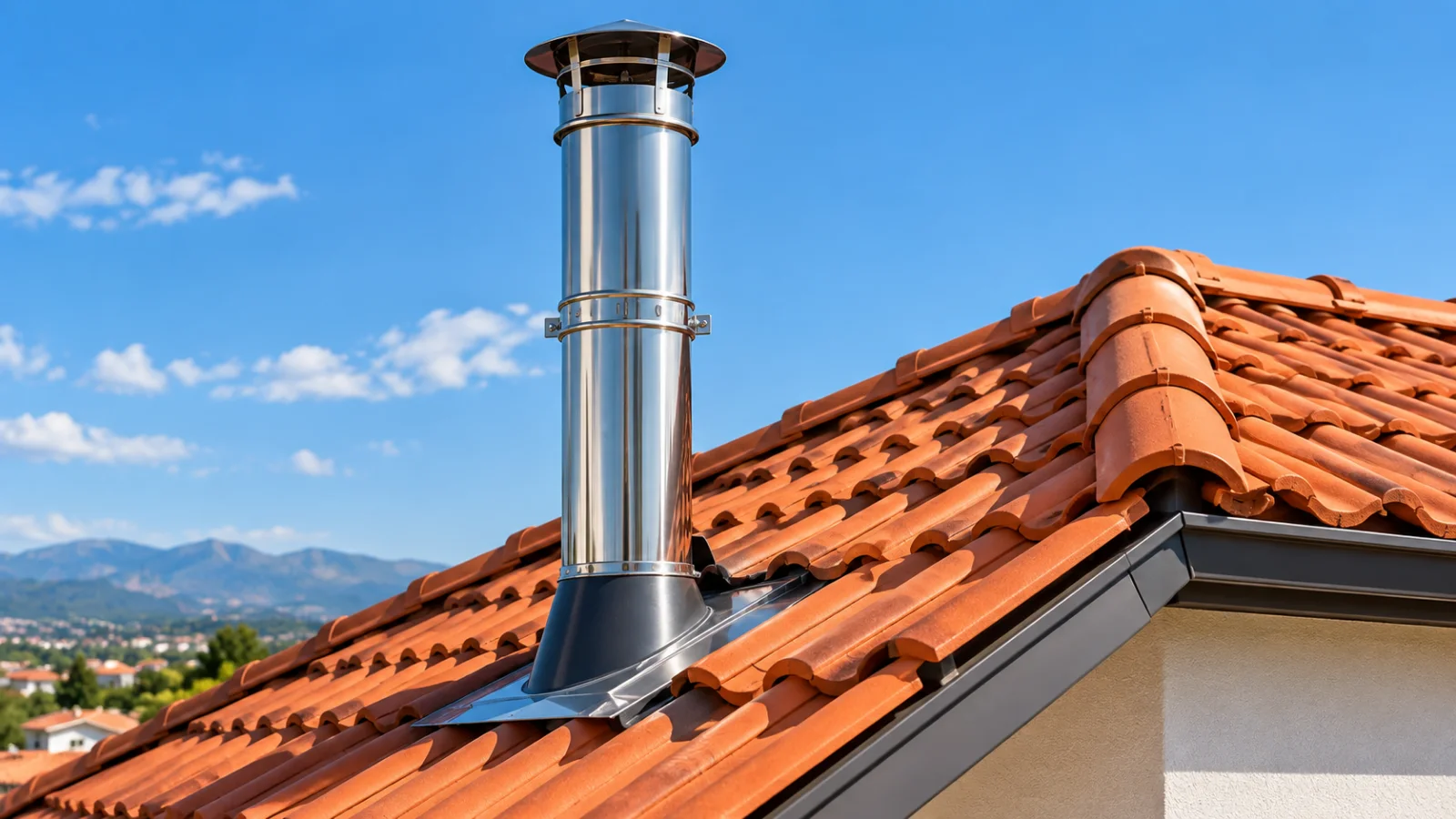
Chimney Height: How It Affects Draft and How to Determine the Correct Height
Chimney height is an important parameter in the design of a flue gas evacuation system. It influences the available natural draft pressure, flue gas flow conditions and, together with other factors, the safe operation of a heating installation.
A chimney that is too short may fail to provide sufficient draft. However, increasing chimney height excessively is not always the correct solution.
The appropriate height must be determined according to the heating appliance, chimney route, internal diameter, flue gas temperature and installation conditions.
How Does Chimney Height Affect Natural Draft?
Natural chimney draft is generated by the difference in density between the warm flue gases inside the chimney and the cooler surrounding outdoor air.
When the flue gases are less dense than the outdoor air, a pressure difference develops that contributes to their upward movement.
In simplified form, the theoretical buoyancy pressure can be expressed as:
Δp = g × H × (ρₐ − ρᶠ)
Where:
Δp: Theoretical buoyancy pressure difference, in Pa.
g: Gravitational acceleration, in m/s².
H: Effective vertical chimney height, in m.
ρₐ: Outdoor air density, in kg/m³.
ρᶠ: Representative flue gas density, in kg/m³.
This equation is a simplified representation and does not replace a complete thermal and fluid dynamic calculation.
As the effective chimney height increases, the theoretical natural draft pressure may also increase.
However, actual operating conditions are influenced by pressure losses and flue gas cooling.
What Happens When a Chimney Is Too Short?
In natural-draft installations, insufficient chimney height can limit the available pressure difference.
Depending on the appliance and operating conditions, this may result in:
Difficulty starting combustion.
Unstable chimney draft.
Smoke entering the occupied space.
Inadequate flue gas evacuation.
Increased sensitivity to changes in wind conditions.
These symptoms are not necessarily caused by chimney height alone. They may also be associated with insufficient combustion air, obstructions, incorrect sizing or appliance-related problems.
Safety warning: Smoke or flue gases entering an indoor space can indicate a serious safety hazard. The appliance should be taken out of operation until the installation has been inspected by a suitably qualified professional.
Is a Taller Chimney Always Better?
Not necessarily.
Increasing chimney height can improve the theoretical natural draft pressure, but it also increases the length of the flue gas path.
This may lead to:
Additional frictional pressure losses.
Greater heat losses.
Increased flue gas cooling.
Additional structural support requirements.
Greater exposure to wind loads.
In certain installations, excessive draft may also adversely affect appliance operation.
Therefore, the objective is not to achieve the greatest possible chimney height, but to establish suitable operating conditions.
How High Should a Chimney Extend Above the Roof?
The position of the chimney termination is a separate consideration from the total chimney height.
The termination must be positioned to allow safe dispersion of combustion products while reducing the influence of adverse wind pressures.
The design should consider:
Roof shape and pitch.
Position of the roof ridge.
Horizontal distance from the ridge.
Adjacent buildings.
Openings and potential air intake locations.
Nearby obstacles and local wind conditions.
Manufacturer requirements and applicable regulations.
There is no single universal height above the roof that applies to every appliance and building.
The required termination position and clearances must be determined according to the applicable regulations and the instructions for the specific installation.
How Does Wind Affect Chimney Performance?
Wind can create positive and negative pressure zones around roofs and nearby structural elements.
Depending on the chimney termination position, these pressure conditions may affect flue gas flow.
A termination located in an unfavourable wind-pressure zone may experience unstable operation even when the overall chimney height appears sufficient.
For this reason, chimney termination position and roof geometry should be assessed together.
Installing an anti-downdraught terminal or chimney cowl is not a universal solution. Any terminal must be compatible with the flue system and permitted by the manufacturer.
What Role Do Chimney Diameter and Insulation Play?
Chimney height cannot be considered independently of diameter.
The internal diameter influences flue gas velocity and pressure losses.
At the same time, thermal insulation affects the temperature profile of the flue gases along the chimney.
In an external chimney without adequate insulation, significant cooling can reduce the available natural draft pressure.
Therefore, increasing chimney height does not necessarily correct an unsuitable diameter or insufficient insulation.
How Is the Correct Chimney Height Calculated According to EN 13384-1?
The European standard EN 13384-1 describes thermal and fluid dynamic calculation methods for chimneys serving one combustion appliance.
The calculation considers parameters such as:
Flue gas mass flow rate.
Flue gas temperature at the appliance outlet.
Appliance pressure requirements.
Chimney geometry and effective height.
Internal diameter and surface roughness.
Resistance from bends and fittings.
Thermal properties of the chimney system.
External design conditions.
The calculation assesses whether the system can operate within the required pressure and temperature limits.
The result is not simply a chimney height in metres, but a technically justified design of the complete flue system.
What Does EN 15287-1 Cover?
EN 15287-1 addresses chimney design, installation and commissioning within its scope of application.
Among the matters considered are chimney routing, termination position, inspection access and installation requirements.
Its application must be considered alongside relevant national requirements and the manufacturer's instructions.
What About Condensing Boilers?
Condensing boilers frequently use fan-assisted flue gas evacuation systems that operate under positive pressure.
In these installations, natural draft is not necessarily the primary mechanism for removing combustion products.
The permitted flue route, length, diameter, bends and termination position are determined by the approved system configuration and the boiler manufacturer's instructions.
Rules intended for traditional natural-draft chimneys should not automatically be applied to these systems.
Common Mistakes When Determining Chimney Height
Increasing Chimney Height Without Calculation
Adding extra chimney sections without a proper assessment may fail to address the actual cause of poor performance.
Ignoring Roof Geometry and Nearby Obstacles
The chimney termination may be located in an unfavourable wind-pressure zone.
Selecting Height Without Checking Diameter
Height and diameter must be evaluated as interdependent parameters within the same system.
Overlooking Heat Losses
A long external chimney route can result in significant flue gas cooling.
Ignoring Appliance Requirements
The flue system requirements for a boiler, stove or fireplace may differ substantially.
When Is a Professional Chimney Inspection Necessary?
A chimney inspection is particularly important when any of the following occur:
Smoke entering the occupied space.
Difficulty lighting the appliance or unstable combustion.
Unusual flue gas odours.
Repeated appliance malfunctions.
Problems that occur mainly during windy weather.
The inspection should consider the appliance, combustion air supply, chimney condition and flue gas evacuation conditions.
Conclusion
Correct chimney height is the result of an integrated design process rather than the application of a single universal rule.
In natural-draft installations, chimney height contributes to the available draft pressure, but actual performance also depends on temperature, diameter, pressure losses and wind conditions.
Correct termination positioning, appropriate sizing and compliance with appliance requirements are essential for safe operation.
Chimney calculations and installation should be carried out by suitably qualified professionals in accordance with applicable standards, national regulations and manufacturer instructions.
Technical References
EN 13384-1 — Chimneys: Thermal and fluid dynamic calculation methods — Part 1: Chimneys serving one combustion appliance.
EN 15287-1 — Chimneys: Design, installation and commissioning — Part 1.
EN 1443 — Chimneys: General requirements.
CEN/TR 1749 — European scheme for the classification of gas appliances according to the method of supplying combustion air and evacuating combustion products.
The applicable editions of standards, national regulations and manufacturer-specific requirements should be verified before applying them to an individual installation.