
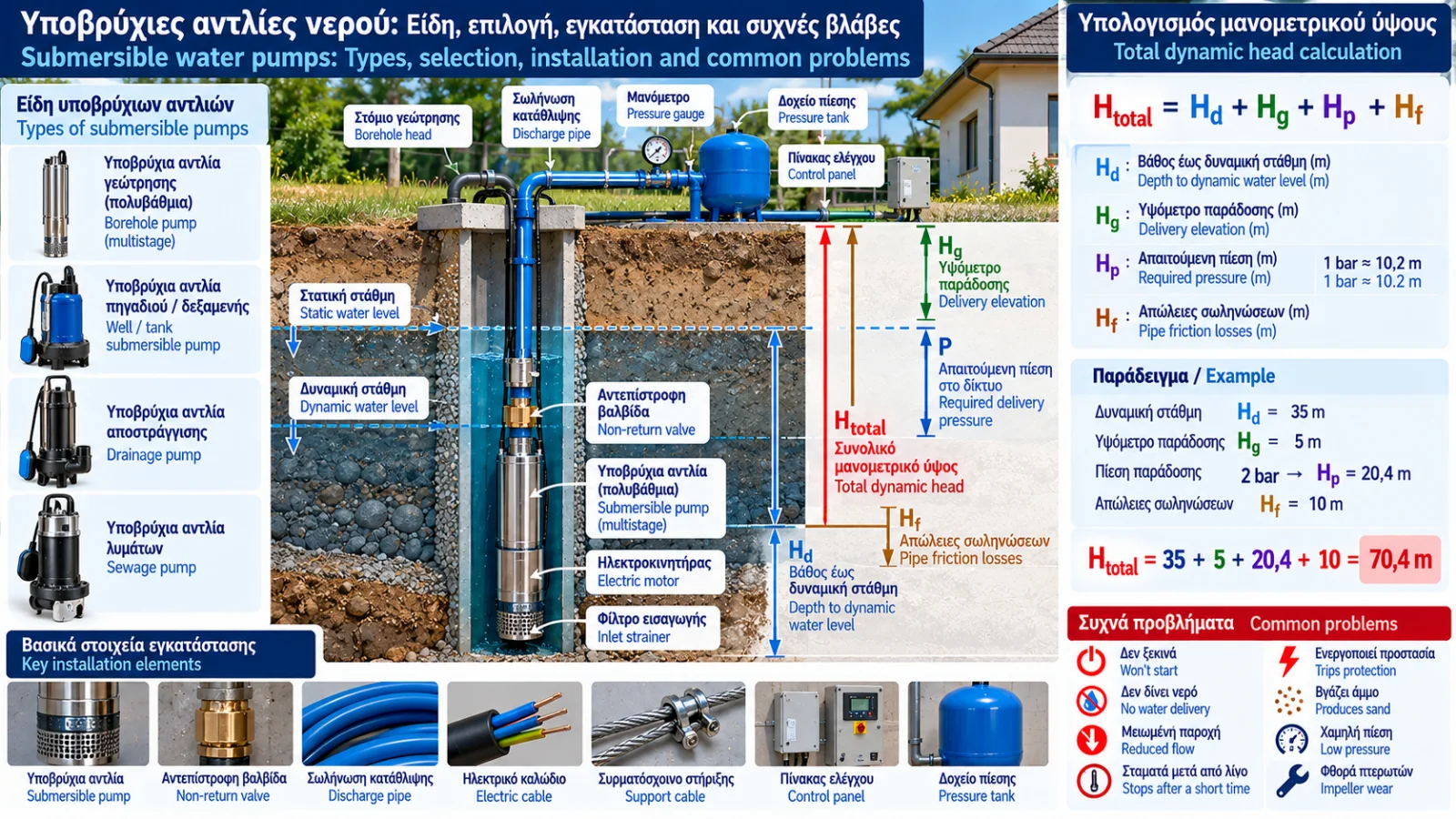
Submersible Water Pumps: Types, Selection, Installation and Common Problems
Submersible water pumps are widely used in boreholes, wells, storage tanks, water supply systems, irrigation and drainage applications.
Unlike surface pumps, their hydraulic components operate while submerged in water. Depending on the design, the electric motor may also be integrated into a sealed underwater assembly.
This allows water to be pumped from depths beyond the conventional suction capability of surface pumps.
However, selecting the right submersible pump requires more than knowing the borehole depth or motor power.
Flow rate, dynamic water level, total dynamic head, borehole diameter and water quality must all be considered.
This Thermosphere.gr guide explains how submersible pumps work, how to select them and how to recognise common operating problems.
1. What Is a Submersible Water Pump?
A submersible pump is designed to operate inside the liquid being pumped.
In common electrically driven designs, the motor and hydraulic section form a single assembly.
The pump transfers energy to water and delivers it through a discharge pipe.
Its submerged arrangement avoids the need for a long suction line, as used with many surface pumps.
However, submersible pumps still have specific operating limits.
These may include maximum submersion depth, water temperature, allowable solids, cooling requirements and permitted operating range.
2. How Does a Borehole Submersible Pump Work?
Most deep-borehole pumps for clean water use multistage centrifugal hydraulics.
Water enters through the pump inlet and passes through successive hydraulic stages.
Each stage typically includes an impeller and stationary components that transfer additional energy to the water.
This allows the pump to achieve higher total head.
The water then travels through the discharge pipe towards a tank or distribution system.
The motor must operate within the manufacturer's cooling requirements.
In many borehole pump assemblies, sufficient water movement around the motor is essential for removing heat.
3. Main Types of Submersible Pumps
Borehole Pumps
These are typically long, narrow pumps designed to fit inside borehole casings.
They are used for water supply, irrigation and tank filling.
Many use multiple hydraulic stages.
Well Pumps
These are used in larger-diameter wells.
Some models are also suitable for tanks or open water sources.
Tank Submersible Pumps
These transfer clean water from storage tanks.
They may operate with pressure booster systems or automatic level controls.
Drainage Pumps
Drainage pumps remove water from pits, basements and flooded spaces.
Depending on the model, they may handle a specified amount or size of solid particles.
Sewage Pumps
These have hydraulic designs intended for liquids containing solids or fibrous material.
They must not be confused with pumps intended for clean or potable water.
4. Submersible Pumps Versus Surface Pumps
Feature | Submersible pump | Surface pump |
|---|---|---|
Installation | Underwater | Outside the water |
Water inlet | Submerged inlet | Usually suction pipe |
Deep boreholes | Suitable models available | Not by conventional suction lift |
Maintenance access | May require lifting | Usually easier |
Motor cooling | Depends on liquid and design | Often air-cooled |
Applications | Boreholes, wells, tanks | Tanks, water supply, irrigation |
The appropriate choice depends on the water source, installation geometry and operating requirements.
5. Understanding Pump Flow Rate
Flow rate is the volume of water delivered per unit of time.
It is represented by Q.
Common units include:
m³/h.
L/min.
L/h.
For example:
3 m³/h = 3,000 L/h = 50 L/min
Actual flow depends on total dynamic head.
A pump's maximum catalogue flow is not guaranteed at every installation depth.
6. What Is Total Dynamic Head?
Total dynamic head represents the hydraulic energy added by the pump per unit weight of water.
It is expressed in metres of water column.
In a borehole installation, required head depends on:
Dynamic water level.
Elevation of the delivery point.
Required delivery pressure.
Pipe friction losses.
Losses through valves, filters and fittings.
Outlet pressure conditions.
It is not necessarily equal to the total depth of the borehole.
This is one of the most important distinctions in submersible pump selection.
7. Static and Dynamic Water Levels
Static Water Level
The water level when pumping is not taking place and the well has reached an appropriate equilibrium condition.
Dynamic Water Level
The water level during pumping at a specified flow rate and under particular operating conditions.
During pumping, the water level may fall.
The difference between static and dynamic levels is called drawdown.
Dynamic water level depends on flow rate, aquifer characteristics, borehole construction and pumping duration.
Pump selection should use the expected dynamic water level rather than relying only on the static level.
8. Example: Calculating Borehole Pump Head
Consider a hypothetical installation:
Total borehole depth: 90 m.
Static water level: 20 m below ground.
Dynamic water level: 35 m below ground.
Delivery point: 5 m above ground.
Required delivery pressure: 2 bar.
Estimated pipe losses: 10 m.
Elevation difference from the dynamic water level to the delivery point:
35 + 5 = 40 m
A pressure of 2 bar corresponds to approximately 20.4 metres of water column.
Therefore:
H ≈ 40 + 20.4 + 10 = 70.4 m
The pump must deliver the required flow at approximately 70 metres of total head, with an appropriate design margin.
A 90-metre-deep borehole does not automatically require a pump with 90 metres of head.
This simplified example assumes approximately constant water density and neglects minor velocity-energy differences.
Final selection must be checked against the actual pump performance curve.
9. How to Determine Required Flow
Required flow should be based on the intended application.
For domestic water supply, assess simultaneous fixture demand and storage requirements.
For irrigation, consider sprinkler or dripper flow, irrigation zones and operating duration.
The borehole's sustainable water supply is equally important.
A pump capable of 8 m³/h should not automatically be operated at that rate if the borehole cannot support it.
Excessive pumping may cause significant drawdown, air entry, sand production or dry-running protection trips.
10. What Is a Pumping Test?
A pumping test evaluates borehole behaviour during water extraction.
Depending on the method, measurements may include:
Pumping flow.
Water-level changes.
Pumping duration.
Water-level recovery.
Sand or solid particles.
Changes in water quality.
The results help establish suitable operating conditions.
Acceptable pumping rates should not be determined solely by pump capacity.
The borehole itself requires professional evaluation.
11. How Deep Should a Submersible Pump Be Installed?
Installation depth must not be selected arbitrarily.
The pump must remain sufficiently submerged during operation and comply with manufacturer limits.
At the same time, installation too close to the borehole bottom may increase the risk of drawing sand or sediment.
Consider:
Dynamic water level.
Total borehole depth.
Screen position.
Minimum required submergence.
Sand production.
Motor cooling requirements.
Additional flow-guiding equipment may be required for motor cooling, particularly in large-diameter wells or tanks.
12. Why Does Borehole Diameter Matter?
Submersible pumps have specific external dimensions.
The borehole must provide sufficient clearance for safe installation and retrieval.
Allowance may be needed for:
Pump assembly.
Electrical cable.
Discharge pipe.
Associated fittings.
Required water circulation.
Nominal borehole diameter alone may not be sufficient.
Actual internal clearance and restrictions must be checked.
13. What Is Dry-Running Protection?
Dry running may occur when water level falls below the permitted operating range.
Depending on pump construction, it may cause:
Overheating.
Hydraulic component wear.
Seal damage.
Motor cooling problems.
Reduced service life.
Protection options include:
Level electrodes.
Level sensors.
Suitable motor controllers.
Electrical operating-condition monitoring.
Electronic control systems.
Not every protection method is suitable for every pump.
Selection must follow manufacturer requirements and borehole operating characteristics.
14. How Does Sand Affect a Submersible Pump?
Sand in pumped water can accelerate hydraulic wear.
Possible consequences include:
Impeller erosion.
Diffuser wear.
Reduced efficiency.
Increased friction.
Mechanical blockage.
Shortened service life.
Each pump has its own permitted solids content where specified.
Using a clean-water pump in a borehole with substantial sand production may cause premature failure.
The correct response is to investigate the borehole conditions, not simply install a more powerful pump.
15. Electrical Installation Requirements
Important electrical considerations include:
Rated voltage.
Motor current.
Cable length.
Voltage drop.
Overload protection.
Insulation fault protection.
Earthing and suitable protective measures.
Dry-running protection.
Compatibility with variable-frequency drives.
Submerged electrical cable joints must be suitable for the installation conditions and installed according to manufacturer requirements.
Cable cross-section must not be selected based only on motor power.
Cable length and permissible voltage drop also matter.
16. Single-Phase Versus Three-Phase Pumps
Single-phase pumps are commonly used in smaller installations with suitable single-phase electrical supply.
Three-phase pumps are used in many commercial and larger applications.
Selection depends on:
Available power supply.
Required motor power.
Motor design.
Starting method.
Control requirements.
Installation conditions.
Some single-phase pumps require external control boxes containing capacitors or dedicated starting equipment.
Electrical connections must follow the diagram for the specific model.
17. Common Submersible Pump Problems
The Pump Will Not Start
Possible causes:
No electrical supply.
Activated protection.
Control panel failure.
Motor fault.
Cable fault.
Low-water-level protection.
The Pump Runs but Delivers No Water
Possible causes:
Water level too low.
Blocked inlet.
Hydraulic damage.
Discharge pipe leak.
Non-return valve problem.
Unsuitable operating point.
Flow Rate Has Decreased
Possible causes:
Lower dynamic water level.
Impeller wear.
Blockage.
Increased hydraulic losses.
Electrical supply problems.
Changes in borehole conditions.
The Pump Stops After a Short Time
Possible causes:
Thermal protection.
Low water level.
Overload.
Insufficient cooling.
Electrical faults.
Electrical Protection Trips
Possible causes:
Insulation failure.
Cable damage.
Overload.
Mechanical seizure.
Motor failure.
Electrical faults require inspection by qualified personnel.
18. Quick Troubleshooting Table
Symptom | Possible cause | Diagnostic direction |
|---|---|---|
Will not start | Supply, protection, motor | Electrical inspection |
No water delivery | Water level, blockage, pipe | Check water level and hydraulics |
Reduced flow | Wear, drawdown, losses | Measure flow and pressure |
Frequent shutdown | Level or overload protection | Check fault records |
Sand in water | Borehole condition | Hydrogeological and technical assessment |
High motor current | Overload or mechanical problem | Motor inspection |
Pressure loss | Leak, valve, wear | Inspect pipework and pump |
This table provides initial guidance rather than a definitive diagnosis.
19. How Should a Submersible Pump Be Maintained?
Maintenance depends on pump type and application.
In a monitored installation, it may include:
Recording flow rate.
Monitoring pressure.
Tracking dynamic water level.
Measuring motor current.
Checking protective devices.
Recording start frequency.
Monitoring sand content.
Inspecting distribution system leaks.
Checking non-return valves.
Scheduled retrieval and inspection when justified.
Not every submersible pump needs to be removed at fixed intervals.
Inspection requirements depend on manufacturer instructions, installation conditions and operating data.
20. Frequently Asked Questions
How High Can a Submersible Pump Lift Water?
It depends on the pump performance curve and required flow. There is no single limit applicable to all submersible pumps.
How Do I Choose a Pump for a 100-Metre Borehole?
Total borehole depth is insufficient. Dynamic water level, required flow, delivery pressure and pipe losses are also necessary.
Can a Submersible Pump Run Continuously?
Only if its duty rating allows it and adequate water supply, cooling and operating conditions are maintained.
What Happens If Borehole Water Level Falls?
Available flow may decrease or low-water-level protection may operate. Pumping must remain compatible with borehole capacity.
Why Is My Submersible Pump Producing Sand?
Possible causes include borehole construction or condition, pump placement and pumping rate.
Does a Submersible Pump Need a Non-Return Valve?
The correct arrangement depends on the pump assembly and manufacturer instructions. Some pumps include an integrated non-return valve.
Can a Submersible Pump Be Used for Drinking Water?
Yes, provided the pump and wetted materials are suitable for the intended application and comply with applicable requirements.
Conclusion
Submersible pumps provide an effective solution for boreholes, wells and water storage tanks, but proper selection requires technical assessment.
The most important parameters are required flow, dynamic water level, total dynamic head, borehole diameter and water quality.
Adequate motor cooling, electrical protection and dry-running prevention are equally important.
The best submersible pump is not necessarily the most powerful model, but the one that operates reliably at the required duty point and within the water source's capabilities.
Technical References and Further Reading
Hydraulic Institute: Pump selection and operation principles — https://www.pumps.org/
Europump: European pump industry technical information — https://www.europump.net/
Grundfos: Submersible pump technical training and guidance — https://www.grundfos.com/
KSB: Pump technical reference — https://www.ksb.com/
IEC 60034: Rotating electrical machines standards series.
IEC 60364: Low-voltage electrical installations standards series.
EN 806: Specifications for installations inside buildings conveying water for human consumption.
General technical references do not replace the performance curve and manual for the actual pump.
Safety note: Installation, electrical connection, retrieval and repair of submersible pumps must be performed by appropriately qualified personnel. Safe electrical isolation and suitable lifting equipment are essential. Never retrieve a pump by pulling its electrical cable.
Thermosphere.gr — Technical knowledge for water supply and building systems.