
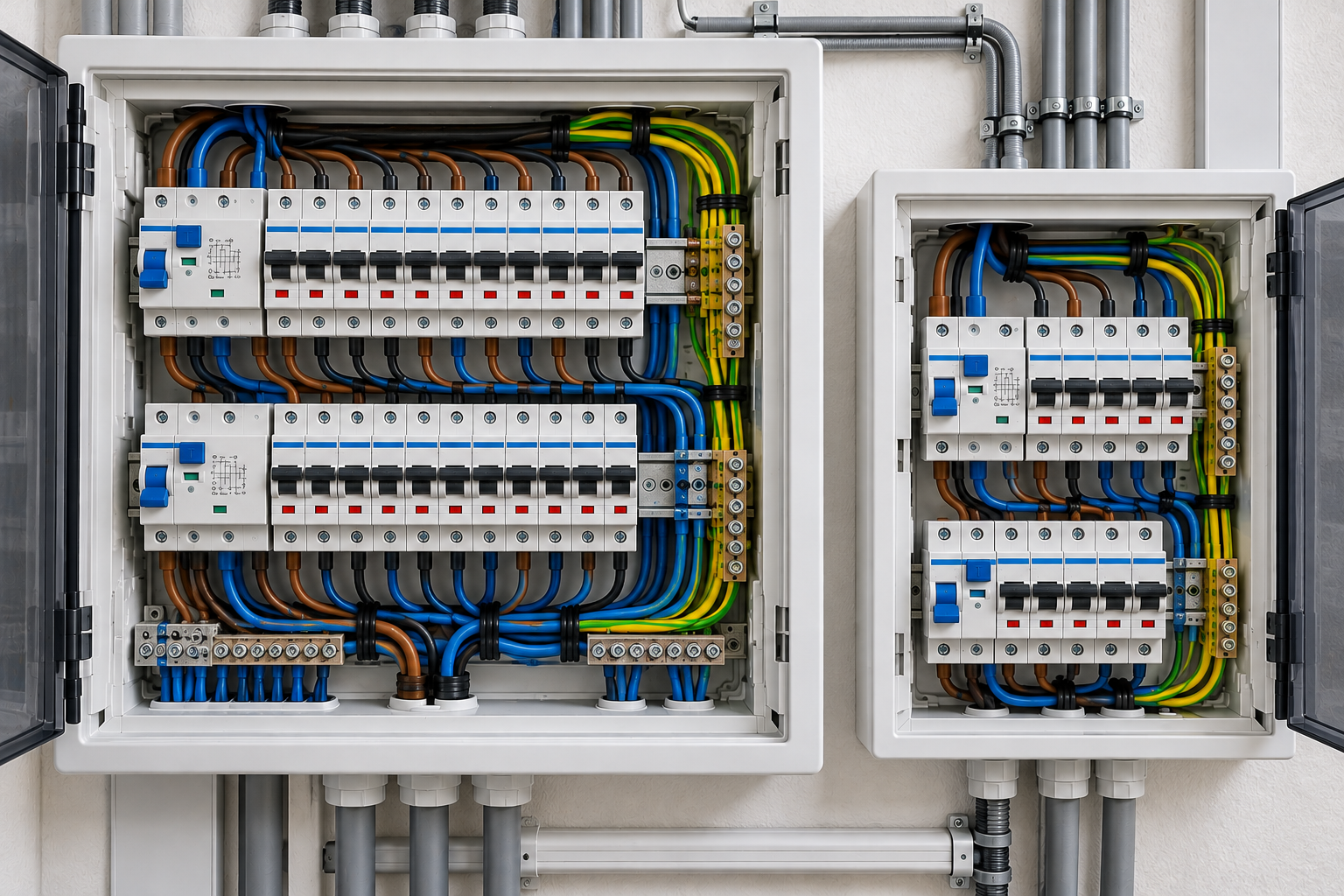
Residential Electrical Subpanels: When You Need One, How They Work and High-Power Loads
An electrical subpanel is a secondary distribution board used to distribute electricity to specific areas or groups of circuits within a building.
In a typical home, the main electrical distribution board supplies lighting, socket outlets and household appliances.
However, larger properties, multi-storey homes, garages, workshops and buildings with additional electrical equipment may benefit from a secondary distribution board.
This is commonly called an electrical subpanel, sub-distribution board or secondary distribution board.
A subpanel does not increase the electrical power available to a property. Instead, it provides an additional point from which electricity can be distributed to selected circuits.
This guide explains when a residential subpanel may be useful, how it operates, its electrical protection requirements and its relationship to heat pumps, electric vehicle chargers and other high-power equipment.
1. What Is an Electrical Subpanel?
An electrical subpanel is a secondary electrical distribution board supplied through a suitably designed feeder circuit from an upstream distribution point.
It distributes electrical power to selected circuits within a particular area of a building.
For example, a two-storey house might have:
A main distribution board on the ground floor.
A secondary distribution board on the first floor.
The subpanel may supply lighting, socket outlets and other electrical loads on that floor.
The exact arrangement depends on the installation design.
A subpanel is not simply an additional box containing circuit breakers. It forms part of the building’s overall electrical distribution system.
2. Main Electrical Panel vs Subpanel: What Is the Difference?
The main distribution board serves as the principal distribution point for the electrical installation.
A subpanel distributes electricity to a selected group of downstream circuits.
Feature | Main Distribution Board | Subpanel |
Main function | Primary electrical distribution | Secondary electrical distribution |
Supply | Incoming supply or upstream distribution | Suitably designed feeder circuit |
Circuits | Main installation circuits | Selected downstream circuits |
Location | Usually a central position | Near the area being supplied |
Protection | According to installation design | According to feeder and downstream circuit requirements |
Both panels must be designed and installed according to the applicable electrical safety requirements.
The presence of a subpanel does not remove the need for appropriate upstream protection.
3. When Does a Home Need an Electrical Subpanel?
Not every home requires a subpanel.
Its installation may be useful in several situations.
Multi-Storey Houses
In a property with multiple floors, a secondary distribution board may serve the circuits of a particular level.
This arrangement can make circuit organization and identification more convenient.
Garages and Workshops
A garage or workshop may require several circuits for lighting, sockets, equipment and other electrical loads.
A subpanel may provide a practical distribution point.
Large Residential Properties
In larger homes, electrical circuits may extend over significant distances.
A decentralized distribution arrangement may be considered as part of the electrical design.
Building Extensions
When additional rooms or buildings are constructed, new electrical circuits may be required.
A subpanel can sometimes be a suitable solution.
Dedicated Technical Areas
Mechanical rooms and other technical spaces may contain multiple electrical loads that benefit from grouped distribution.
However, the decision to install a subpanel should always be based on an assessment of the actual installation requirements.
4. How Does an Electrical Subpanel Work?
A subpanel receives electrical power through a feeder circuit and distributes it to individual downstream circuits.
A simplified arrangement is:
Main distribution board → Feeder circuit → Subpanel → Individual circuits
This is a conceptual representation, not a wiring diagram.
A real installation must account for:
Appropriate feeder protection.
Correct conductor selection.
Protective conductors.
Suitable switching and isolation.
Protection against electric shock.
Overcurrent protection.
Compatibility of protective devices.
Inspection and verification before operation.
The feeder circuit and subpanel must be considered together as part of the overall installation design.
5. Does a Subpanel Need Its Own Circuit Protection?
The feeder supplying a subpanel must be protected appropriately according to the electrical design.
Protective device selection depends on factors such as:
Design current.
Conductor cross-sectional area.
Cable length.
Installation method.
Ambient temperature.
Expected electrical demand.
Fault conditions.
Required disconnection times.
Protective device characteristics.
There is no single circuit breaker rating suitable for every subpanel.
The correct rating must be established through electrical calculations and assessment of the installation.
The presence of protective devices inside the subpanel does not eliminate the need to consider protection of the feeder itself.
6. Single-Phase vs Three-Phase Subpanels
A subpanel can be designed for single-phase or three-phase distribution.
The choice depends on the upstream supply and the equipment that will be connected.
Single-Phase Subpanel
A single-phase subpanel may distribute electricity to selected single-phase circuits where the available supply and installation design permit it.
Typical applications include residential lighting, socket circuits and certain household equipment.
Three-Phase Subpanel
A three-phase subpanel may be appropriate when three-phase equipment must be supplied or when single-phase loads need to be distributed among several phases.
A three-phase subpanel does not create a three-phase electrical supply.
The required phases must already be available from the upstream installation.
7. Do Heat Pumps Require a Separate Electrical Subpanel?
Not necessarily.
Many heat pumps can be supplied through a suitably designed circuit originating from the main electrical distribution board.
However, a subpanel may be considered when:
Several technical loads are located in the same area.
A property has a dedicated mechanical room.
Multiple circuits need to be distributed locally.
The distance from the main panel affects the design.
Future electrical expansion is anticipated.
Which Heat Pump Specifications Matter?
A qualified electrician should evaluate:
Rated supply voltage.
Maximum electrical current.
Manufacturer’s protective device requirements.
Auxiliary electric heating elements.
Available supply capacity.
Installation instructions.
Applicable electrical safety requirements.
Important: A heat pump with a heating capacity of 12 kW does not necessarily consume 12 kW of electrical power.
Thermal output and electrical input are different quantities.
The electrical supply must be designed according to the actual electrical specifications of the equipment.
8. Electrical Subpanels for EV Chargers
Electric vehicle charging equipment can place substantial demands on a building’s electrical installation.
An EV charger may be supplied through a suitably designed dedicated circuit from the main distribution board.
In some installations, particularly where a garage or parking area also contains other electrical loads, a subpanel may be useful.
Typical AC Charging Power Levels
Supply Arrangement | Approximate Nominal Power |
Single-phase, 230V, 16A | 3.7 kW |
Single-phase, 230V, 32A | 7.4 kW |
Three-phase, 400V, 16A | 11 kW |
Three-phase, 400V, 32A | 22 kW |
These values are theoretical nominal calculations.
Actual charging power depends on:
The charging equipment.
The vehicle’s onboard AC charger.
Available electrical supply capacity.
Load management settings.
Installation and network limitations.
A 22 kW charging station does not guarantee that every electric vehicle will charge at 22 kW.
EV Charging Protection Requirements
EV charging installations have specific electrical protection requirements.
The selection of residual current protection and any required DC residual current detection must account for the charger design, manufacturer’s instructions and applicable standards.
IEC 60364-7-722 addresses electrical installations intended to supply electric vehicles.
A conventional RCD should not automatically be assumed suitable for every EV charging installation.
The protective arrangement must be determined by a qualified professional.
9. Subpanels for Garages, Storage Areas and Workshops
A secondary distribution board can be useful when an auxiliary area contains several electrical circuits.
For example, a garage might require:
Lighting.
General-purpose socket outlets.
Electric garage door equipment.
EV charging equipment.
Additional electrical tools or machinery.
A subpanel can provide a centralized distribution point for these circuits.
However, the enclosure and protective devices must be suitable for the environmental conditions.
Garages and workshops may be exposed to moisture, dust, mechanical impacts or other conditions requiring particular attention.
The equipment selection should reflect the actual installation environment.
10. Why Is Voltage Drop Important?
Voltage drop occurs when electrical current flows through conductors with electrical impedance.
Its magnitude depends on factors including:
Cable length.
Electrical current.
Conductor cross-sectional area.
Conductor material.
Circuit configuration.
Operating temperature.
Power factor, where relevant.
When a subpanel is located far from the main distribution board, voltage drop may become an important design consideration.
Selecting a cable based only on the circuit breaker’s nominal current is not sufficient.
The electrical design must also consider voltage drop, installation conditions, fault protection and other applicable requirements.
11. Earthing and Electrical Protection in Subpanels
Protection against electric shock is a fundamental requirement of electrical installation design.
The subpanel arrangement must account for:
The earthing system.
Protective conductors.
Protective conductor continuity.
Automatic disconnection requirements.
Appropriate RCD protection where required.
Coordination of protective devices.
Verification and testing.
The correct treatment of neutral and protective conductors depends on the earthing arrangement and applicable electrical standards.
Neutral and protective earth conductors must not be connected together arbitrarily.
Improper connections can compromise electrical protection and create dangerous conditions.
The installation must be designed and verified by a suitably qualified electrician.
12. Where Should an Electrical Subpanel Be Installed?
Subpanel location should be selected with safety, accessibility and environmental conditions in mind.
Important considerations include:
Suitable access for inspection and maintenance.
Protection against moisture and water.
Mechanical protection.
Appropriate enclosure characteristics.
Manufacturer’s installation instructions.
Adequate working space.
Applicable local installation requirements.
A subpanel should not be placed in an unsuitable location simply because it is close to the electrical loads.
In outdoor or exposed environments, additional enclosure protection may be required.
13. How Much Does Electrical Subpanel Installation Cost?
There is no universal installation price.
The total cost depends on the characteristics of the installation.
Cost Factor | Why It Matters |
Subpanel size | Determines enclosure requirements |
Number of circuits | Affects equipment quantity and labour |
Single-phase or three-phase design | Influences protective device selection |
Distance from main panel | Affects cable requirements and installation work |
Protective devices | Different types and ratings have different costs |
Installation environment | May require additional enclosure protection |
Labour and testing | Includes installation, verification and documentation |
A small subpanel located near the main distribution board may involve substantially different work from a three-phase subpanel installed in a distant garage or workshop.
A reliable quotation should identify:
The proposed equipment.
Feeder cable requirements.
Protective devices.
Installation labour.
Necessary electrical testing.
Required documentation.
Additional building work, where applicable.
A professional site assessment is necessary for a meaningful cost estimate.
14. Common Electrical Subpanel Installation Mistakes
Underestimating Electrical Loads
The subpanel is designed without adequately assessing the connected equipment and expected demand.
Incorrect Feeder Selection
Cable length, conductor size and installation conditions are not properly considered.
Poor Protective Device Coordination
Protective devices are selected without evaluating the complete electrical installation.
Inadequate Circuit Labelling
The circuits supplied by the subpanel are not clearly identified.
Unsuitable Enclosure
The distribution board is not appropriate for the installation environment.
Ignoring Available Supply Capacity
The installation is designed under the incorrect assumption that adding a subpanel increases the property’s available electrical power.
Inadequate Testing
The installation is put into service without the required verification procedures.
These problems can affect safety, reliability and future maintenance.
15. When Is a Subpanel Unnecessary?
A subpanel may not be necessary when:
Only a small number of additional circuits are required.
The existing main distribution board has suitable expansion capacity.
The location and arrangement do not justify secondary distribution.
The electrical loads can be supplied through appropriately designed circuits from the main board.
Installing a subpanel should provide a genuine technical or operational benefit.
It should not be treated as a mandatory addition to every electrical upgrade.
16. Frequently Asked Questions
Can I install a subpanel in an apartment?
It may be technically possible, depending on the electrical installation design and applicable requirements.
Does a subpanel increase available electrical power?
No. Available electrical capacity depends on the supply and the characteristics of the overall installation.
Does a heat pump need a subpanel?
Not necessarily. Many heat pumps can be supplied from an appropriately designed circuit originating at the main distribution board.
Does an EV charger need a separate subpanel?
Not always. The decision depends on charger specifications, installation location, other electrical loads and available supply capacity.
Can a subpanel be three-phase?
Yes, provided a suitable three-phase supply is available and the installation is designed accordingly.
Does every subpanel require an RCD?
The appropriate residual current protection arrangement depends on the downstream circuits, earthing system and applicable requirements. There is no universal arrangement suitable for every installation.
Can a homeowner install an electrical subpanel?
Subpanel installation involves hazardous electrical work, technical design, protective device selection and verification. It should be performed by appropriately qualified professionals.
Is a subpanel the same as a second electricity meter?
No. A subpanel is a secondary electrical distribution board. It does not automatically create a separate utility supply, electricity account or metering arrangement.
Conclusion
An electrical subpanel can be a practical solution for distributing electricity in multi-storey homes, garages, workshops and buildings with multiple groups of circuits.
It can also support the organization of electrical equipment in mechanical rooms and other technical areas.
However, a subpanel does not increase the available electrical power of a property, and it is not automatically required for heat pumps or EV chargers.
The correct solution depends on the building’s electrical requirements, supply characteristics and applicable safety standards.
Professional design, installation and verification are essential.
Thermosphere.gr — Technical knowledge for safer and more efficient installations.
Disclaimer: This article provides general technical information. It is not a wiring instruction manual and does not replace professional electrical design, installation, inspection or testing.
Technical References
IEC 60364 — Low-voltage electrical installations.
IEC 60364-4-41 — Protection against electric shock.
IEC 60364-4-43 — Protection against overcurrent.
IEC 60364-5-52 — Selection and erection of wiring systems.
IEC 60364-5-53 — Devices for protection, isolation, switching, control and monitoring.
IEC 60364-6 — Verification of electrical installations.
IEC 60364-7-722 — Supplies for electric vehicles.
IEC 61439-3 — Distribution boards intended to be operated by ordinary persons.
ELOT 60364 — Requirements for electrical installations in Greece.
HEDNO (DEDDIE) — Official information on electricity supply arrangements and installation modification procedures.