
Introduction to calculating thermal requirements
Choosing the right size for your radiators is not just a matter of aesthetics or available space under the window. It is a critical technical process that ensures your home's thermal comfort and economy in fuel (oil, natural gas) or electricity (heat pumps) consumption. A radiator that is too small will leave the room cold on freezing winter days, while one that is excessively large increases installation costs and can cause malfunctions in the network balance.
The basic formula: From cubic meters to calories
The most correct way to start is by calculating the volume of the room. In Greece, most studies are based on the calories (kcal/h) required per cubic meter (m³).
Step 1: Calculating Volume
Measure the length, width, and height of the room. For example, a 4m x 4m room with a height of 2.8m has a volume of 44.8 m³.
Step 2: Heat Loss Coefficient
This is where the technician's experience comes in. The general rule for a moderately insulated house in the Athens climate zone is approximately 40-50 kcal/h per cubic meter. However, this number varies:
- Good insulation (double glazing, thermal envelope): 30-35 kcal/m³
- Moderate insulation (old frames, no thermal insulation): 45-55 kcal/m³
- Poor insulation (detached house, north-facing room, no roof insulation): 60-70 kcal/m³
Factors affecting performance
Volume is not enough. You must consider the specific characteristics of each space. The main factors are:
- Orientation: A room facing north has greater heat loss than a south-facing one.
- Window surface area: Large balcony doors act as "thermal bridges" that expel heat.
- Top floor or piloti: If the room is located under an uninsulated roof or above an open piloti, losses increase by up to 20%.
- Climate Zone: In Northern Greece (Kozani, Florina), requirements are significantly higher compared to Crete.
Choosing the radiator type (Panel vs Aluminum)
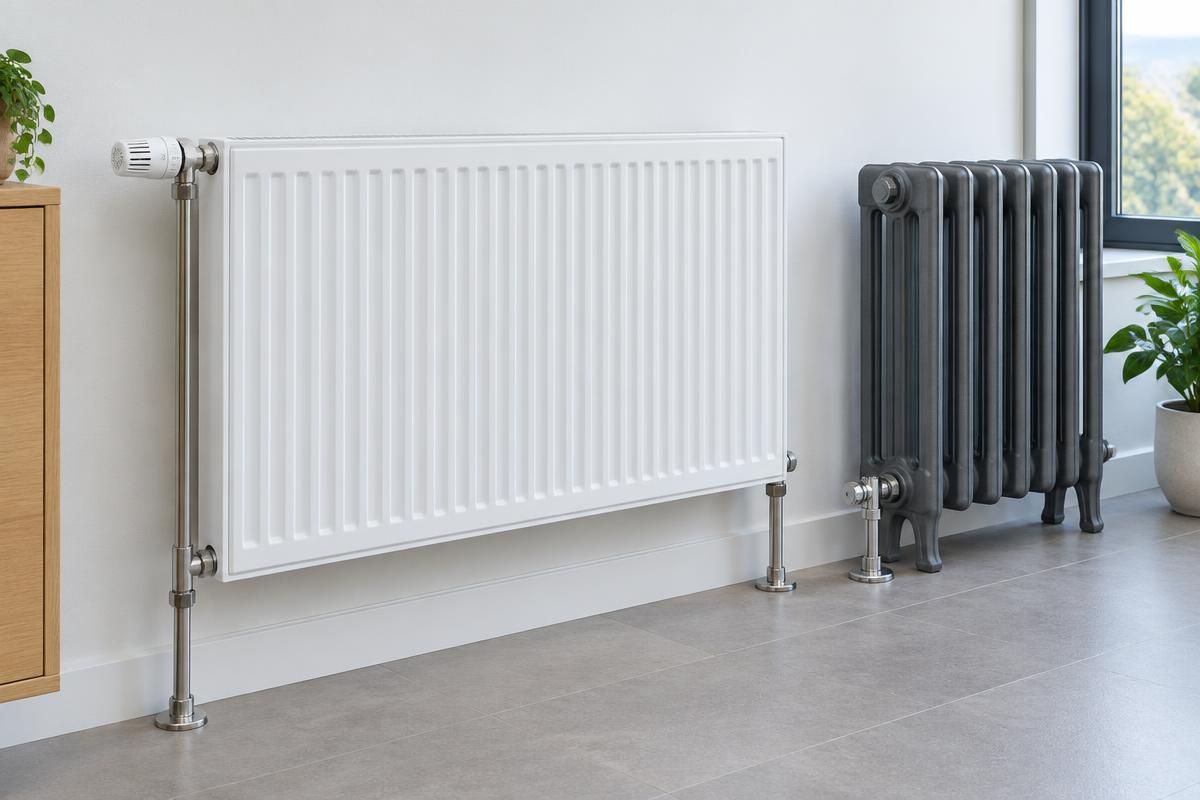
Once you find the total calories, you need to choose the radiator type. The most common in the Greek market are Panel radiators (types 11, 22, 33) and aluminum radiators (sections).
Panel Radiators (Steel)
These radiators are characterized by their thickness. For example, Type 22 (double panel with double convection fins) is the most common. A 22/600/1000 radiator (height 60cm, length 1m) yields approximately 1700-1900 kcal/h at a water temperature of 75°C-80°C.
Aluminum Radiators
Here, the calculation is done per "section." Each 600mm high section yields approximately 110-140 kcal/h. If the room requires 1500 kcal/h, you will need approximately 12-13 sections.
The importance of flow temperature (Heat Pumps)
A common trap is choosing radiators for low-temperature systems. If you plan to install a heat pump, the water will circulate at 45°C-55°C instead of the 75°C of a boiler. In this case, the radiator output drops by almost half. You will need much larger surfaces (or Fan Coil units) to heat the space.
Frequently Asked Questions (FAQ)
1. What will happen if I install a larger radiator than needed?
The room will heat up faster, but you may have uneven heat distribution if the thermostat is in another room. Technically, using thermostatic heads can correct this problem.
2. Why is my radiator hot at the top and cold at the bottom?
This usually indicates trapped air (it needs bleeding) or poor water circulation due to low pressure or a problem with the circulator pump.
3. How does a radiator cover affect performance?
Decorative covers can reduce performance by up to 20%. If you use one, you should choose a larger radiator to compensate for the loss.
4. Can I calculate the calories just by the square footage?
It is a rough rule of thumb (e.g., 100-120 kcal/m² for standard apartments), but it does not account for ceiling height or specific losses, so it is not recommended for an accurate study.
Conclusion
Proper radiator calculation requires attention to detail. Start with the room volume, correctly estimate your building's insulation, and choose the radiator type based on the manufacturer's specifications for your system's operating temperature. For absolute accuracy, the advice of a mechanical engineer or an experienced thermo-hydraulic technician is essential, especially in new installations or renovations.