
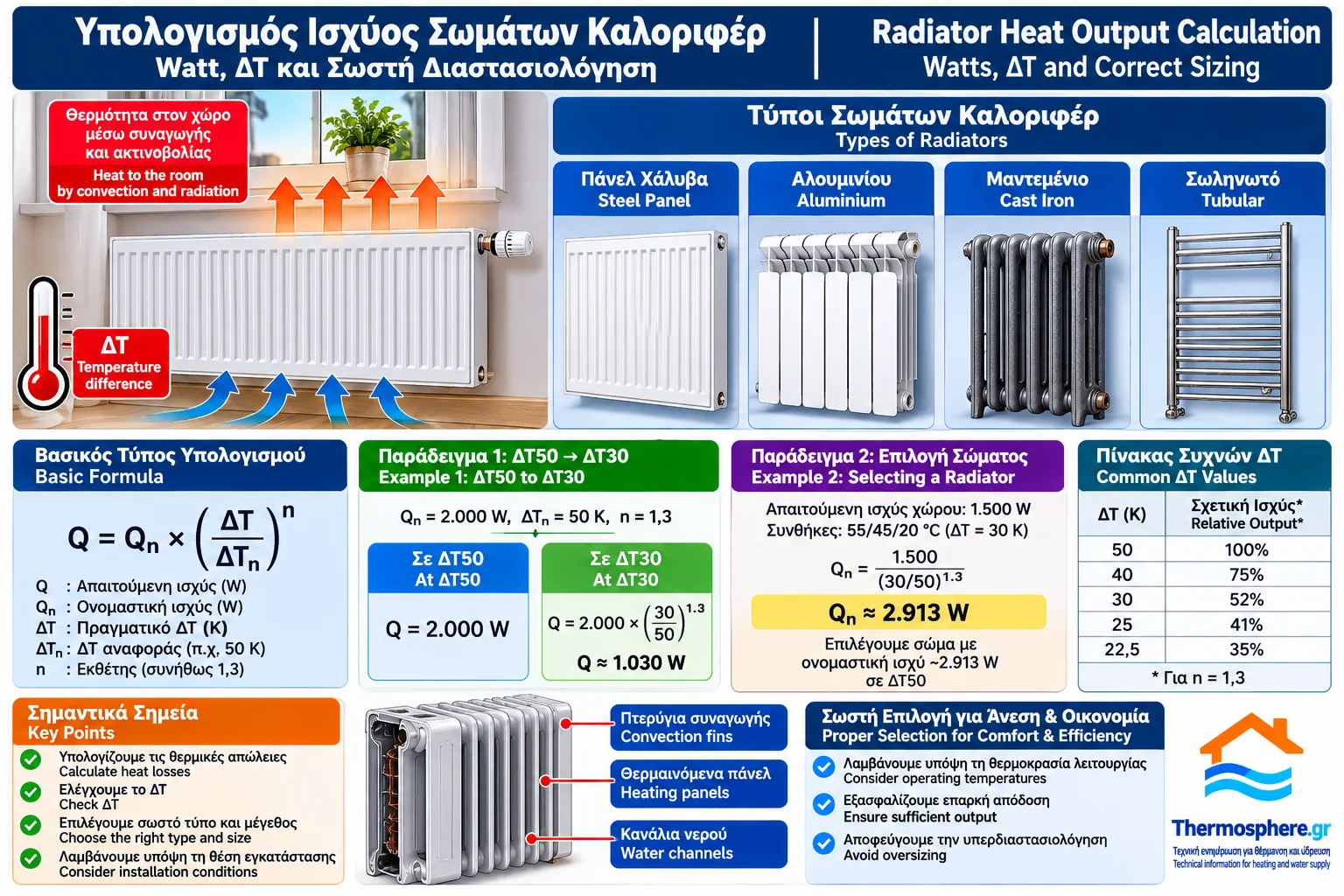
Radiator Heat Output Calculation: Watts, ΔT and Correct Sizing
Correct radiator sizing is essential for effective heating system operation.
A radiator must deliver enough heat to cover the room's design heat losses under the actual operating conditions.
Selection cannot be based on radiator height or length alone. It depends on heat output, water temperatures, radiator construction and installation conditions.
A radiator rated at 2,000 W under high-temperature conditions may deliver considerably less heat when connected to a heat pump or a condensing boiler operating at lower water temperatures.
Understanding watts, room heat loss, temperature difference and rated output is therefore essential.
1. What Is Radiator Heat Output?
Radiator heat output describes the rate at which a radiator transfers thermal energy into a room.
The standard unit is the watt (W).
A radiator delivering 1,500 W transfers energy at a rate of 1,500 joules per second.
Heat output must not be confused with energy.
Power: W or kW.
Energy: Wh or kWh.
For example, a radiator delivering a constant 1.5 kW for two hours transfers 3 kWh of thermal energy.
2. Room Heat Loss and Required Heating Capacity
Before selecting a radiator, the room's design heat loss must be determined.
Heat losses occur through:
External walls.
Windows and glazing.
Roofs and floors.
Thermal bridges.
Ventilation and air infiltration.
Rooms with identical floor areas may have very different heating requirements.
Insulation, orientation, glazing and local climate all affect the required capacity.
Proper radiator sizing should be based on a room heat loss calculation, commonly using EN 12831-1 or another applicable design method.
3. Why Floor Area Alone Is Not Enough
Simplified estimates sometimes use a fixed heating load per square metre.
For example, an assumed value of 80 W/m² for a 20 m² room gives:
20 × 80 = 1,600 W.
However, 80 W/m² is not a universal requirement.
A well-insulated room may require substantially less heat, while a poorly insulated room may require more.
Area-based estimates are suitable only for preliminary assessment.
4. What Is Rated Radiator Output?
Rated output is the heat output declared under specified reference conditions.
For many radiators assessed under EN 442, common reference conditions are:
Supply temperature: 75°C.
Return temperature: 65°C.
Room temperature: 20°C.
These conditions are commonly referred to as 75/65/20°C or ΔT50.
A radiator rated at 2,000 W under these conditions does not necessarily deliver 2,000 W in every installation.
Actual output must be assessed at the intended operating temperatures.
5. What Does Radiator ΔT Mean?
Radiator ΔT describes the temperature difference between radiator water and room air.
For common approximate calculations, the arithmetic mean water temperature is used:
ΔT = [(T_supply + T_return) / 2] − T_room
Where:
T_supply is the water inlet temperature.
T_return is the water outlet temperature.
T_room is the room air temperature.
The temperature difference is expressed in kelvin (K).
A temperature difference of 50 K has the same numerical magnitude as a difference of 50°C.
The arithmetic mean is useful for approximations. More precise calculations may use a logarithmic mean temperature difference and manufacturer-specific performance data.
6. ΔT50 Calculation Example
Consider the following operating conditions:
Supply: 75°C.
Return: 65°C.
Room: 20°C.
Then:
ΔT = [(75 + 65) / 2] − 20
ΔT = 70 − 20
ΔT = 50 K
These are the common ΔT50 reference conditions.
If the manufacturer declares 1,800 W under these conditions, the rating applies to this temperature regime.
7. ΔT30 Calculation Example
Now consider:
Supply: 55°C.
Return: 45°C.
Room: 20°C.
Then:
ΔT = [(55 + 45) / 2] − 20
ΔT = 50 − 20
ΔT = 30 K
The temperature difference is lower, so radiator heat output decreases.
This reduction is generally nonlinear.
8. How Does Radiator Output Change With ΔT?
A commonly used heat output conversion relationship is:
Q = Qn × (ΔT / ΔTn)^n
Where:
Q = calculated heat output.
Qn = rated heat output.
ΔT = operating temperature difference.
ΔTn = reference temperature difference.
n = radiator characteristic exponent.
The exponent depends on the radiator's construction and thermal characteristics.
An illustrative value of n = 1.3 is sometimes used, but the actual value should be obtained from the manufacturer.
The equation must be applied using the appropriate temperature difference definition and within the valid range of the product data.
9. Practical Heat Output Conversion Example
Assume:
Rated output: 2,000 W.
Reference ΔT: 50 K.
Operating ΔT: 30 K.
Illustrative exponent: n = 1.3.
Then:
Q = 2,000 × (30/50)^1.3
Q ≈ 2,000 × 0.515
Q ≈ 1,030 W
Under these assumptions, a radiator rated at 2,000 W at ΔT50 delivers approximately 1,030 W at ΔT30.
Actual performance must be verified against manufacturer data.
10. Comparing Radiator Output at Different Temperatures
Consider a hypothetical radiator rated at 2,000 W at ΔT50, using n = 1.3.
Operating Conditions | Approximate ΔT | Calculated Output |
|---|---|---|
75/65/20°C | 50 K | 2,000 W |
65/55/20°C | 40 K | 1,496 W |
55/45/20°C | 30 K | 1,030 W |
50/40/20°C | 25 K | 812 W |
45/40/20°C | 22.5 K | 708 W |
40/35/20°C | 17.5 K | 511 W |
These are illustrative calculations using the same approximate conversion equation.
The key conclusion is that heat output falls substantially as water temperatures decrease.
11. Selecting a Radiator for a Specific Room
Assume a room has a calculated design heat loss of:
1,500 W
The heating system is designed for:
Supply: 55°C.
Return: 45°C.
Room: 20°C.
Therefore:
ΔT = 30 K.
Using an illustrative exponent of n = 1.3:
Qn = 1,500 / (30/50)^1.3
Qn ≈ 2,913 W
Under these assumptions, a radiator rated at approximately 2,913 W at ΔT50 would deliver about 1,500 W at 55/45/20°C.
Final selection must use manufacturer performance tables and account for actual water flow and installation conditions.
12. Radiator Sizing for Heat Pumps
Heat pumps generally operate more efficiently at lower required supply temperatures, although actual efficiency depends on equipment and conditions.
For example, a system may be designed for 45/40/20°C.
The approximate radiator temperature difference is:
ΔT = [(45 + 40)/2] − 20
ΔT = 22.5 K
A radiator rated at 2,000 W at ΔT50 may deliver approximately 708 W using n = 1.3.
Therefore, when converting an existing heating system to a heat pump, radiator capacity must be checked under the new operating conditions.
This does not automatically mean that every radiator must be replaced.
13. Radiator Sizing for Condensing Boilers
Condensing boilers recover additional heat by condensing water vapour in the flue gases.
Lower return water temperatures generally favour condensing operation.
Correct radiator sizing can help the system operate at reduced water temperatures while maintaining room comfort.
For example, a system originally designed for 75/65°C may be evaluated for 55/45°C operation.
The lower temperature regime is suitable only if the radiators can still cover the design heat losses.
14. How Does Water Flow Affect Heat Transfer?
The heat transferred by circulating water depends on mass flow rate and the temperature difference between supply and return.
The fundamental relationship is:
Q = ṁ × cp × (T_supply − T_return)
Where:
Q is heat transfer rate in W.
ṁ is mass flow rate in kg/s.
cp is specific heat capacity in J/(kg·K).
For water at typical heating temperatures, an approximate practical relationship is:
Q(W) ≈ 1.163 × V̇(L/h) × ΔT_water(K)
Here, ΔT_water means the supply-to-return temperature drop, not the radiator-to-room temperature difference.
15. Water Flow Calculation Example
Suppose a radiator must transfer 1,500 W.
The design water temperature drop is 10 K.
Then:
V̇ = 1,500 / (1.163 × 10)
V̇ ≈ 129 L/h
The required approximate flow is 129 litres per hour.
However, this calculation only establishes the water flow needed to transfer 1,500 W at a 10 K temperature drop.
It does not prove that a particular radiator can deliver 1,500 W to the room.
The radiator must also have sufficient heat transfer capacity at the specified water and room temperatures.
16. How Does Flow Rate Affect Radiator Performance?
Water flow affects temperature distribution inside the radiator.
Insufficient flow can produce a large inlet-to-outlet temperature difference.
This may reduce average radiator temperature and heat output.
Excessive flow, however, may increase hydraulic losses and pumping energy without providing a proportional increase in useful heat transfer.
The correct flow rate must be established through thermal and hydraulic design.
17. Effect of Room Temperature
Radiator heat output also depends on room temperature.
For example, if room temperature increases from 20°C to 23°C while water temperatures remain unchanged, the radiator-to-room temperature difference decreases.
Heat output therefore decreases.
Radiator calculations must use the intended indoor design temperature.
18. Effect of Installation Position
Actual radiator output can be affected by installation conditions.
Relevant factors include:
Restricted clearance below the radiator.
Insufficient distance from the wall.
Decorative radiator covers.
Furniture placed directly in front.
Heavy curtains.
Restricted natural air circulation.
Correction factors should be based on manufacturer data or an appropriate engineering assessment.
19. One Large Radiator or Two Smaller Radiators?
A room's required heating capacity may sometimes be provided by one large radiator or several smaller radiators.
Selection depends on:
Room geometry.
Available installation positions.
Desired heat distribution.
Hydraulic pressure losses.
Connection arrangements.
Cost.
Two radiators may improve heat distribution in a large room, but the hydraulic system must be designed and balanced accordingly.
20. Common Radiator Sizing Mistakes
Selecting Radiators Only by Floor Area
Floor area alone does not describe the room's heat losses.
Ignoring the Rated ΔT
A radiator rated at 2,000 W at ΔT50 will not deliver the same output at ΔT30.
Ignoring Water Flow
Adequate radiator output requires suitable hydraulic conditions.
Unnecessary Oversizing
Excessive oversizing can increase installation cost and space requirements.
Ignoring Installation Restrictions
Incorrect placement or restrictive covers can reduce actual heat transfer.
Ignoring Heat Pump Operating Temperatures
Existing radiators must be assessed at the intended low-temperature design conditions.
21. Practical Radiator Selection Procedure
A reliable selection process follows these steps:
Calculate room design heat loss.
Define the indoor design temperature.
Select supply and return water temperatures.
Determine the appropriate radiator temperature difference.
Obtain manufacturer heat output data.
Select radiator type and dimensions.
Calculate the required water flow.
Check hydraulic pressure losses.
Review installation position and clearances.
Verify that available heat output covers the room design heat loss.
22. Technical Standards and Manufacturer Data
Important references include:
EN 442: European standard series covering radiators and convectors within its scope, including relevant performance determination methods.
EN 12831-1: Methodology for calculating room and building design heat loads.
Manufacturer technical data: Rated heat output, conversion factors, characteristic exponent, dimensions, hydraulic characteristics and permitted operating conditions where available.
Final selection should always be based on documented performance data for the specific radiator model.
Conclusion
Correct radiator sizing begins with the room's design heat loss and ends with selecting a radiator that can deliver the required heat under actual operating conditions.
Understanding ΔT is essential because radiator heat output decreases as water temperatures decrease.
Do not select a radiator solely by the watts shown in a catalogue. Select it according to the watts it can actually deliver in the intended heating installation.
This article is intended for technical information. Final calculations and radiator sizing must be based on appropriate engineering design and manufacturer specifications.
Thermosphere.gr — Technical information for heating and water supply.