
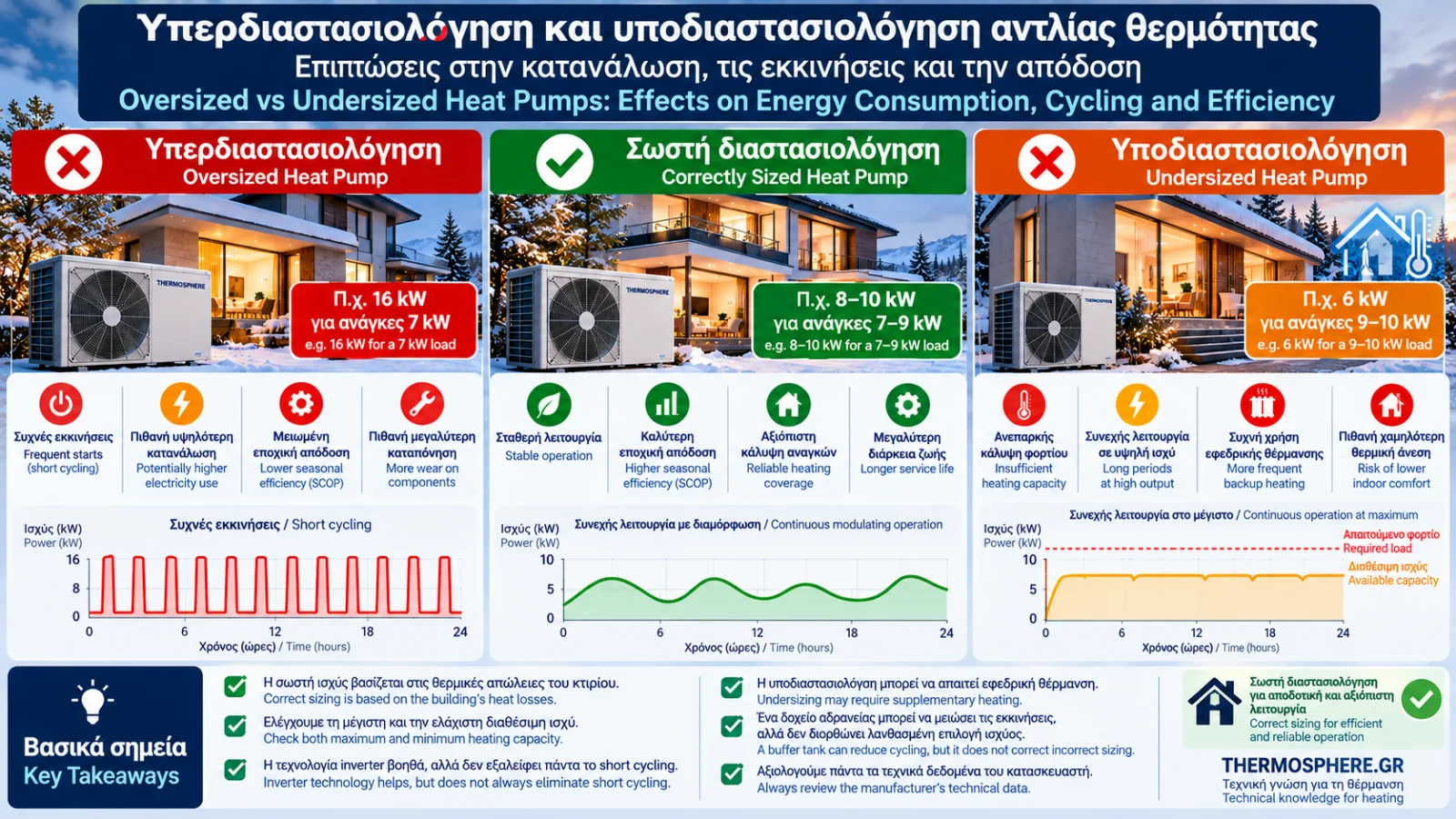
Oversized vs Undersized Heat Pumps: Effects on Energy Consumption, Cycling and Efficiency
Correct heat pump sizing is one of the most important decisions in the design of a heating installation.
A common assumption is that selecting a larger heat pump is always safer because the system will have more heating capacity available during extremely cold weather.
In reality, excessive capacity can cause operating problems, especially when the building has relatively low heating demand.
Conversely, a smaller heat pump is not necessarily a more economical choice. If it has not been selected as part of a deliberate design strategy, it may be unable to meet the building's heating requirements during demanding winter conditions.
Correct sizing involves much more than comparing the nominal kW rating with the calculated heat loss.
It requires evaluating actual heating output, minimum modulation capacity, leaving-water temperature, heating-system hydraulics and the selected control strategy.
This Thermosphere.gr guide explains the differences between oversized and undersized heat pumps, the consequences of incorrect sizing and the key technical considerations for reliable operation.
1. What Is an Oversized Heat Pump?
A heat pump is considered oversized when its available heating capacity is unnecessarily high compared with the building's design requirements and the intended operating strategy.
For example, if a home has a calculated design heating load of 7 kW, selecting a unit capable of delivering 16 kW under the same design conditions requires careful technical justification.
However, oversizing cannot be determined from the commercial model name alone.
A heat pump marketed as a 12 kW model may deliver a different output depending on outdoor temperature and leaving-water temperature.
The correct comparison must therefore use actual manufacturer performance data.
2. Why Is a Larger Heat Pump Not Always Better?
Building heating demand changes continuously throughout the heating season.
A house may require 8 kW at the design outdoor temperature but only 2–4 kW during milder winter conditions.
The heat pump must respond to these changing loads.
If the unit's minimum available heating output exceeds the building's actual demand, it may be unable to operate continuously.
Instead, the compressor may repeatedly start and stop to maintain the required water temperature.
This behaviour is commonly called short cycling.
3. What Is Heat Pump Short Cycling?
Short cycling occurs when the compressor operates for relatively short periods before stopping and restarting.
Consider a hypothetical example:
The building requires 2.5 kW of heating.
The heat pump can reduce its heating output only to 5 kW under the current operating conditions.
The unit produces heat faster than the building requires it.
Water temperature rises until the controller stops the compressor.
Once water temperature falls, the compressor starts again.
This sequence may repeat.
The frequency of cycling depends on the water volume, hydraulic arrangement, system controls, thermal inertia and heat pump characteristics.
There is no universal number of starts per hour that defines unacceptable operation for every heat pump model.
4. How Does Short Cycling Affect Energy Consumption?
Excessively frequent compressor starts can reduce seasonal operating efficiency.
After startup, the heat pump may require time to reach stable operating conditions.
If operating cycles are very short, a significant portion of operation may occur under transient conditions.
Repeated starts may also increase wear on certain components.
However, it would be incorrect to suggest that every compressor start is harmful.
Modern heat pumps are designed to start and stop when necessary.
The concern is unnecessarily frequent cycling that could have been avoided through better sizing, hydraulic design or control settings.
5. The Role of Inverter Technology
Most modern air-to-water heat pumps use variable-speed compressors.
Inverter technology allows the compressor to adjust heating output to match changing demand.
For example, a heat pump might operate between 3 and 10 kW under a specified set of conditions.
This means that it can reduce its output, but not necessarily below 3 kW.
If the building requires only 1.5 kW, the unit may still need to cycle.
Important: Inverter technology does not automatically eliminate short cycling.
The minimum available heating capacity under actual operating conditions is a critical specification.
6. Why Minimum Heating Capacity Matters
Maximum heating output is not the only capacity figure worth checking.
Minimum stable heating output is equally important.
A heat pump with a relatively high maximum output but a low minimum output may perform better under low-load conditions than a smaller model with a narrower modulation range.
Consider the following hypothetical comparison:
Specification | Heat Pump A | Heat Pump B |
|---|---|---|
Maximum heating capacity | 12 kW | 10 kW |
Minimum heating capacity | 2 kW | 4 kW |
Current building heating load | 3 kW | 3 kW |
Potential for continuous operation at this load | Yes | Limited |
All figures are illustrative and refer to the same hypothetical operating conditions.
This example demonstrates why the unit with the higher maximum output is not automatically the poorer choice.
Actual equipment selection requires detailed manufacturer performance curves.
7. What Is an Undersized Heat Pump?
A heat pump is undersized when its available heating capacity is insufficient to meet the required heating load under conditions where the design expects the heat pump to provide full coverage without supplementary heating.
For example:
Building design heating load: 10 kW.
Available heat pump capacity at design conditions: 7 kW.
Capacity shortfall: 3 kW.
Without an appropriately designed supplementary heating source, the installation may fail to maintain the desired indoor temperature during the coldest conditions.
However, selecting a smaller heat pump can be acceptable when it is part of a properly engineered bivalent heating system.
8. Problems Associated With Undersizing
An undersized heat pump may experience several operating limitations.
Insufficient heating capacity
During very cold weather, available heat output may be lower than the building's heat loss.
Extended operation at high compressor output
The compressor may operate for long periods near its available capacity.
This is not inherently harmful when the equipment remains within the manufacturer's operating limits.
Greater dependence on backup heating
An electric resistance heater or other supplementary heat source may operate more frequently.
Slow indoor temperature recovery
After a substantial indoor temperature setback, the system may require longer to restore the desired room temperature.
9. Does Undersizing Always Increase Electricity Consumption?
Not necessarily.
A smaller heat pump may operate efficiently during much of the heating season, especially when the building experiences relatively low heating demand for most hours.
Overall energy performance depends on:
Local climate.
Frequency and duration of very low outdoor temperatures.
Heat pump efficiency at full and partial load.
Efficiency of supplementary heating.
Control strategy.
Indoor comfort requirements.
Deliberate sizing for bivalent operation should not be confused with accidental undersizing caused by incorrect heat-loss calculations.
10. What Is Bivalent Heating?
A bivalent heating system combines a heat pump with a supplementary heating source.
This may include:
Electric resistance heating.
An existing boiler.
Another appropriately designed heat source.
The supplementary source provides additional heating when required by the design strategy.
The outdoor temperature at which available heat pump capacity meets the building's heating demand is known as the bivalent temperature.
Its selection should be based on a technical and energy assessment rather than a universal fixed value.
11. Can a Buffer Tank Correct Oversizing?
A buffer tank can increase system water volume and thermal inertia.
In some installations, this helps reduce compressor cycling and supports minimum operating-time requirements.
However, a buffer tank does not remove the fundamental capacity mismatch created by an oversized heat pump.
If the unit's minimum heating output remains significantly higher than building demand, a buffer tank may reduce symptoms without solving the underlying issue.
Incorrect hydraulic arrangements may also introduce additional heat losses or undesirable temperature mixing.
Buffer tank selection must therefore follow manufacturer requirements and the hydraulic design of the installation.
12. How Do Heating Zones Affect Heat Pump Operation?
In multi-zone systems, heating demand may decrease suddenly when individual thermostatic zones close.
This can result in:
Reduced active heating demand.
Lower water flow through the system.
Reduced active water volume.
More frequent compressor cycling.
Heat pumps must operate within their permitted flow-rate and water-volume limits.
Zone controls, pumps, valves and hydraulic separation must therefore be designed as an integrated system.
13. Practical Example: A Home With an 8 kW Design Heating Load
Consider a hypothetical home with a calculated design heating load of 8 kW.
We compare three illustrative heat pumps using their actual heating output at the same design operating condition.
Parameter | Unit A | Unit B | Unit C |
|---|---|---|---|
Available capacity at design conditions | 6 kW | 8.5 kW | 14 kW |
Minimum output during mild weather | 2 kW | 2.5 kW | 5 kW |
Full design-load coverage by compressor | No | Yes | Yes |
Risk of cycling at low heating loads | Depends | Depends | Higher |
These figures are hypothetical and do not represent specific commercial products.
Unit A
Cannot cover the full design load independently. It would require supplementary heating or another design strategy.
Unit B
Covers the design load and has a relatively low minimum output. It is a potential candidate for further evaluation.
Unit C
Provides substantial maximum heating capacity but may struggle to match low heating demand because of its higher minimum output.
The final decision must also consider COP, SCOP, leaving-water temperatures, hydraulic requirements and total ownership cost.
14. Signs of Possible Oversizing
Indicators that deserve investigation include:
Very frequent compressor starts and stops.
Short operating cycles during mild weather.
Rapid increases in leaving-water temperature.
A large mismatch between minimum heating output and actual load.
Difficulty maintaining stable operation despite appropriate settings.
These symptoms do not prove oversizing on their own.
They may also result from unsuitable weather-compensation settings, insufficient water flow or control-system problems.
A technical assessment is required before reaching a conclusion.
15. Signs of Possible Undersizing
Possible indicators include:
Indoor temperature falling during very cold weather.
Continuous high-output operation without meeting heating demand.
More frequent backup-heater operation than anticipated.
Failure to maintain the required heating conditions.
Before attributing these symptoms to inadequate capacity, the installation should be checked for water-flow problems, incorrect leaving-water temperature, defrost-related issues and other operational faults.
16. Seven Common Heat Pump Sizing Mistakes
1. Sizing based only on floor area
Floor area alone does not establish building heat loss.
2. Selecting a much larger heat pump for safety
Excessive spare capacity can create part-load operating problems.
3. Ignoring minimum inverter capacity
The unit must also operate effectively at low heating demand.
4. Using nominal kW without checking operating conditions
Actual heating output depends on outdoor and water temperatures.
5. Ignoring radiator and emitter performance
Heat emitters must provide the required heating output at the selected water temperature.
6. Overlooking hydraulic design
Minimum water volume, flow rate and zoning arrangements affect system operation.
7. Ignoring seasonal performance
The best choice is not determined solely by maximum heating capacity or initial purchase price.
17. Heat Pump Sizing Checklist
Before purchasing a heat pump, confirm:
Calculated building design heat loss.
Local design outdoor temperature.
Required heating-water temperature.
Actual heating capacity at design conditions.
Minimum available output under part-load conditions.
COP and seasonal energy efficiency.
Need for supplementary heating.
Minimum system water flow and volume.
Heating-zone control arrangements.
Manufacturer installation and operating requirements.
18. Frequently Asked Questions
Is It Better to Choose a Slightly Larger Heat Pump?
Not necessarily. Any capacity margin should be justified by the engineering design and intended operating strategy.
Does an Oversized Heat Pump Always Consume More Electricity?
No. Energy consumption depends on actual efficiency, modulation range, cycling behaviour and installation conditions.
Can a Smaller Heat Pump Be the Correct Choice?
Yes. A smaller unit can be appropriate in a properly designed bivalent system.
Does Inverter Technology Prevent Short Cycling?
It reduces cycling when heating output can match demand. Cycling may still occur when building demand falls below the unit's minimum capacity.
Does Every Heat Pump Need a Buffer Tank?
No. The requirement depends on manufacturer specifications, available water volume, hydraulic design and control strategy.
Conclusion
Both oversizing and undersizing can affect heat pump efficiency, indoor comfort and operating behaviour.
An excessively large unit may struggle to operate efficiently under low-load conditions, while an inadequately sized unit may fail to meet heating demand during severe winter weather.
The correct heat pump is not simply the largest or smallest available model. It is the unit that meets the design heating load while operating efficiently across the widest practical range of real conditions.
Technical References and Further Reading
EN 12831-1 — Method for calculating building design heat load.
EN 14511 series — Heat pump performance testing and operating conditions.
EN 14825 — Seasonal performance assessment under part-load conditions.
Commission Regulation (EU) No 813/2013 — Ecodesign requirements for space heaters.
Official manufacturer technical manuals — Heating capacity curves, minimum modulation, water-flow requirements and system volume specifications.
Thermosphere.gr — Technical knowledge for heating and building systems.