
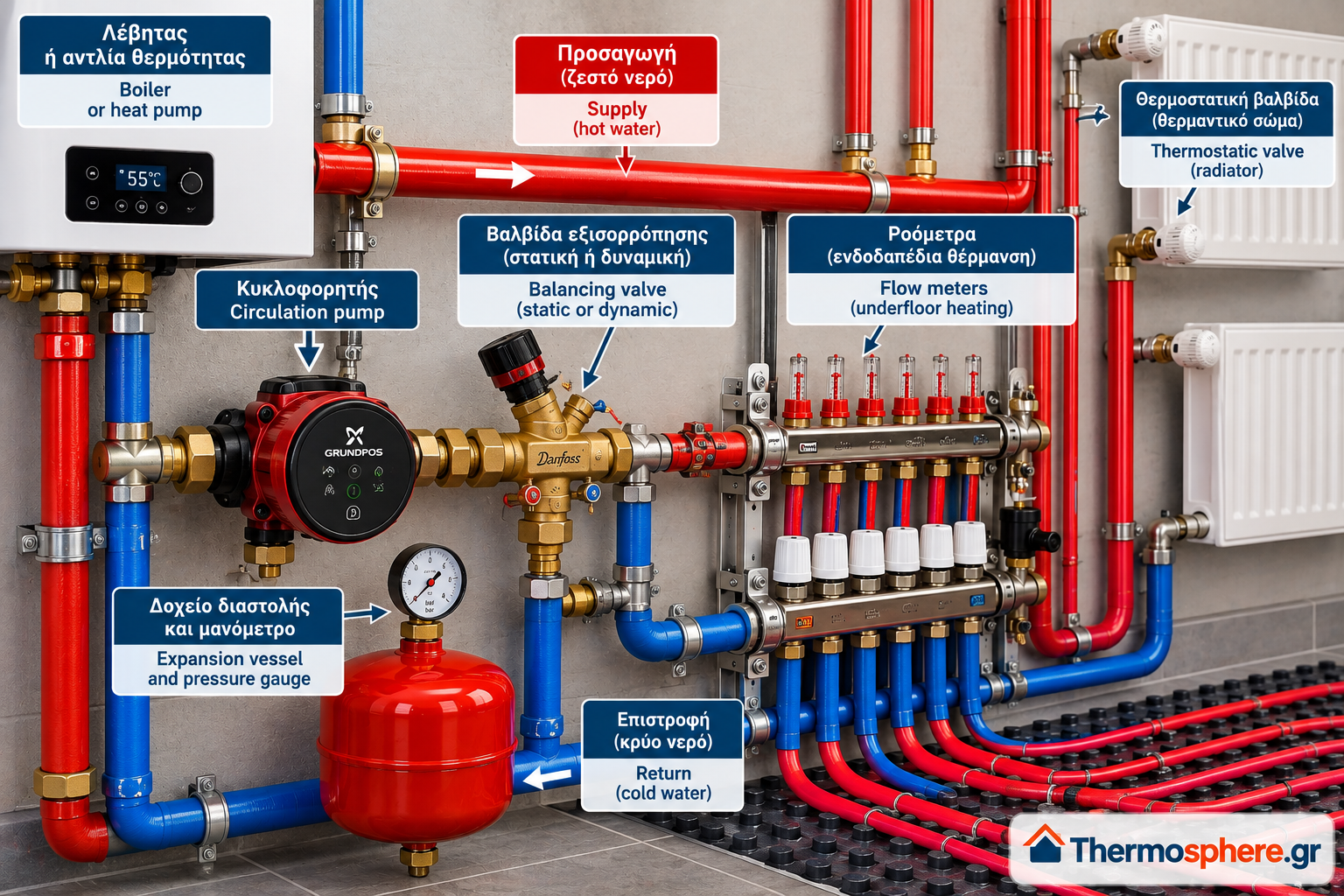
Hydronic Balancing in Heating Systems: Complete Guide to Adjustment and Commissioning
Hydronic balancing is one of the most important procedures for ensuring the correct operation of water-based heating systems.
In an unbalanced heating installation, some radiators or heating circuits receive more water than required, while others receive insufficient flow.
This can result in uneven room temperatures, unnecessary energy consumption, excessive valve noise and poor heating control.
Proper hydronic balancing ensures that each circuit receives the required water flow according to its heating demand and design conditions.
This guide explains how hydronic balancing works, how to calculate design flow rates, which components are used and how to identify common problems.
1. What Is Hydronic Balancing?
Hydronic balancing, also known as hydraulic balancing, is the process of adjusting and verifying water flow distribution throughout a heating system.
Its purpose is to ensure that each radiator, heating manifold or branch receives the appropriate flow rate.
Water does not automatically distribute evenly between different heating circuits.
Flow distribution depends on several factors:
Pipe length and diameter.
Hydraulic resistance.
Valves and fittings.
Available differential pressure.
Circulation pump characteristics.
Thermostatic valve operation.
Balancing reduces unwanted differences between actual and required flow rates.
2. Why Is Hydronic Balancing Important?
In an unbalanced system, circuits with lower hydraulic resistance may receive excessive flow.
At the same time, more restrictive or distant circuits may receive insufficient water.
Common consequences
Some rooms become warmer than others.
Certain radiators heat up slowly.
Valves produce whistling or other noises.
The circulation pump operates at an unsuitable duty point.
Room temperature control becomes unstable.
Energy consumption may increase.
Hydronic balancing can improve system performance, but it does not guarantee a fixed percentage of energy savings.
Actual savings depend on the original condition of the installation, its design and operating strategy.
3. How Is Water Distributed in a Heating System?
The circulation pump generates a pressure difference that drives water through the pipe network.
Each heating circuit has its own hydraulic resistance.
The actual flow rate depends on the available differential pressure and the hydraulic characteristics of that circuit.
In parallel heating networks, flow distribution is not determined solely by the distance between the heat source and the radiator.
It depends on the overall resistance of each flow path.
Balancing valves and other hydraulic components are adjusted to achieve the required design flow rates.
4. Calculating the Required Water Flow Rate
Correct balancing begins with determining the heating capacity required by each circuit.
The fundamental heat transfer equation is:
P = ṁ × cp × ΔT
Where:
P = heat transfer rate in kW.
ṁ = mass flow rate in kg/s.
cp = specific heat capacity in kJ/(kg·K).
ΔT = supply-to-return temperature difference in K.
For water at typical heating temperatures, a commonly used approximation is:
Q = P / (1.163 × ΔT)
Where:
Q = volumetric flow rate in m³/h.
P = heating capacity in kW.
ΔT = temperature difference in K.
This approximation applies to water. Water-glycol mixtures require calculations based on the actual thermophysical properties of the fluid.
Calculation example
Consider a heating circuit with:
Heating capacity: 5 kW.
Supply temperature: 55°C.
Return temperature: 45°C.
Temperature difference: 10 K.
The required flow rate is:
Q = 5 / (1.163 × 10)
Q ≈ 0.430 m³/h
This corresponds to approximately:
430 litres per hour.
This is the theoretical design flow rate for the specified conditions.
5. Components Used for Hydronic Balancing
Different components can be used depending on the size, layout and operating characteristics of the heating installation.
Static balancing valves
Static balancing valves allow manual adjustment of hydraulic resistance.
Flow rates can be determined using differential pressure measurements and the manufacturer’s valve characteristics.
These valves are commonly used in systems with relatively stable hydraulic conditions.
Dynamic balancing valves
Dynamic balancing valves regulate or limit flow within a specified differential pressure operating range.
They are particularly useful in systems where hydraulic conditions change during operation.
Pressure Independent Control Valves (PICVs)
PICVs combine flow control with differential pressure compensation within their specified operating range.
They are commonly used in automatically controlled heating circuits.
Presettable thermostatic radiator valves
Presettable radiator valves allow the maximum flow through a radiator to be limited.
The thermostatic head regulates room temperature, while the presetting determines the valve’s hydraulic flow characteristic.
Underfloor heating manifold flow meters
Flow meters installed on suitable underfloor heating manifolds allow technicians to monitor and adjust individual circuit flow rates.
6. Step-by-Step Hydronic Balancing Procedure
The exact procedure depends on the installation’s size, hydraulic design and control system.
Step 1: Document the heating installation
Identify and record:
Radiators and heating emitters.
Heating circuits and manifolds.
Circulation pumps.
Balancing and control valves.
Design heating loads.
Available hydraulic design information.
Step 2: Calculate design flow rates
Calculate the required water flow for each circuit using its design heating capacity and supply-to-return temperature difference.
Step 3: Inspect the installation
Before adjusting valves, verify:
Correct system filling pressure.
Proper air removal.
Clean strainers and filters.
Correct circulation pump operation.
Functional control valves.
Availability of suitable measurement points.
Step 4: Adjust the circulation pump
Select the appropriate pump control mode according to the system design.
Depending on the installation, constant differential pressure, proportional differential pressure or another manufacturer-supported control strategy may be suitable.
Maximum pump speed does not necessarily provide better heating performance.
Step 5: Adjust balancing valves
Adjust valves according to the calculated flow rates and measured hydraulic conditions.
In statically balanced systems, repeated adjustments may be necessary because changing the resistance of one circuit can affect flow distribution in other circuits.
Step 6: Verify the results
Where possible, measure and document:
Actual water flow rates.
Differential pressures.
Supply and return temperatures.
Final valve settings.
Deviations from design values.
Acceptance criteria should follow the project specifications and applicable commissioning requirements.
7. Balancing Radiator Heating Systems
In radiator systems, balancing can be performed using presettable thermostatic radiator valves or suitable return-side regulating valves.
Each radiator should receive the flow required to deliver its design heating output.
Simply closing a radiator valve partially without calculations or verification is not a reliable balancing method.
Correct adjustment requires appropriate components, design information and verification.
8. Balancing Underfloor Heating Systems
Underfloor heating circuits may have different lengths, heating loads and hydraulic resistances.
Therefore, individual circuit flow rates should not automatically be set to identical values.
Balancing is generally performed using the manifold’s flow meters and regulating valves, according to the system design.
Example flow settings
Circuit A: 1.2 L/min.
Circuit B: 1.8 L/min.
Circuit C: 2.1 L/min.
These values are illustrative only and are not universal settings.
The correct values must be calculated for the specific installation.
Supply temperatures and floor construction limitations must also be respected.
9. Hydronic Balancing and Heat Pumps
Heat pumps require suitable water flow rates for reliable operation.
Insufficient flow may cause:
Reduced heating performance.
Unfavorable temperature differences.
Flow protection alarms.
Operational interruptions.
Excessive flow may increase pumping energy consumption and create undesirable hydraulic conditions.
Balancing must account for the minimum and nominal flow requirements specified by the heat pump manufacturer.
Special attention is necessary in systems incorporating hydraulic separators or buffer vessels.
In such installations, primary and secondary circuit flow rates may differ.
10. Common Hydronic Balancing Problems
Radiators close to the heat source become hotter
This may indicate uneven flow distribution.
However, incorrect radiator sizing, valve problems and control settings should also be investigated.
Distant radiators remain cold
Possible causes include:
Insufficient differential pressure.
Low water flow.
Trapped air.
Blocked pipes or valves.
Incorrect balancing settings.
Heating valves produce noise
Possible causes include excessive differential pressure, high water velocity and unfavorable control valve operating conditions.
Energy consumption remains high
Hydronic balancing may improve efficiency, but other factors must also be assessed, including:
Building insulation.
Heating curve settings.
Thermostat operation.
Heat generator efficiency.
Circulation pump control.
11. Common Balancing Mistakes
Frequent mistakes include:
Adjusting valves without calculating design flow rates.
Using unsuitable balancing components.
Ignoring circulation pump characteristics.
Balancing before removing air or cleaning filters.
Neglecting differential pressure conditions.
Failing to verify actual flow rates.
Not recording final settings.
Assuming every heating problem is caused by hydraulic imbalance.
Hydronic balancing should form part of the overall heating system commissioning process.
12. Frequently Asked Questions
How can I tell whether my heating system needs balancing?
Uneven heating, valve noise and significant flow differences between circuits may indicate hydraulic imbalance. A technical assessment is required to confirm the cause.
Can I balance my heating system myself?
Accurate balancing requires hydraulic design information, knowledge of the installation and often specialized measuring instruments. Professional commissioning is recommended.
Does hydronic balancing reduce energy consumption?
It can reduce unnecessary energy use, particularly in installations with significant initial imbalance. However, the savings vary between systems.
Does underfloor heating require balancing?
Yes. Individual underfloor heating circuits have different flow requirements and should be adjusted according to the design.
When should balancing be repeated?
Balancing should be reviewed after significant system modifications, replacement of important hydraulic components or when flow distribution problems are identified.
Conclusion
Hydronic balancing is essential for correct water distribution in heating installations.
By calculating required flow rates, selecting appropriate balancing components and verifying actual operating conditions, heating systems can achieve more stable performance and improved temperature control.
The procedure is particularly important in installations with multiple heating zones, thermostatic radiator valves, underfloor heating and heat pumps.
Correct balancing should always be based on hydraulic design calculations, manufacturer instructions and reliable measurements.
Technical References
CIBSE — Commissioning Code W: Water Distribution Systems.
CIBSE — Guide B1: Heating.
EN 14336 — Heating Systems in Buildings: Installation and Commissioning of Water-Based Heating Systems.
EN 1264 — Water-Based Surface Embedded Heating and Cooling Systems.
Danfoss — Technical documentation on hydronic balancing.
IMI Hydronic Engineering — Technical guidance on balancing and differential pressure control.
Grundfos — Technical documentation on circulation pumps and hydronic system optimization.
This article provides general technical information and does not replace installation-specific engineering design, manufacturer instructions or professional commissioning procedures.