
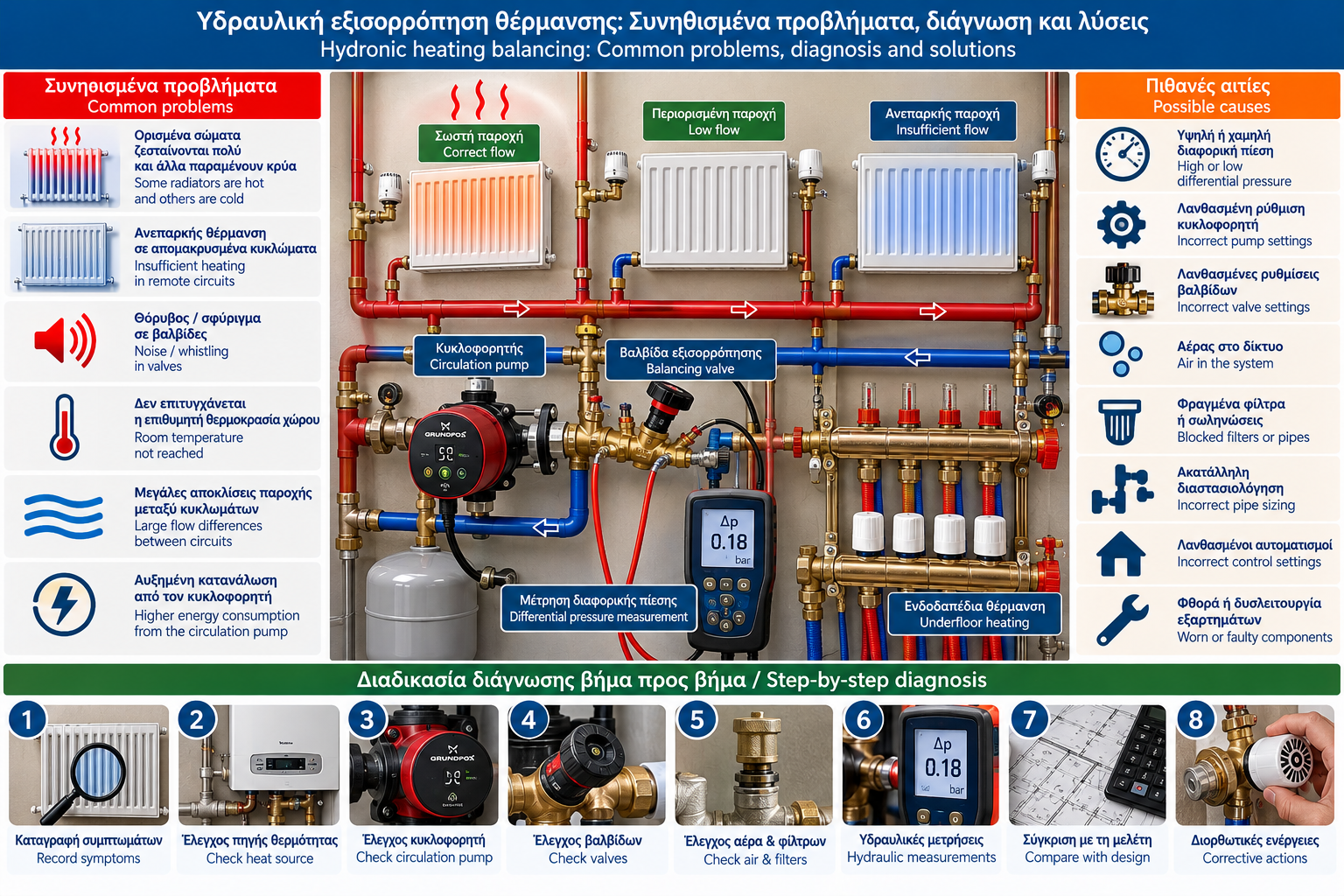
Hydronic Balancing Problems: Common Faults, Diagnosis and Solutions
Hydronic balancing is essential for distributing water correctly throughout a heating system.
When a heating installation is not properly balanced, some radiators may receive excessive water flow while others receive insufficient flow.
This can lead to uneven room temperatures, noisy valves, unnecessary circulation pump energy consumption and difficulties maintaining thermal comfort.
However, not every heating problem is caused by poor hydronic balancing.
Accurate diagnosis requires a systematic assessment of the hydraulic network, circulation pump, control valves and heating controls.
This guide explains the most common hydronic balancing problems, their possible causes and the technical procedures used to identify and resolve them.
1. How Can You Identify a Hydronic Balancing Problem?
Common symptoms include:
Some radiators become very hot while others remain cold.
Radiators located farther from the heat source receive insufficient heat.
Thermostatic or balancing valves produce whistling or other flow-related noise.
Certain rooms fail to reach their desired temperature.
Water flow rates differ significantly from the design requirements.
Heating performance changes considerably when thermostatic valves open or close.
These symptoms indicate possible hydraulic problems, but they do not establish a definitive diagnosis.
Similar symptoms can result from trapped air, blocked filters, incorrect pump settings or malfunctioning heating controls.
2. Why Are Some Radiators Hot While Others Remain Cold?
In a heating system with parallel circuits, water distribution depends on the available differential pressure and the hydraulic resistance of each flow path.
A circuit with relatively low resistance may receive more water than required.
Meanwhile, a circuit with higher resistance may receive insufficient flow.
Possible causes
Missing or incorrect hydronic balancing.
Incorrect valve presetting.
Insufficient circulation pump head.
Trapped air inside the system.
Blocked strainers or pipework.
Partially closed valves.
Incorrect pipe sizing.
Recommended approach
The technician should first determine whether insufficient water flow is actually responsible for the problem.
Valve positions, system pressure, circulation pump operation and potential restrictions should then be examined.
Increasing the pump speed without identifying the underlying cause is not always an appropriate solution.
3. Noise and Whistling in Heating Valves
Whistling or excessive flow noise is a common complaint in hydronic heating systems.
It may occur when a control valve restricts water flow while the differential pressure across the valve is too high.
Possible causes
Excessive differential pressure.
Incorrect circulation pump settings.
Inadequate differential pressure control.
Excessive flow velocity.
Incorrect valve selection.
Incorrect installation direction where required by the manufacturer.
Possible solutions
Depending on the diagnosis, corrective measures may include:
Adjusting the circulation pump.
Checking and correcting hydronic balancing.
Installing an appropriate differential pressure controller.
Selecting a more suitable valve.
Correcting an installation error.
Replacing a thermostatic radiator head without investigating hydraulic conditions may not solve the problem.
4. Circulation Pump Problems and Hydronic Balancing
The circulation pump provides the differential pressure required to move water through the heating network.
If the available pressure is insufficient, some circuits may not receive their required flow rates.
Conversely, excessive pressure can cause unwanted flow, valve noise and unnecessary pumping energy consumption.
Common pump operating modes
Depending on the model, modern electronic circulation pumps may offer:
Constant differential pressure.
Proportional differential pressure.
Constant speed.
Manufacturer-specific automatic adaptation modes.
The correct operating mode depends on the hydraulic configuration and control strategy.
There is no single pump setting suitable for every heating installation.
5. Excessive Water Flow
Excessive water flow does not necessarily mean that a radiator or heating circuit will perform better.
Potential consequences include:
Increased hydraulic pressure losses.
Unnecessary pumping energy consumption.
Noise in valves and pipework.
Poor distribution of water between circuits.
Unfavourable operation of certain heating control arrangements.
How is excessive flow corrected?
The required design flow rate must first be established.
The actual flow should then be assessed using appropriate measurements or a validated commissioning method.
Suitable balancing or flow control valves can be adjusted to achieve the required conditions.
6. Insufficient Water Flow
Insufficient water flow may limit the thermal power transferred to a radiator or heating circuit.
Possible causes
Insufficient differential pressure.
Excessively restricted balancing valve.
Undersized pipework.
Blocked strainer or filter.
Trapped air.
Circulation pump malfunction.
Diagnosis
Where suitable measurement points are available, technicians can measure differential pressure and flow rate.
Supply and return water temperatures can also provide useful diagnostic information.
However, temperature measurements alone are not sufficient to establish the cause of a hydraulic problem.
7. What Does the Supply and Return Temperature Difference Indicate?
The thermal power transferred by circulating water depends on its mass flow rate and temperature difference.
The basic relationship is:
P = ṁ × cp × ΔT
Where:
P = thermal power.
ṁ = mass flow rate.
cp = specific heat capacity.
ΔT = temperature difference.
For water under typical heating conditions, the following approximation is commonly used:
P = 1.163 × Q × ΔT
Where:
P is expressed in kW.
Q is expressed in m³/h.
ΔT is expressed in K.
Example calculation
Consider a heating circuit with:
Water flow rate: 0.5 m³/h.
Temperature difference: 10 K.
The thermal power is:
P = 1.163 × 0.5 × 10
P ≈ 5.82 kW
This is an approximate calculation for water; fluid properties and glycol concentration must be considered where applicable.
A large supply-return temperature difference does not automatically prove that the flow rate is insufficient.
The result must be interpreted in relation to the heating load, design conditions and operating state.
8. Hydronic Balancing Problems in Underfloor Heating
Underfloor heating circuits often have different lengths, thermal loads and hydraulic resistances.
Balancing is usually performed at the distribution manifold using suitable adjustment valves and flow meters.
Common symptoms
Some rooms heat more slowly than others.
Room temperatures differ significantly.
Flow meter readings do not match design values.
Certain circuits show little or no circulation.
Possible causes
Incorrect manifold balancing.
Closed or malfunctioning thermal actuator.
Trapped air.
Insufficient differential pressure.
Blocked circuit.
Heating control malfunction.
The correct flow rate for each circuit should be determined from the heating design.
Setting every circuit to the same flow rate is not necessarily correct.
9. Hydronic Balancing in Heat Pump Installations
Heat pumps have specific water flow requirements.
If the flow rate is too low, possible consequences include:
Reduced operating performance.
Unwanted temperature fluctuations.
Flow protection alarms.
Automatic shutdowns.
Excessive flow may increase pumping energy consumption.
In systems with a buffer tank or hydraulic separator, the primary and secondary circuits should be evaluated separately.
The manufacturer’s minimum and nominal water flow requirements must always be respected.
The appropriate flow rate also depends on the heat pump operating conditions and hydraulic configuration.
10. Step-by-Step Technical Troubleshooting Procedure
A systematic troubleshooting process helps prevent unnecessary component replacement and incorrect adjustments.
Step 1 — Record the symptoms
Identify which radiators or heating circuits are affected.
Determine when the problem occurs and whether it changes under different operating conditions.
Step 2 — Check the heat source
Confirm that the boiler or heat pump is operating correctly.
Check for relevant alarms or abnormal operating conditions.
Step 3 — Check the circulation pump
Verify that the circulation pump is operating.
Assess its control mode and settings against the system requirements.
Step 4 — Inspect control and balancing valves
Check the positions and operation of thermostatic, control and balancing valves.
Identify incorrect settings or mechanical faults.
Step 5 — Check for trapped air and blocked filters
Investigate possible air accumulation or restrictions in the water circuit.
Step 6 — Perform hydraulic measurements
Measure differential pressure and water flow where suitable instruments and measurement points are available.
Step 7 — Compare results with the system design
Compare the measured values with the specified design flow rates and pressure requirements.
Step 8 — Apply and verify corrective measures
Adjust or repair the relevant components.
Repeat the necessary measurements to confirm that the system is operating correctly.
Hydraulic interventions should be performed by appropriately qualified personnel.
11. Common Mistakes When Troubleshooting Heating Systems
Increasing pump speed without diagnosis
This may increase water flow, but it can also create valve noise and unnecessary pumping energy consumption.
Randomly closing balancing valves
Changing one valve can alter the hydraulic conditions in other circuits.
Replacing components without confirming the fault
Unnecessary replacements increase maintenance costs and may leave the actual problem unresolved.
Balancing without measurements or design data
Adjustments based only on how warm a radiator feels cannot reliably establish the correct design flow rate.
Ignoring heating controls
Thermostats, thermal actuators and control valves can significantly affect water distribution and system operation.
12. When Should Hydronic Balancing Be Checked Again?
A hydronic balancing review may be necessary when:
Radiators are added or removed.
The circulation pump is replaced.
The boiler or heat pump is changed.
Significant pipework modifications are made.
New control valves are installed.
Persistent heating distribution problems occur.
Whether full rebalancing is required depends on the extent of the modification and the measured operating conditions.
13. Frequently Asked Questions
Why do the last radiators in a heating system stay cold?
Possible causes include insufficient flow, incorrect balancing, trapped air or excessive hydraulic resistance.
Can poor hydronic balancing increase energy consumption?
Yes. It can contribute to unnecessary pumping energy consumption and inefficient heating operation. The actual impact depends on the installation.
Will increasing the circulation pump speed solve the problem?
Not necessarily. The underlying hydraulic or control problem should be identified first.
Can hydronic balancing be performed without specialist instruments?
Basic observations can be made without specialist equipment.
However, accurate balancing requires design information and suitable measurements or documented commissioning procedures.
When should I contact a heating technician?
Professional inspection is recommended for persistent heating problems, leaks, unusual valve noise, circulation faults or adjustments involving pumps and hydraulic components.
Conclusion
Hydronic balancing plays an important role in the reliable operation of water-based heating systems.
Common problems include uneven heat distribution, insufficient or excessive water flow and noise from control valves.
Effective troubleshooting requires systematic diagnosis, suitable measurements and an understanding of the hydraulic network.
Random adjustments without technical verification may create additional problems.
Correct balancing, together with suitable circulation pump control and properly configured heating controls, supports efficient and reliable system operation.
Technical References
CIBSE — Commissioning Code W: Water Distribution Systems.
CIBSE — Guide B1: Heating.
EN 14336 — Heating Systems in Buildings: Installation and Commissioning of Water-Based Heating Systems.
Danfoss — Technical guidance on hydronic balancing and differential pressure control.
IMI Hydronic Engineering — Technical documentation on hydronic balancing and troubleshooting.
Grundfos — Technical documentation on circulation pump control and hydronic system performance.
This article provides general technical information and does not replace project-specific engineering design, manufacturer instructions or professional inspection.