
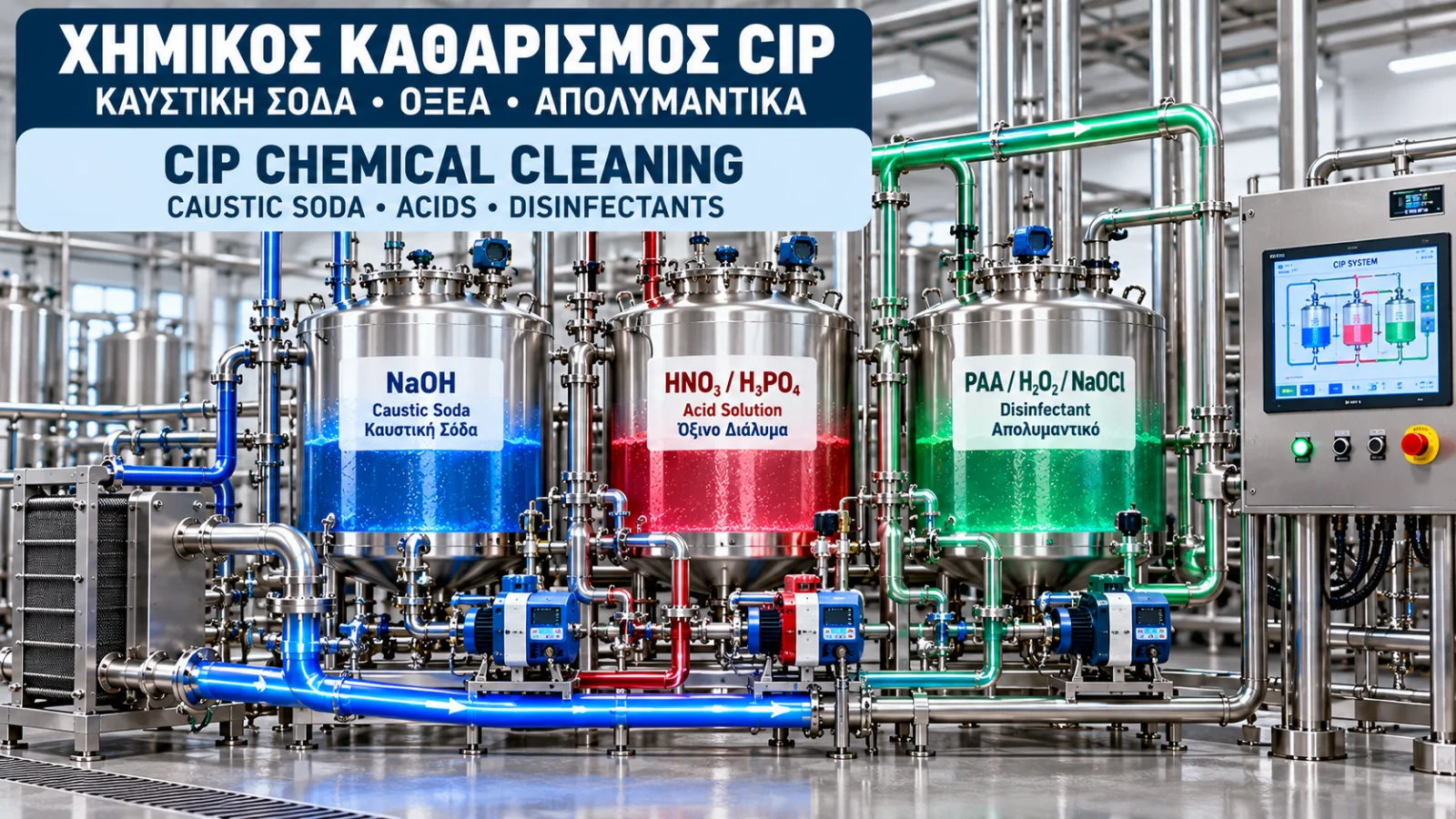
CIP Chemical Cleaning: Caustic Soda, Acids and Disinfectants — A Complete Technical Guide
Introduction
Chemical cleaning is a critical component of Cleaning in Place (CIP) operations. Its effectiveness depends on selecting suitable cleaning agents and controlling their concentration, temperature, contact time and circulation conditions.
In food, beverage, dairy, pharmaceutical and biotechnology processing, equipment surfaces may accumulate different types of contamination.
Organic residues such as fats and proteins require different cleaning mechanisms from inorganic deposits such as calcium scale.
For this reason, CIP procedures may combine alkaline cleaning, acid cleaning, rinsing and, where necessary, disinfection.
1. Why Are Chemicals Used in CIP Systems?
Water can remove loose and water-soluble residues, but many industrial deposits cannot be eliminated effectively by rinsing alone.
Chemical cleaning agents help to:
Remove organic contamination.
Dissolve or detach fats and protein residues.
Dissolve mineral scale.
Improve the removal of deposits from equipment surfaces.
Enhance wetting when suitable surfactants are included.
The cleaning chemical should be selected according to the contamination and equipment requirements rather than simply choosing the strongest available product.
2. Sodium Hydroxide (NaOH): The Main Alkaline Cleaning Agent
Sodium hydroxide, commonly known as caustic soda, is widely used in industrial cleaning.
When dissolved in water, it produces hydroxide ions, creating a strongly alkaline environment.
NaOH → Na⁺ + OH⁻
High alkalinity helps remove many organic deposits.
How Does NaOH Remove Fats?
Alkaline solutions can hydrolyze certain fats through saponification.
During this reaction, triglycerides react with alkali to produce glycerol and fatty acid salts.
These products can facilitate the removal of fatty contamination.
How Does NaOH Affect Proteins?
Strong alkaline conditions can denature and hydrolyze protein deposits, making them easier to remove.
Cleaning performance depends on the characteristics of the residue, concentration, temperature and contact time.
Typical NaOH Concentrations
Some industrial CIP applications use solutions containing approximately 0.5–2% sodium hydroxide by mass.
However, this is only an illustrative range. Actual concentrations vary with the cleaning formulation, equipment and validated process.
A general concentration should never replace application-specific operating instructions.
3. Acid Cleaning: Nitric and Phosphoric Acid
Acid cleaning is primarily used to remove inorganic deposits.
Common examples include:
Nitric acid (HNO₃).
Phosphoric acid (H₃PO₄).
Specially formulated acidic cleaning products.
Nitric Acid
Nitric acid can remove mineral deposits in appropriately designed cleaning processes.
It is a strong acid and an oxidizing agent, so equipment compatibility and chemical handling requirements must be carefully assessed.
Phosphoric Acid
Phosphoric acid is used in various industrial acid cleaning formulations.
It can help remove deposits containing mineral salts.
Example: Dissolving Calcium Carbonate
A simplified chemical reaction is:
CaCO₃ + 2H⁺ → Ca²⁺ + CO₂ + H₂O
Hydrogen ions react with calcium carbonate, promoting its dissolution.
The actual cleaning behavior depends on the composition of the deposits and cleaning solution.
4. Why Combine Alkaline and Acid Cleaning?
Alkaline and acid cleaning address different categories of contamination.
Alkaline cleaning is mainly used for organic residues, while acid cleaning is generally used for mineral scale.
For example, dairy processing equipment may accumulate protein deposits, fats and mineral residues.
A combined cleaning procedure may therefore provide better results than a single chemical stage.
Nevertheless, not every CIP cycle requires both alkaline and acid cleaning.
5. Disinfectants and Chemical Sanitization
Cleaning removes contamination, whereas disinfection aims to reduce microbial contamination to a specified level.
Depending on the application, chemical products may include:
Peracetic acid (PAA).
Hydrogen peroxide (H₂O₂).
Sodium hypochlorite (NaOCl), where suitable and permitted.
Other disinfectants approved for the intended application.
Peracetic Acid
Peracetic acid is an oxidizing disinfectant used in various industrial applications.
Its effectiveness depends on concentration, contact time, temperature, microbial contamination and operating conditions.
Sodium Hypochlorite
Sodium hypochlorite can be used for certain disinfection applications.
However, material compatibility, corrosion risks and chemical safety must be considered.
It is not suitable for every CIP installation.
Critical safety warning: Mixing hypochlorite-based products with acids can release toxic chlorine gas.
Disinfectants must be selected according to their authorized use, supplier documentation and validated facility procedures.
6. Understanding pH in CIP Cleaning
pH is an important chemical parameter.
Sodium hydroxide solutions are strongly alkaline, while acid cleaning solutions have a low pH.
However, pH does not directly represent cleaning chemical concentration.
Two different products may have similar pH values but different compositions and cleaning performance.
Therefore, concentration should be verified using suitable methods, such as titration or calibrated conductivity measurements.
7. Conductivity and Chemical Concentration Control
Electrical conductivity is frequently used to monitor CIP solutions.
Conductivity is influenced by dissolved ions.
During rinsing, decreasing conductivity may indicate the removal of cleaning chemical residues.
However, conductivity depends on:
Chemical composition.
Temperature.
Other dissolved substances.
Sensor calibration.
Accurate concentration control requires suitable calibration or independent analytical verification.
8. Temperature and Contact Time
Temperature influences cleaning chemistry, but higher temperatures are not always better.
Excessive temperatures may cause:
Damage to seals and gaskets.
Increased energy consumption.
Material compatibility problems.
Reduced removability of certain deposits.
Contact time must be sufficient for the required cleaning outcome without unnecessarily extending the cycle.
There is no universal temperature or contact time suitable for all CIP installations.
9. Chemical Compatibility with Equipment Materials
Cleaning chemicals must be compatible with all wetted materials.
Stainless Steel
Stainless steel is widely used in hygienic industrial equipment.
However, its corrosion resistance depends on alloy grade, chemical composition, concentration and temperature.
Chlorides and certain oxidizing environments may cause localized corrosion.
Elastomers and Seals
EPDM, FKM, PTFE and other sealing materials have different chemical and temperature resistance characteristics.
Material selection should follow manufacturer compatibility data and actual operating conditions.
10. Safe Chemical Storage and Dosing
Caustic soda and strong acids can cause severe chemical burns.
Facilities should provide:
Suitable chemical storage tanks.
Secondary containment.
Safe chemical transfer and dosing systems.
Appropriate personal protective equipment.
Equipment isolation procedures.
Accessible safety data sheets (SDS).
Protection against mixing incompatible chemicals.
Dilution of concentrated chemicals must only be performed using approved procedures, suitable equipment and supplier instructions.
11. Common Chemical CIP Problems
Insufficient Concentration
Low chemical concentration may result in incomplete removal of deposits.
Excessive Concentration
Overdosing may increase operating costs, corrosion and safety risks without providing proportional cleaning benefits.
Inadequate Rinsing
Insufficient rinsing may leave chemical residues on equipment surfaces.
Incorrect Cleaning Sequence
An unsuitable sequence may cause unwanted chemical mixing or reduced cleaning effectiveness.
Incorrect Conductivity Readings
Measurement errors may result from poor calibration, temperature compensation problems or solution contamination.
12. Optimizing Chemical Consumption
Chemical optimization should not rely on arbitrary concentration reductions.
Potential improvements include:
More effective pre-rinsing.
Reliable chemical concentration monitoring.
Prevention of unintended dilution.
Controlled recovery of suitable cleaning solutions.
Regular maintenance of dosing pumps.
Analysis of PLC cleaning-cycle records.
Validation of changes to critical cleaning parameters.
Conclusion
Chemical CIP cleaning relies on the correct selection and application of alkaline cleaners, acidic products and disinfectants.
Sodium hydroxide is primarily used to remove organic deposits, while acidic cleaners are mainly applied to mineral scale.
Disinfection is a separate operation when required.
Cleaning effectiveness and safety depend on suitable concentration, temperature, contact time, material compatibility and documented verification.
Technical References
EHEDG — Hygienic Design Requirements for CIP Installations, Guideline Document 50.
https://2024.ehedg.org/guidelines-working-groups/guidelines/guidelines/detail/hygienic-design-requirements-for-cip-installations3-A Sanitary Standards — Cleanability of Equipment.
https://my.3-a.org/Knowledge-Center/Resource-Papers/Cleanability-of-EquipmentCDC — Guideline for Disinfection and Sterilization in Healthcare Facilities (general principles of chemical disinfection).
https://www.cdc.gov/infection-control/hcp/disinfection-sterilization/index.htmlECHA — Biocidal Products Regulation.
https://echa.europa.eu/regulations/biocidal-products-regulation/understanding-bprISO 14159 — Safety of machinery — Hygiene requirements for the design of machinery.