
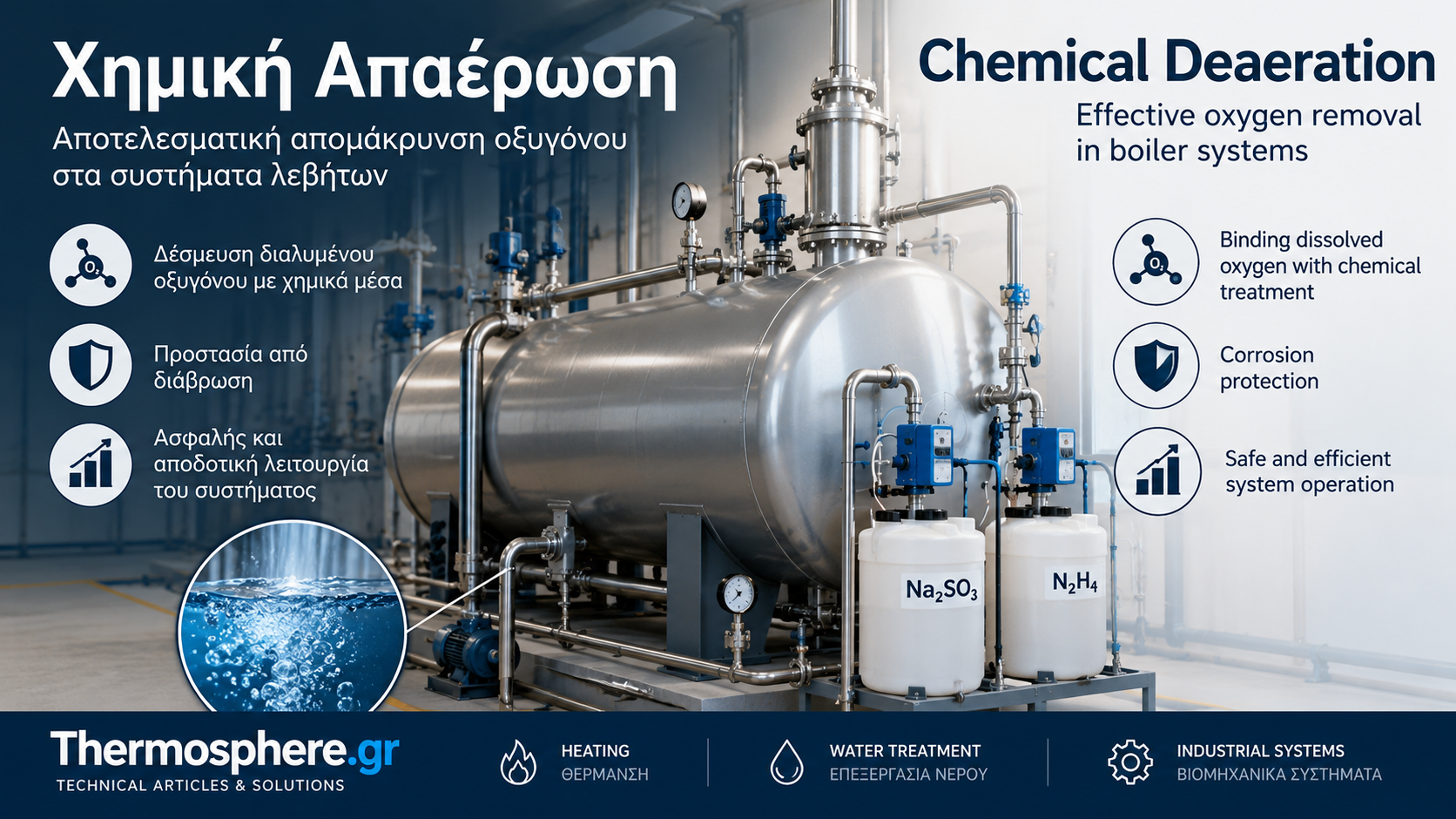
# Chemical Deaeration: Oxygen Scavengers and Boiler Corrosion Protection
## Introduction
Dissolved oxygen in boiler feedwater is an important contributor to corrosion risk in industrial steam systems.
Thermal deaerators remove most dissolved gases through heating, direct steam-water contact and venting. However, some installations require supplementary chemical treatment to control residual oxygen.
Chemicals used for this purpose are known as oxygen scavengers. Their selection depends on boiler type, operating pressure, water quality and the overall corrosion-control strategy.
## 1. What Is Chemical Deaeration?
Chemical deaeration is the consumption of dissolved oxygen through chemical reactions.
Unlike thermal deaeration, which physically removes gases from water, oxygen scavengers react with oxygen to produce other chemical compounds.
They are not universally required or suitable for every boiler system.
## 2. Dissolved Oxygen and Corrosion
Dissolved oxygen participates in electrochemical corrosion reactions and can contribute to localized pitting corrosion.
Corrosion risk depends on oxygen concentration, temperature, pH, metallurgy and overall water chemistry.
Effective protection requires a comprehensive water treatment strategy.
## 3. Thermal and Chemical Deaeration
Thermal deaeration physically removes most dissolved gases.
Chemical treatment may supplement this process by consuming residual oxygen.
A typical treatment sequence includes makeup water pretreatment, condensate return, thermal deaeration, controlled chemical dosing and water chemistry monitoring.
## 4. Sodium Sulfite
Sodium sulfite (Na₂SO₃) is a well-established oxygen scavenger used in suitable industrial boiler applications.
The overall reaction is:
2 Na₂SO₃ + O₂ → 2 Na₂SO₄
Approximately 7.88 mg of anhydrous sodium sulfite are theoretically required for each 1 mg of oxygen.
Actual dosing depends on product purity, reaction kinetics, losses and residual-control requirements.
## 5. Advantages and Limitations
Sodium sulfite has well-established chemistry and allows residual sulfite monitoring.
However, it produces dissolved sulfate and increases total dissolved solids.
It may be unsuitable for certain high-pressure or high-purity systems.
Excessive dosing can negatively affect boiler water chemistry.
## 6. DEHA – Diethylhydroxylamine
DEHA is an organic oxygen scavenger used in selected steam-water treatment programs.
Its performance depends on temperature, pH, residence time and system chemistry.
Chemical compatibility, reaction products and steam-use restrictions must be evaluated before application.
## 7. Carbohydrazide
Carbohydrazide has been used in oxygen-control and corrosion-control programs.
Its behavior depends on operating conditions and possible decomposition reactions.
Selection requires consideration of temperature, pressure, reaction kinetics, environmental requirements and material compatibility.
## 8. Alternative Treatment Strategies
Not all steam-water systems use oxygen scavengers.
Some high-purity power generation cycles employ alternative chemistry programs.
Chemical selection must follow the equipment manufacturer's requirements and the approved plant water chemistry strategy.
## 9. Theoretical Dosing Example
Consider:
Feedwater flow: 20 m³/h.
Dissolved oxygen: 0.10 mg/L.
Oxygen mass flow:
20 × 1,000 × 0.10 = 2,000 mg/h = 2 g/h.
Theoretical sodium sulfite requirement:
2 × 7.88 = 15.76 g/h.
This is the stoichiometric requirement for pure anhydrous sodium sulfite.
It is not a final chemical dosing setpoint.
Actual commercial product consumption depends on concentration, operating conditions and treatment requirements.
## 10. Water Chemistry Monitoring
Monitoring may include:
- Dissolved oxygen.
- pH.
- Conductivity.
- Residual scavenger, where applicable.
- Iron and corrosion products.
- Condensate quality.
- Chemical consumption.
Control limits must be established for each installation.
## 11. Common Operating Problems
Potential problems include insufficient dosing, overdosing, dosing pump failure, incorrect solution concentration, air ingress and poor thermal deaerator performance.
Troubleshooting should be based on reliable measurements and root-cause identification.
## 12. Safety Requirements
Chemical handling requires reviewing safety data sheets, using appropriate protective equipment, ensuring compatible storage and dosing systems, and following applicable safety requirements.
Chemical selection and dosing must be supervised by qualified personnel.
## 13. Integrated Boiler Protection
Effective corrosion protection combines appropriate makeup water treatment, reliable thermal deaeration, air-ingress prevention, suitable chemical treatment and systematic monitoring.
Increasing chemical dosing should not be used to conceal persistent mechanical failures.
## Conclusion
Oxygen scavengers can provide effective supplementary oxygen control in suitable industrial boiler systems.
Sodium sulfite, DEHA and carbohydrazide have different properties, limitations and monitoring requirements.
Their selection must be based on actual operating conditions and a technically justified water treatment program.
Thermosphere.gr – Technical Knowledge for Professionals.